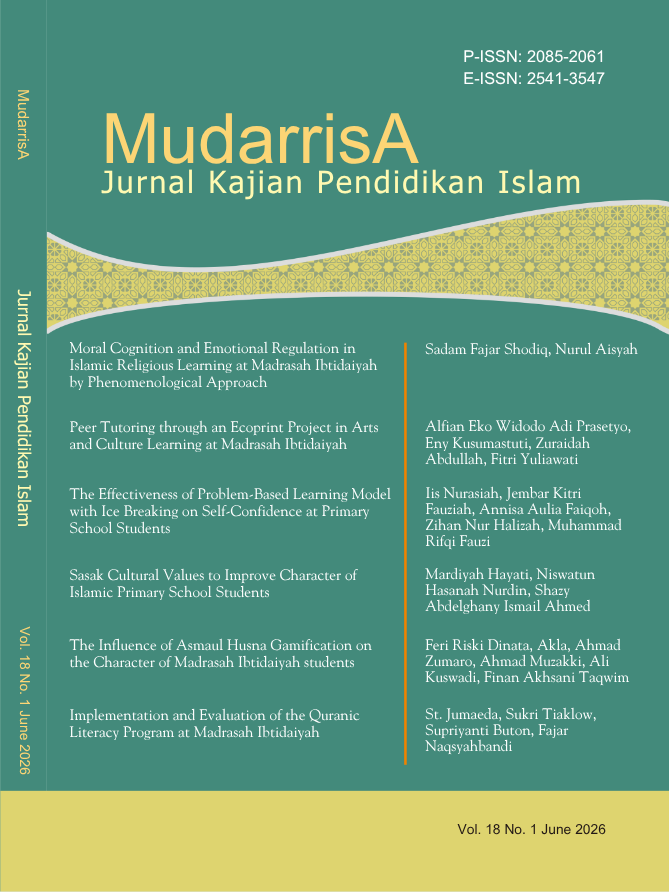
The Effectiveness of Problem-Based Learning Model with Ice Breaking on Self-Confidence at Primary School Students
DOI:
https://doi.org/10.18326/mudarrisa.v18i1.4917Keywords:
Problem Based Learning, Ice Breaking, Self Confidence, Rumi, Madrasah IbtidaiyahAbstract
Objectives: This research aims to find the implementation of PBL with ice breaking and its effectiveness on self-confidence in speaking Rumi in sixth grade students at Nirandon Wittaya School in Thailand.
Method: This research used a quasi-experimental approach with a one-group pre-test post-test design. The participants consisted of 30 students selected through purposive sampling. Data were collected using a standardized self-confidence questionnaire and a speaking performance observation rubric and analyzed using descriptive statistics and a paired t-test.
Results: This research found five stages in implementing the PBL model with ice breaking: 1) ice breaking, 2) presentation of contextual problems, 3) working in groups, 4) presenting results, and 5) reflection. This research concluded that the Problem-Based Learning model with ice breaking was effective in improving the confidence of sixth-grade students in speaking Rumi at Nirandon Wittaya School, Thailand.
Theoretical Contribution: The results of this research contribute to strengthening Bandura's Self-Efficacy Theory and the learning of al-tiqu bi al-nafs (self-confidence) and izzah (self-dignity) in Islamic education.
Implication: This research has implications for the importance of problem-based learning and ice breaking to build student’s self-confidence in language learning.
References
Abdullah., Mahendra, Y., Purba, D., & Rozuli, A. (2025). Implementasi Global Citizenship Education (GCED) sebagai Pendekatan Edukatif Isu Sampah di Desa Karanganyar. Jurnal Pengabdian Kepada Masyarakat Nusantara (JPkMN), 6(4), 6043–6051. https://doi.org/10.55338
Ahmad, N., Alias, F.A., Hamat, M., & Mohamed, S. A. (2024). Reliability Analysis: Application of Cronbach’s Alpha in Research Instruments. In Pioneering the Future: Delving Into E ‐ Learning ’s Landscape (pp. 114–119). https://appspenang.uitm.edu.my/sigcs/2024-2/Articles/e-Book_SIGCSe-LearningVol8_2024.pdf#page=121%0A%0A
Akbari, O., & Sahibzada, J. (2020). Students’ Self-confidence and Its Impacts on Their Learning Process. American International Journal of Social Science Research, 5(1), 1–15. https://doi.org/10.46281/aijssr.v5i1.462
Bandura, A. (1997). Self-efficacy: The Exercise of Control. Henry Holt & Co. https://doi.org/10.1891/0889-8391.13.2.158
Biesta, G. (2021). Mixing Methods. In Research Methods and Methodologies in Education (p. 186). https://ejournal.upsi.edu.my/index.php/SAECJ/article/view/10068
Chang, Y., Davidson, C., Conklin, S., & Ewert, A. (2019). The Impact of Short-Term Adventure-Based Outdoor Programs on College Students’ Stress Reduction. Journal of Adventure Education and Outdoor Learning, 19(1), 67–83. https://doi.org/10.1080/14729679.2018.1507831
Coe, R., Waring, M., Hedges, L. V, Ashley, L. D. A. Y., Smith, C. E., Torgerson, C. C., & Hall, J. (2025). Research Methods & Methodologies in Education 4th Edition.
Creswell, J. W., & Poth, C. N. (2018). Qualitative Inquiry and Research Design- Choosing Among Five Approaches (4th ed.). SAGE Publications. https://doi.org/10.1177/1524839915580941
Dey, M., Amelia, R., & Setiawan, A. (2024). The Impact of Age on Second Language Acquisition: A Critical Review. International Journal of Evaluation and Research in Education, 13(5), 3560–3570. https://doi.org/10.11591/ijere.v13i5.27958
Djami, M., Hardhienata, S., & Tukiran, M. (2019). Improvement of Job Satisfaction through Transformational Leadership, Personality, and Achievement Motivation using Scientific Identification Theory of Operations research in education management (SITOREM). International Journal of Managerial Studies and Research (IJMSR), 7(4), 62–70. https://doi.org/10.20431/2349-0349.0704009
Dressel, D. P. (2020). Breaking the Ice to Build Relationships: Using Icebreakers to Create New Relationships, Promote Emotional Safety, and Incorporate Social and Emotional Learning. Journal of Physical Education, Recreation & Dance, 91(5), 51–54. https://doi.org/10.1080/07303084.2020.1739434
Ellis, N. C. (2019). Essentials of a Theory of Language Cognition. The Modern Language Journal, 10(3), 39–60. https://doi.org/10.1111/modl.12532
Fitria, Y., Virgian Darmanto, R., & Widyasari. (2023). Perancangan Desain Karakter 2D Untuk Video Edukasi Rotasi Dan Revolusi Bumi. Jurnal Ilmiah Wahana Pendidikan, 9(17), 690–697. https://doi.org/10.5281/zenodo.8321739.
Gibson, E. (2019). How Efficiency Shapes Human Language. In Elsevier.
Gopalan, M., Rosinger, K., Ahn, J. (2020). Use of Quasi-Experimental Research Designs in Education Research: Growth, Promise, and Challenges. Sage Journals, 44(1), 218–243. https://doi.org/10.3102/0091732X20903302
Habler, C. (2025). When Text, Talk and Thinking Come Together: Preservice Teachers Reading Fiction in a Course in Intercultural Education. Social Sciences & Humanities Open, 12(4), 1–7. https://doi.org/10.1016/j.ssaho.2025.101815
Haryani, S. (2018). Improvement of Metacognitive Skills and Students’ Reasoning Ability through Problem-Based Learning. Journal of Physics: Conference Series, 983(1), 121–143. https://doi.org/10.1088/1742-6596/983/1/012174
Hébert, L., & Tabler, J. (2019). The functions of language. In An Introduction to Applied Semiotics. https://doi.org/10.4324/9780429329807
Hengki, Jabu, B., & Salija, K. (2017). The Effectiveness of Cooperative Learning Strategy through English Village for Teaching Speaking Skill. Journal of Language Teaching and Research, 8(2), 306–312. https://doi.org/10.17507/jltr.0802.12
Hwang, H. (2025). Growth of Lexical and Syntactic Complexity, Accuracy, and Fluency in Spoken Production of First Language and Second language children. Elsevier, 132(8), 1–13. https://doi.org/10.1016/j.system.2025.103695
Indriani, FI, & Holisah, H. (2022). Evaluation of the Implementation of the Teaching Campus Program in Elementary Schools: A Phenomenological Approach. Journal of Educational Research and Evaluation, 26(2), 137–159. https://doi.org/10.21831/pep.v26i2.46834
Isayah, K. (2019). Analisis Sosiolinguistik Masyarakat Melayu di Tiga Wilayah Sempadan Selatan Thailand Berlandaskan Teori Etnografi Komunikasi Authors. Journal of Communication in Scientific Inquiry (JCSI), 1(1), 59–76. https://ejournal.unimap.edu.my/index.php/jcsi/article/view/891?articlesBySimilarityPage=2
Iswandari, D. C. (2017). Effect of Environmental Problem-Based Learning on the Indonesian EFL Students’ Environment-Related Vocabulary Mastery and Writing Ability. Theory and Practice in Language Studies, 7(8), 608–616. https://doi.org/10.17507/tpls.0708.02
Jerrim, J., Latorre, C. P., & Shure, N. (2024). Self-efficacy of Teachers: A Review of the Literature. American Educational Research Journal, 62(2), 378–413. https://doi.org/10.3102/00028312241300265
Joni, D, Wirastuti, I. (2018). Self-efficacy Effect on Basic Level Learners in Speaking Activities. Journal of Applied Studies in Language, 2(1), 1–9. https://doi.org/10.31940/JASL.V2I1.808
Kantavong, P., Sujarwanto., Rerkjaree, S., & Budiyanto. (2017). A Comparative Study of Teacher’s Opinions Relating to Inclusive Classrooms in Indonesia and Thailand. Kasetsart Journal of Social Sciences, 38(3), 291–296. https://doi.org/10.1016/j.kjss.2016.05.005
Kartikasari, A., & Widjajanti, D. (2017). The Effectiveness of Problem-Based Learning Approach Based on Multiple Intelligences in Terms of Student’s Achievement, Mathematical Connection Ability, and Self-Esteem. Journal of Physics: Conference Series, 812(1), 34. https://doi.org/10.1088/1742-6596/812/1/012097
Latif, R., Mumtaz, S., Mumtaz, R., & Hussain, A. (2018). A Comparison of Debate and Role Play in Enhancing Critical Thinking and Communication Skills of Medical Students during Problem Based Learning. Biochemistry and Molecular Biology Education, 46(4), 336–342. https://doi.org/10.1002/bmb.21124
Lucero, M., Fernández, M. J., & Montanero, M. (2018). Teachers’ Written Feedback Comments on Narrative Texts in Elementary and Secondary Education. Studies in Educational Evaluation, 59(4), 279–289. https://doi.org/https://doi.org/10.1016/j.stueduc.2018.07.002
Mahmud, M., & Nur, S. (2018). Exploring Students’ Learning Strategies and Gender Differences in English Language Teaching. International Journal of Language Education, 2(1), 51–64. https://doi.org/10.26858/ijole.v2i1.4346
Mamaghani, E. A., Hosseinian, E., & Maghsoodi, E. (2024). Role Playing is an Effective Method for Training Physical Examinations: A Mixed-methods Study. Teaching and Teacher Education, 19(4), 307–404. https://doi.org/10.1016/j.teln.2024.06.005
Matara, K., Suleman, Z., & Wibawa, N. H. H. P. (2022). Law for Handling Problematic Children in Families in the Context of Child Psychology Education. Educational Administration: Theory and Practice, 28(2), 74–87. https://doi.org/10.17762/kuey.v28i02.449
Moallem, M., Hung, W., & Dabbagh, N. (2019). The Wiley Handbook of Problem ‐ based Learning. In John Wiley & Sons, Inc. https://doi.org/10.1002/9781119173243
Pasini, S., Maragliano, G., Kim, J., & Tonella, P. (2026). Cross-site Scripting Adversarial Attacks Based on Deep Reinforcement Learning: Evaluation and Extension Study. The Journal of Systems & Software, 237(3), 1–10. https://doi.org/https://doi.org/10.1016/j.jss.2026.112856
Peraturan Menteri Pendidikan Dan Kebudayaan Nomor 22 Tahun 2016 Tentang Standar Proses Pendidikan Dasar Dan Menengah (2016). https://peraturan.bpk.go.id/Details/224242/permendikbud-no-22-tahun-2016
Purnamasari, D., Arianty, R., Susetianingtias, D. T., & Kusumawati, R. D. (2016). Query Rewriting and Corpus of Semantic Similarity as Encryption Method for Documents in Indonesian Language. Lecture Notes in Electrical Engineering, 365, 565–571. https://doi.org/10.1007/978-981-287-988-2_63
Rahman, A., Ahmar, A. S., & Rusli. (2016). The Influence of Cooperative Learning Models on Learning Outcomes Based on Students’ Learning Styles. World Transactions on Engineering and Technology Education, 14(3), 425–430. https://doi.org/10.26858/wtetev14i3y2016p6425430
Rahman, M., Bustomi, J., & Waehana, M. (2024). Multiculturalism, Religious Moderation, and Identity Challenges in Southern Thailand. Gunung Djati Publishing.
Retnawati, H., Djidu, H., Kartianom, & Apino, E. (2018). Teachers’ Knowledge about Higher-order Thinking Skills and its Learning Strategy. Problems of Education in the 21st Century, 76(2), 215–230. https://doi.org/10.33225/pec/18.76.215
Reza, M., Ibrahim, M., & Rahayu, S. (2018). Development of Problem-Based Learning Oriented Teaching Learning Materials to Facilitate Students’ Mastery of Concept and Critical Thinking Skill. Journal of Physics: Conference Series, 947(1), 56–59. https://doi.org/10.1088/1742-6596/947/1/012062
Sasson, I., Yehuda, I., & Malkinson, N. (2018). Fostering the Skills of Critical Thinking and Question-Posing in a Project-Based Learning Environment. Thinking Skills and Creativity, 29. https://doi.org/10.1016/j.tsc.2018.08.001
Setiawan, N. A. (2019). Pengaruh Pelatihan Goal Setting Untuk Meningkatkan Motivasi Belajar Pada Mahasiswa. American Journal of Psychology, 2(1), 101–120. https://doi.org/10.24042/ajp.v2i1.4150
Sheikh, S. U., & Ali, M. A. (2019). Al-Ghazali’s Aims and Objectives of Islamic Education. Journal of Education and Educational Development, 6(1), 111–125. https://doi.org/10.22555/joeed.v6i1.2033
Silverstein, M. (2022). Language in Culture: Lectures on the Social Semiotics of Language. Cambridge University Press.
Soyusiawaty, D., & Aribowo, E. (2016). Designing and Implementing Parsing for Ambiguous Sentences in Indonesian Language. Journal of Theoretical and Applied Information Technology, 84(3), 339–347. https://www.scopus.com/pages/publications/84959262486
Subekti, A. S. (2018). An Exploration of Learners’ Foreign Language Anxiety in the Indonesian University Context: Learners’ and Teachers’ Voices. Teflin Journal, 29(2), 219–244. https://doi.org/10.15639/teflinjournal.v29i2/219-244
Sugrah, N. (2019). Implementasi Teori Belajar Konstruktivisme dalam Pembelajaran Sains. Humanika: Kajian Ilmiah Mata Kuliah Umum, 19(2), 121–138. https://doi.org/10.21831/hum.v19i2.29274
Sukirlan, M., Mahpul, Setiyadi, B. A., & Hariri, H. (2023). Use of Second Language Communication Strategies to Teach Autonomy in Speaking: A Study of Indonesian EFL Learners’ Use of Second Language Communication Strategies. Theory and Practice in Language Studies, 13(8), 2123–2130. https://doi.org/10.17507/tpls.1308.29
Sumarni, W., Wardani, S., Darmin, S., & Gupitasari, D. N. (2016). Project Based Learning (PBL) to Improve Psychomotoric Skills: A Classroom Action Research. Jurnal Pendidikan IPA Indonesia (JPII), 5(2), 157–163. https://doi.org/10.15294/jpii.v5i2.4402
Susetyarini, E., Nurrohman, E., & Husamah, H. (2022). Analysis of Students’ Collaborative, Communication, Critical Thinking, and Creative Abilities through Problem-Based Learning. Journal of Educational Research and Assessment: E-Saintika, 6(1), 33–42. https://doi.org/10.36312/esaintika.v6i1.584
Suwardi, Hariyadi, R., Susapti, P., Billah, A., Kurniawan, W., & Prabowo, S. A. (2025). SCT Tree Model To Integrate Spirituality And Computational Thinking In Science Learning. Jurnal Pendidikan IPA Indonesia (JPII), 14(3), 443–457. https://doi.org/10.15294/jpii.v14i3.31172
Tan, O. S. (2004). Cognition, Metacognition, and Problem-Based Learning. In Enhancing Thinking Through Problem-Based Learning Approaches (pp. 1–15). Cengage Learning. https://doi.org/10.1142/9789812562470_0001
Tegler, H., Bowden, H. M., Skovholt, K., & Sikveland, R. O. (2025). The Effectiveness of the Conversation Analytic Role-Play Method (CARM) on Teachers’ and Classroom Assistants’ Self-efficacy and Interactional awareness: Identifying and responding to aided-speaking students’ questions in whole class interaction. Teaching and Teacher Education, 156(5), 1–9. https://doi.org/10.1016/j.tate.2025.104944
Tholibon, D. A., Nujid, M. M., Mokhtar, H., Rahim, J. A., Rashid, S. S., Saadon, A., Tholibon, D., & Salam, R. (2022). The Factors of Students’ Involvement on Student-Centered Learning Method. International Journal of Evaluation and Research in Education, 11(4), 1637–1646. https://doi.org/10.11591/ijere.v11i4.22314
Turner, S., & Harder, N. (2018). Psychological Safe Environment: A Concept Analysis. International Nursing Association for Clinical Simulation and Learning, 18(1), 47–55. https://doi.org/10.1016/j.ecns.2018.02.004
Vaughan ‐ Johnston, T. I., & Jacobson, J. A. (2020). Self ‐ efficacy Theory. In The Wiley Encyclopedia of Personality and Individual Differences: Models and Theories (pp. 375–379). https://doi.org/10.1002/9781118970843.ch62
Verma, J.P., & Abdel-Salam, A.-S. G. (2019). Testing Statistical Assumptions in Research. https://doi.org/10.1002/9781119528388
Vygotsky, L. S. (1978). Mind in Society: The Development of Higher Psychological Processes. In Mind of Society. Harvard University Press. https://doi.org/10.4324/9781315078465
Wahyu, W., Kurnia, & Eli, R. N. (2016). Using Problem-Based Learning to Improve Students’ Creative Thinking Skills on Water Purification. AIP Conference Proceedings, 1708. https://doi.org/10.1063/1.4941158
Xiaojing, L. V., Zhou, J., & Ren, X. (2025). The Bidirectional Relationship between Critical Thinking and Academic Achievement is Independent of General Cognitive Ability: A Three-Year Longitudinal Study on Elementary School Children Author. Journal of Psychology and Education, 120(5), 1–10. https://doi.org/10.1016/102666
Yusuf. (2017). The Influence of Technology Learning Facilities and Student Motivation Towards Learning Independence (Empiric Study on Bidikmisi Scholarship Students Regional Office of Universitas Terbuka at Ternate, Indonesia). International Journal of Civil Engineering and Technology, 8(10), 1576–1591. https://doi.org/09766308
Downloads
Published
How to Cite
Issue
Section
License
Copyright (c) 2026 Iis Nurasiah, Jembar Kitri Fauziah, Annisa Aulia Faiqoh, Zihan Nur Halizah, Muhammad Rifqi Fauzi

This work is licensed under a Creative Commons Attribution-NonCommercial-ShareAlike 4.0 International License.