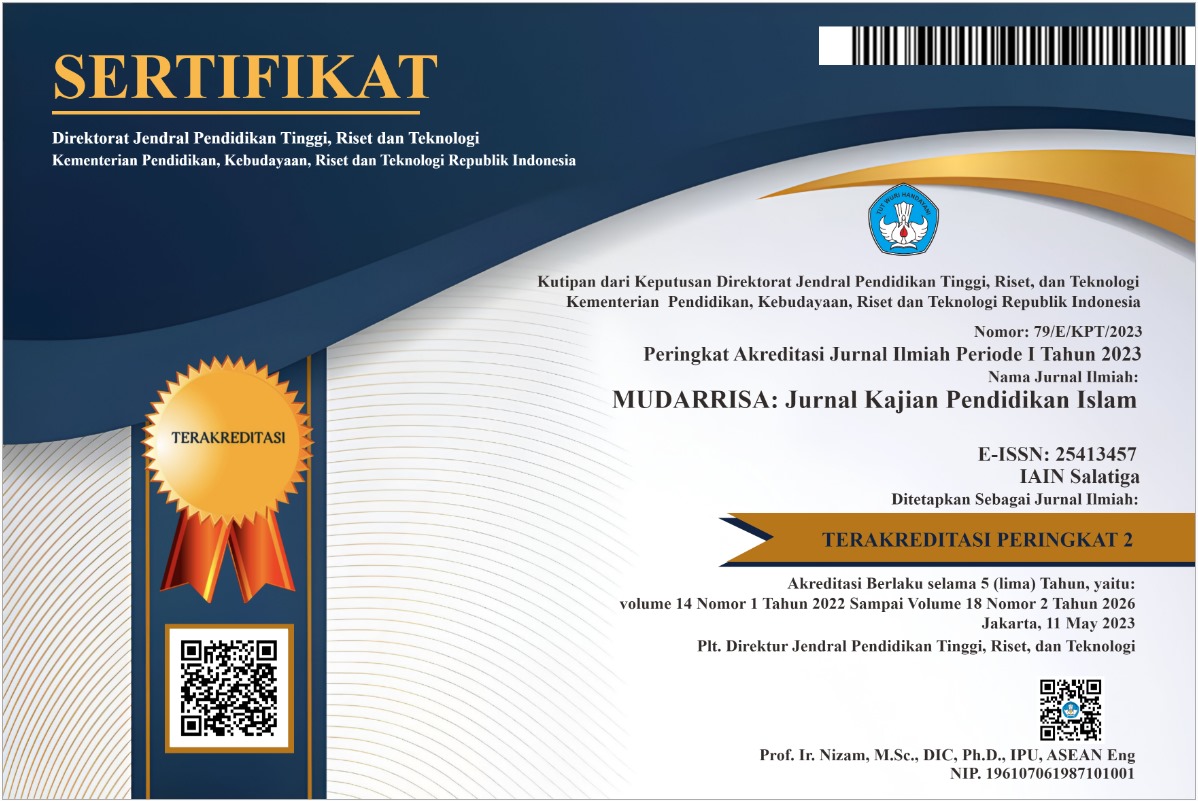
SINTA 2 Indexed

MUDARRISA: Jurnal Kajian Pendidikan Islam is committed to publishing original scholarly work and maintaining high standards of academic integrity.
Plagiarism, self-plagiarism, inappropriate duplicate publication, and other forms of misrepresentation of scholarly contributions are unacceptable.
The journal's plagiarism policy is guided by its Publication Ethics and relevant Committee on Publication Ethics (COPE) principles.
Plagiarism occurs when an author presents another person's words, ideas, data, research findings, or intellectual contributions as their own without appropriate acknowledgment.
It may involve direct copying, insufficiently attributed paraphrasing, unauthorized reproduction of figures or tables, and the use of another person's intellectual work without proper citation.
Self-plagiarism and redundant publication may occur when substantial portions of an author's previously disseminated work are reused without appropriate disclosure, citation, or scholarly justification.
Authors must ensure that submitted manuscripts are original, accurately referenced, and not under simultaneous consideration by another journal.
Any significant overlap with previously published articles, conference papers, theses, preprints, or other research outputs must be disclosed to the editorial office.
Authors must obtain the necessary permissions for copyrighted material when reuse is not otherwise legally permitted.
Submitted manuscripts may be examined through editorial assessment and similarity-detection tools as part of the journal's originality screening procedures.
The editorial team evaluates similarity reports by considering the source, context, extent, and nature of textual overlap.
A similarity percentage alone does not establish plagiarism or automatically determine acceptance or rejection.
Properly cited quotations, standardized methodological terminology, bibliographic entries, and other legitimate textual similarities should be assessed in context.
When potential plagiarism is identified, the editorial office may request clarification, examine the relevant sources, and provide the author with an opportunity to respond.
Depending on the evidence and seriousness of the concern, appropriate actions may include requesting corrections, suspending editorial assessment, rejecting the manuscript, or initiating further investigation.
Credible allegations concerning published articles will be investigated in accordance with the journal's Allegations of Research Misconduct Policy.
Editorial actions may include a correction, expression of concern, or retraction, depending on the evidence and implications for the scholarly record.
The journal will ensure that allegations are assessed fairly, confidentially, and without treating unverified claims as established misconduct.
Authors are responsible for the originality, accuracy, appropriate attribution, and ethical integrity of submitted manuscripts, including material prepared with technical or artificial intelligence assistance.
Relevant sources must be cited accurately, and any substantial reuse of previously disseminated material must be transparently disclosed.
SINTA 2 Indexed
Journal Information
Publication Ethics & Rights
Journal Management
Manuscript Template Download

Reference Manager Applications

Visit Statistics
Mudarrisa: Jurnal Kajian Pendidikan IslamISSN (electronic): 2541-3457 | ISSN: 2085-2061
Mailing address :
Editorial Office of Mudarrisa: Jurnal Kajian Pendidikan Islam
Universitas Islam Negeri (UIN) Salatiga Jl. Lingkar Salatiga Km. 2 Pulutan, Sidorejo, Kota Salatiga, Jawa Tengah, Indonesia Technical issues email: [email protected] Contact information |
Content Use Policy |