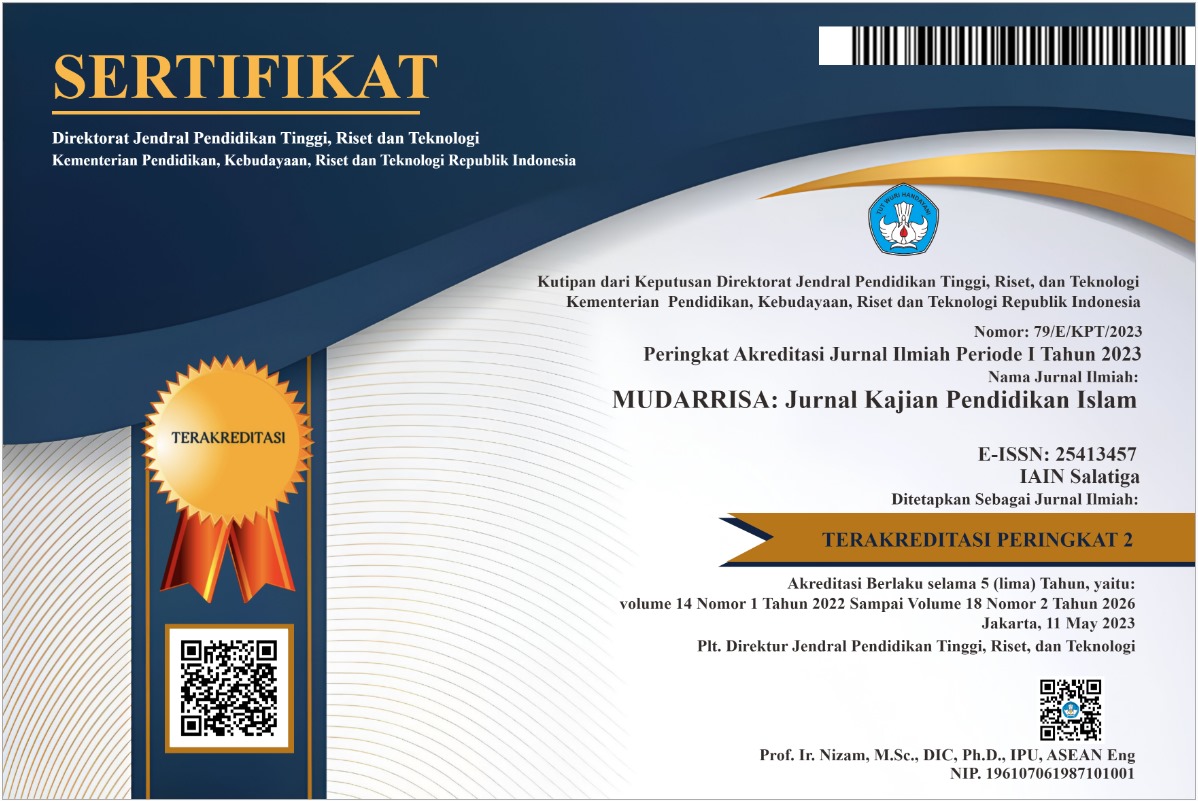
SINTA 2 Indexed

MUDARRISA: Jurnal Kajian Pendidikan Islam is committed to maintaining a rigorous, fair, independent, confidential, and transparent peer-review process to ensure the scholarly quality, methodological soundness, originality, and integrity of published research.
The journal employs a double-blind peer-review system, in which authors' identities are concealed from reviewers and reviewers' identities are concealed from authors. All research articles accepted for publication undergo independent evaluation by at least two suitably qualified peer reviewers.
The peer-review process is conducted in accordance with the journal's Publication Ethics and relevant guidance from the Committee on Publication Ethics (COPE).
1. Initial Editorial Screening
All manuscripts submitted to MUDARRISA: Jurnal Kajian Pendidikan Islam undergo an initial editorial assessment conducted by the Editor-in-Chief or a designated handling editor.
During this stage, manuscripts are evaluated according to the following criteria:
The editorial team may employ appropriate similarity-checking and technical assessment tools to support the screening process. However, editorial decisions shall not be determined solely by automated similarity scores or other numerical indicators.
Manuscripts that fail to meet the journal's fundamental scholarly, ethical, or submission requirements may be declined without external peer review.
Manuscripts that successfully pass the initial screening proceed to the double-blind peer-review stage.
2. Manuscript Anonymization and Double-Blind Review
MUDARRISA: Jurnal Kajian Pendidikan Islam implements an editor-managed manuscript anonymization procedure to preserve the integrity of its double-blind peer-review system.
Authors submit their manuscripts in accordance with the journal's Author Guidelines, including the required author identification and affiliation information.
After a manuscript passes the initial editorial screening, the handling editor or authorized editorial staff prepares an anonymized version of the manuscript before assigning it to external reviewers.
The anonymization process involves removing or concealing information that could directly identify the authors, including names, affiliations, email addresses, acknowledgments containing identifying details, and other relevant identifying information.
The editorial team also takes reasonable steps to remove identifying document metadata and address potentially identifying references where necessary, while preserving the scholarly content and integrity of the manuscript.
Only the anonymized manuscript and relevant review materials are provided to reviewers.
The editorial office retains the original submission information for legitimate editorial and administrative purposes under appropriate confidentiality safeguards.
The identities of reviewers remain confidential and are not disclosed to authors.
All parties involved in the peer-review process must respect the confidentiality of submitted manuscripts, review communications, and unpublished research findings.
3. Reviewer Selection and Independence
Manuscripts proceeding to external review are evaluated by at least two appropriately qualified reviewers with relevant expertise in the manuscript's subject area.
Reviewers are selected by the Editor-in-Chief or designated handling editor based on their academic competence, relevant research expertise, independence, and ability to provide objective and constructive evaluations.
Reviewers must disclose any actual, potential, or perceived competing interests that could influence their assessment.
Reviewers with unmanageable conflicts of interest shall not participate in the evaluation. Editors with relevant competing interests must recuse themselves, and responsibility for the manuscript shall be assigned to an independent editor.
Reviewers are expected to evaluate manuscripts impartially and provide constructive feedback supported by scholarly reasoning and evidence.
Reviewers must not use confidential manuscript information for personal advantage, distribute unpublished materials without authorization, or upload confidential submissions to external artificial intelligence systems without explicit journal permission and appropriate safeguards.
4. Peer-Review Evaluation
Reviewers assess the scholarly and methodological quality of manuscripts according to the journal's editorial standards.
The evaluation generally considers:
Reviewers are expected to provide evidence-based, respectful, and constructive assessments that help editors make informed decisions and assist authors in improving their manuscripts.
Reviewers should alert the handling editor confidentially to suspected plagiarism, redundant publication, data irregularities, undisclosed conflicts of interest, or other potential ethical concerns.
Recommendations for additional references must be academically justified and must not be intended to manipulate citation metrics.
Reviewers must not delegate their assigned reviews to other individuals without prior editorial approval.
5. Editorial Decisions
Following the peer-review process, the Editor-in-Chief or designated handling editor evaluates the reviewers' reports, the manuscript, and any relevant editorial considerations before reaching a decision.
Possible editorial decisions include:
Where reviewers provide substantially conflicting assessments, the handling editor may seek an additional independent review or reach a reasoned decision based on the available evidence.
Reviewer recommendations inform editorial decisions but do not automatically determine the final outcome.
Editorial decisions are based on scholarly merit, originality, methodological soundness, ethical compliance, and relevance to the journal's scope.
Decisions shall remain independent of authors' personal characteristics, institutional affiliations, financial interests, publication charges, and other inappropriate external influences.
The Editor-in-Chief retains overall responsibility for the integrity and independence of the editorial decision-making process, including decisions delegated to designated handling editors.
6. Manuscript Revision and Reassessment
Authors invited to revise their manuscripts are expected to respond carefully and comprehensively to the comments and recommendations provided by reviewers and editors.
Revised submissions should include an updated manuscript and a point-by-point response explaining how each substantive comment has been addressed.
Where authors disagree with a particular recommendation, they should provide a clear and academically justified explanation.
The handling editor evaluates the revised manuscript to determine whether the identified concerns have been adequately addressed.
Where necessary, revised manuscripts may be returned to the original reviewers or assigned to additional independent reviewers for further evaluation.
The editorial team may request additional revisions when unresolved scholarly or methodological concerns remain.
Submission of a revised manuscript does not guarantee acceptance. The final publication decision depends on the manuscript's compliance with the journal's scholarly and ethical requirements.
7. Confidentiality and Publication Integrity
Editors, reviewers, and editorial personnel are responsible for protecting the confidentiality and integrity of manuscripts throughout the review process.
Unpublished manuscripts, supplementary materials, reviewer reports, editorial communications, and confidential research information must not be disclosed or used for unauthorized purposes.
Any suspected research or publication misconduct identified during editorial screening or peer review shall be addressed in accordance with the journal's Publication Ethics and relevant COPE guidance.
Allegations shall be evaluated fairly and confidentially on the basis of available evidence.
Where appropriate, affected parties shall be given an opportunity to respond before editorial action is taken.
Editors may seek additional information or consult relevant experts, institutions, or research integrity authorities when necessary.
Editorial decisions concerning suspected misconduct shall not be based solely on unverified allegations, automated assessments, or an author's refusal to cooperate.
8. Complaints and Editorial Appeals
MUDARRISA: Jurnal Kajian Pendidikan Islam recognizes the right of authors, reviewers, readers, and other stakeholders to raise legitimate concerns regarding editorial procedures, peer-review conduct, conflicts of interest, or potential violations of publication ethics.
Complaints and editorial appeals may be submitted directly to the editorial office of MUDARRISA: Jurnal Kajian Pendidikan Islam via email at [email protected].
Complaints should identify the relevant manuscript or published article, clearly describe the concern, and provide supporting information or documentation where available.
Authors seeking reconsideration of an editorial decision should identify substantive grounds for appeal, such as a material procedural error, a demonstrable conflict of interest, or a significant misunderstanding of the manuscript.
Disagreement with an unfavorable editorial decision alone does not constitute sufficient grounds for an appeal.
The Editor-in-Chief or an appropriately designated independent editor shall assess complaints and appeals fairly and impartially.
When a complaint concerns the Editor-in-Chief, responsibility for its assessment shall be assigned to an independent editor or an appropriate authority not involved in the matter.
Where practicable, editorial appeals shall be considered by an editor who was not responsible for the original decision.
The editorial office shall acknowledge complaints, examine relevant records, request additional information where necessary, and communicate a reasoned outcome while respecting confidentiality and applicable legal obligations.
Complainants and respondents shall be treated fairly, and retaliation against individuals raising concerns in good faith is prohibited.
An appeal does not guarantee manuscript acceptance or an additional round of peer review.
9. Editorial Accountability and Quality Assurance
MUDARRISA: Jurnal Kajian Pendidikan Islam is committed to maintaining the integrity, independence, and accountability of its editorial and peer-review procedures.
The editorial team maintains appropriate records of manuscript assessments, reviewer assignments, review reports, editorial decisions, and relevant ethical concerns.
Editors shall monitor the quality and integrity of peer-review assessments and take appropriate action when potential reviewer misconduct, conflicts of interest, or peer-review manipulation are identified.
The journal periodically reviews its peer-review procedures to promote consistency with its Publication Ethics, relevant COPE guidance, and evolving standards of scholarly publishing.
Through this process, MUDARRISA: Jurnal Kajian Pendidikan Islam seeks to ensure that published research makes a credible and meaningful contribution to the development of scholarship in Islamic education.
SINTA 2 Indexed
Journal Information
Publication Ethics & Rights
Journal Management
Manuscript Template Download

Reference Manager Applications

Mudarrisa: Jurnal Kajian Pendidikan IslamISSN (electronic): 2541-3457 | ISSN: 2085-2061
Mailing address :
Editorial Office of Mudarrisa: Jurnal Kajian Pendidikan Islam
Universitas Islam Negeri (UIN) Salatiga Jl. Lingkar Salatiga Km. 2 Pulutan, Sidorejo, Kota Salatiga, Jawa Tengah, Indonesia Technical issues email: [email protected] Contact information |
Content Use Policy |