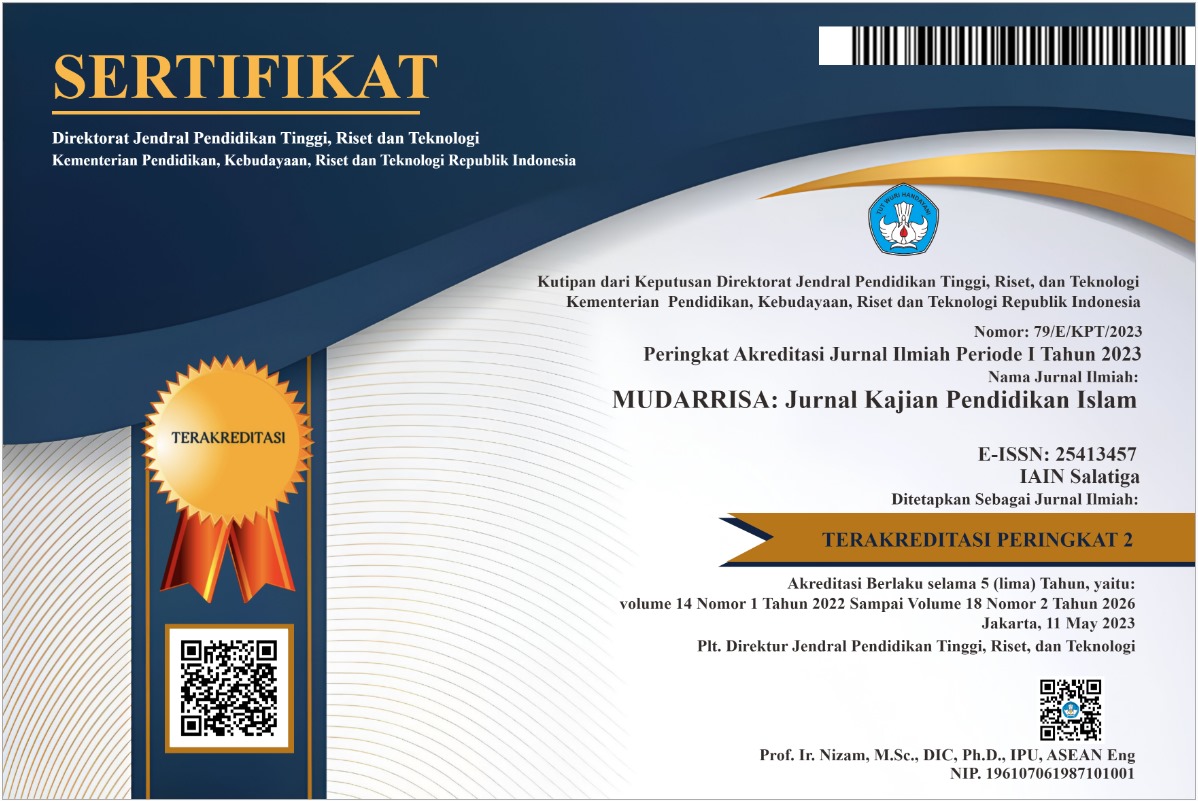
SINTA 2 Indexed

MUDARRISA: Jurnal Kajian Pendidikan Islam is committed to maintaining the accuracy, reliability, transparency, and integrity of the scholarly record. The journal recognizes that errors, ethical concerns, or questions regarding the reliability of published research may arise after publication, even when manuscripts have undergone editorial assessment and peer review.
To address such concerns, the journal maintains procedures for corrections, expressions of concern, retractions, and, in exceptional circumstances, article removal or replacement. These procedures are implemented in accordance with the journal's Publication Ethics and relevant guidance from the Committee on Publication Ethics (COPE).
Post-publication actions are intended to preserve the integrity and completeness of the scholarly record, provide accurate information to readers, and ensure that published research remains subject to appropriate scientific and ethical scrutiny. Retraction is a mechanism for correcting the literature rather than punishing authors.
1. Article Correction
A correction may be issued when a published article contains a material error that can be transparently amended without rendering its principal findings or conclusions unreliable.
Corrections may be considered in circumstances including:
Corrections may be identified as an erratum, corrigendum, or another appropriate correction notice, depending on the nature and source of the error.
Erratum: A correction addressing a material error introduced during the journal's editorial or production process.
Corrigendum: A correction addressing a material error originating from the authors that does not fundamentally invalidate the article's principal findings.
Addendum: A separately identified addition providing necessary clarification or supplementary information about an existing publication, where appropriate and editorially justified. An addendum must not be used to conceal substantive errors or introduce unsupported findings.
Requests to correct authorship information shall be assessed in accordance with the journal's Authorship and Contributorship provisions. Supporting documentation and written agreement from affected authors may be required. Where authorship is disputed, the journal may seek clarification from the relevant institutions rather than independently determining contested contributions without sufficient evidence.
The Editor-in-Chief or designated handling editor determines whether a correction is necessary after evaluating the available evidence and consulting authors, reviewers, or other qualified experts where appropriate.
2. Expression of Concern
An expression of concern may be issued when serious questions regarding the reliability, validity, or ethical compliance of a published article remain unresolved and readers should be informed while further assessment or investigation is undertaken.
An expression of concern may be considered when:
An expression of concern does not constitute a definitive finding of misconduct and must not present unsubstantiated allegations as established facts.
The notice shall clearly identify the affected article, describe the nature of the unresolved concern, and indicate that further assessment may be necessary. When additional evidence becomes available, the journal shall determine whether the expression of concern should be followed by a correction, retraction, or another appropriately linked notice resolving the concern.
3. Article Retraction
Retraction may be warranted when a published article contains serious errors, unreliable findings, substantial ethical violations, or other deficiencies that fundamentally compromise the integrity of the scholarly record.
The journal may consider retracting an article under circumstances including:
Retraction decisions shall be based on the nature and seriousness of the identified concerns, the reliability of the published record, and the available evidence. Honest errors and research misconduct shall be distinguished where the evidence permits.
The purpose of retraction is to alert readers that the affected publication should not be relied upon as an accurate or trustworthy contribution to the scholarly record. Retraction shall not be used primarily as a disciplinary punishment.
4. Retraction Assessment and Decision Process
Concerns that may warrant retraction can be raised by authors, reviewers, editors, readers, institutions, or other parties able to provide relevant evidence. The journal may also initiate an assessment when significant concerns are identified through its editorial or post-publication review activities.
The Editor-in-Chief or a designated independent editor shall conduct a preliminary assessment of the concern, document the available evidence, and identify any actual, potential, or perceived competing interests.
Editors with relevant competing interests shall recuse themselves from the assessment and decision-making process.
Affected authors shall ordinarily be informed of substantive concerns and provided with a fair opportunity to respond, clarify the circumstances, and submit relevant supporting documentation.
Where necessary, the journal may consult independent experts, the publisher, other journals, research integrity officers, or relevant institutions. Institutions ordinarily investigate allegations of researcher misconduct, while the journal remains responsible for evaluating the reliability and integrity of its published record.
Editorial decisions shall not rely solely on automated assessments, unverified allegations, or an author's refusal to cooperate. The journal shall distinguish between suspected misconduct and findings supported by sufficient evidence.
The final editorial decision regarding retraction shall be made by the Editor-in-Chief or an appropriately designated independent editor when the Editor-in-Chief has a relevant conflict of interest.
The publisher may provide administrative, legal, or procedural support but shall not improperly influence editorial judgments. Decisions and supporting evidence shall be appropriately documented.
When sufficient evidence establishes that a publication requires retraction, the journal shall act promptly. Where serious concerns remain unresolved, an expression of concern may be issued when appropriate while further inquiries continue.
5. Publication of Correction, Expression of Concern, and Retraction Notices
Corrections, expressions of concern, and retractions shall be communicated through clearly identified notices published on the journal's official website.
Such notices shall:
Retracted articles shall normally remain accessible in the journal's electronic archive with clear and prominent labeling indicating their retracted status. The published notice shall provide sufficient information to explain the reason for retraction while respecting confidentiality, privacy, and applicable legal obligations.
Where technically possible, the journal shall ensure that article records and relevant metadata reflect the correction, expression of concern, or retraction status.
6. Article Removal
Removal of a published article from the journal's electronic archive is considered an exceptional measure and shall not be used as a routine alternative to correction or retraction.
Article removal may be considered only when continued public availability creates serious legal, privacy, or safety concerns that cannot reasonably be addressed through less restrictive editorial measures.
Such circumstances may include:
Where removal is necessary, the journal shall normally retain the article's bibliographic metadata and replace the full text with a clearly identified notice explaining the removal, to the extent permitted by law and relevant safety or privacy considerations.
The journal shall document the reasons for removal and preserve appropriate editorial records. Any limitations on publicly disclosed information shall be explained as transparently as circumstances permit.
7. Article Replacement and Republishing
Article replacement or republication may be considered only in exceptional circumstances where a previously published article contains serious deficiencies and a corrected version is necessary to maintain the accuracy and integrity of the scholarly record.
Replacement or republication shall not be used to conceal errors, circumvent appropriate retraction procedures, or silently substitute materially different research findings for the original publication.
Where the journal determines that retraction followed by republication is justified, the original article shall be clearly identified as retracted, and the retraction notice shall explain the circumstances and identify the corrected publication.
The corrected publication shall be clearly distinguished from the original article and linked to the relevant retraction notice wherever technically feasible. Appropriate information about the publication history shall be preserved to maintain transparency and traceability.
Decisions regarding replacement or republication shall remain subject to independent editorial judgment, applicable ethical standards, and relevant COPE guidance.
8. Post-Publication Discussion and Reporting of Concerns
MUDARRISA: Jurnal Kajian Pendidikan Islam welcomes evidence-based scholarly discussion and constructive criticism concerning published articles.
Authors, readers, researchers, and other stakeholders may submit concerns regarding potential errors, research reliability, ethical compliance, or the interpretation of published findings to the editorial office.
Substantive scholarly comments may be considered for publication as correspondence or another clearly identified moderated format, subject to editorial standards, confidentiality requirements, and applicable law.
Reports should identify the relevant article, explain the concern, and provide supporting evidence or documentation where available.
Concerns and supporting documentation may be submitted by email to the editorial office of MUDARRISA: Jurnal Kajian Pendidikan Islam at [email protected].
9. Complaints, Appeals, and Editorial Accountability
Authors and other stakeholders may submit documented complaints or appeals concerning editorial procedures, potential conflicts of interest, or decisions related to corrections, expressions of concern, retractions, or article removal.
Complaints and appeals shall be assessed fairly, confidentially, and in accordance with the journal's Publication Ethics. Where practicable, an appeal shall be considered by an independent editor who was not responsible for the original decision.
When concerns involve the Editor-in-Chief, responsibility for their assessment shall be assigned to an appropriately independent editor or authority.
The editorial office shall examine relevant evidence, seek clarification where necessary, and communicate a reasoned outcome while protecting confidential information and respecting applicable legal obligations.
Complainants and respondents shall be treated fairly, and retaliation against individuals raising concerns in good faith is prohibited.
The journal shall maintain appropriate records of post-publication concerns, editorial assessments, decisions, and corrective actions to support transparency, accountability, and the long-term integrity of the scholarly record.
SINTA 2 Indexed
Journal Information
Publication Ethics & Rights
Journal Management
Manuscript Template Download

Reference Manager Applications

Mudarrisa: Jurnal Kajian Pendidikan IslamISSN (electronic): 2541-3457 | ISSN: 2085-2061
Mailing address :
Editorial Office of Mudarrisa: Jurnal Kajian Pendidikan Islam
Universitas Islam Negeri (UIN) Salatiga Jl. Lingkar Salatiga Km. 2 Pulutan, Sidorejo, Kota Salatiga, Jawa Tengah, Indonesia Technical issues email: [email protected] Contact information |
Content Use Policy |