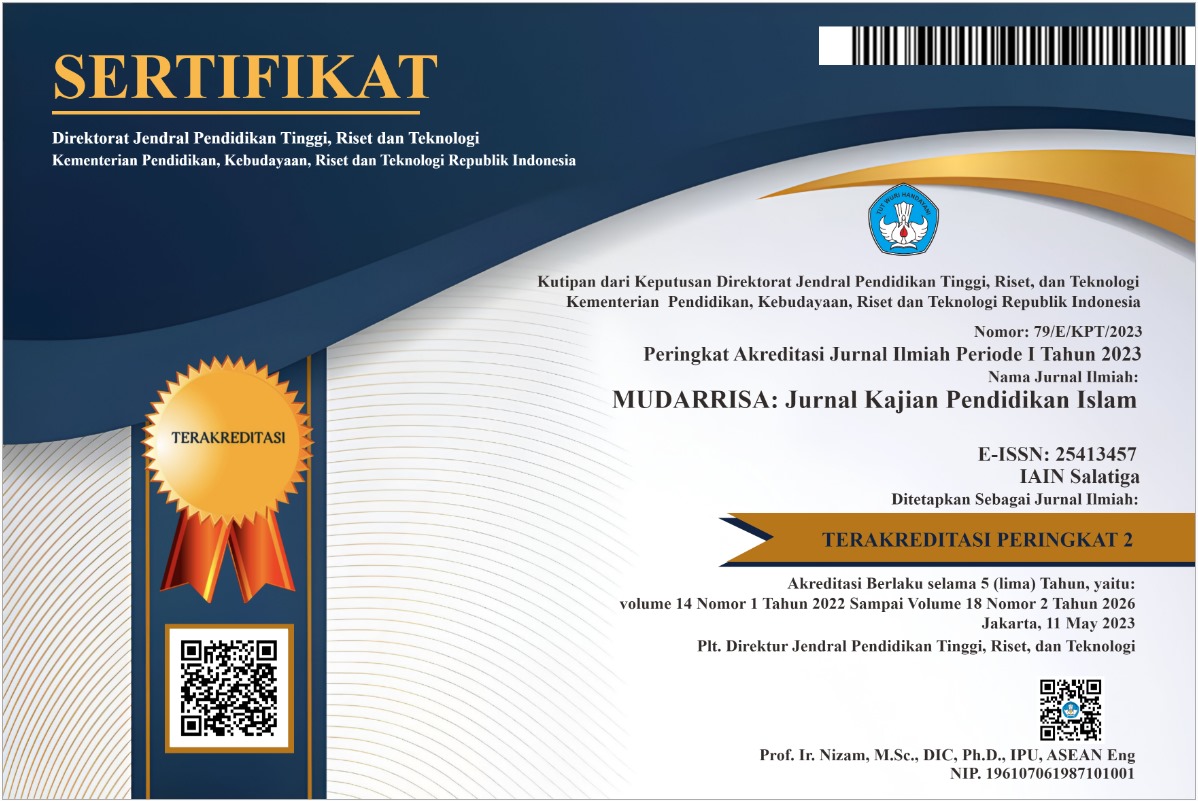
SINTA 2 Indexed

MUDARRISA: Jurnal Kajian Pendidikan Islam is committed to transparency, impartiality, and editorial independence in scholarly publishing.
All authors, editors, reviewers, and other individuals involved in the publication process must disclose actual, potential, or perceived conflicts of interest that could influence, or reasonably appear to influence, their professional judgment.
Conflicts of interest may arise from financial, professional, institutional, academic, or personal relationships.
Examples include research sponsorship, employment relationships, consultancy arrangements, financial interests, close professional collaborations, institutional affiliations, personal relationships, and academic competition.
The existence of a competing interest does not automatically invalidate research or prohibit publication. Appropriate disclosure and management are essential.
Authors must disclose all relevant financial and non-financial competing interests when submitting a manuscript.
All sources of research funding and the role of sponsors in study design, data collection, analysis, interpretation, manuscript preparation, and publication decisions must be disclosed.
A competing interests declaration must be provided even when no conflicts exist.
Where applicable, authors may state:
"The authors declare that they have no competing interests that could have influenced the research reported in this article."
Editors must disclose relationships or interests that may compromise their impartiality in handling a manuscript.
An editor with a relevant conflict must withdraw from the editorial assessment and decision-making process for the affected submission.
The manuscript will be assigned to an independent editor where appropriate.
Editorial decisions must remain independent of commercial interests, publishing charges, advertising, sponsorship, and institutional influence.
Reviewers must inform the editorial office of any circumstances that could affect their ability to evaluate a manuscript objectively.
Reviewers should decline assignments when competing interests cannot be managed appropriately.
Confidential manuscript information must not be used for personal, professional, or financial advantage.
The editorial office will assess declared competing interests and determine appropriate management measures.
These may include additional disclosure, independent editorial oversight, reviewer replacement, reassignment of editorial responsibility, or other proportionate actions.
Relevant author declarations may be published with accepted articles to support transparency.
Credible allegations involving undisclosed material conflicts of interest will be examined in accordance with the journal's Publication Ethics and Allegations of Research Misconduct Policy.
Where necessary, the journal may issue an appropriate correction, expression of concern, or retraction based on the seriousness and consequences of the undisclosed interest.
This policy follows the principles of editorial independence, transparency, accountability, and responsible conflict management reflected in COPE Core Practices.
SINTA 2 Indexed
Journal Information
Publication Ethics & Rights
Journal Management
Manuscript Template Download

Reference Manager Applications

Visit Statistics
Mudarrisa: Jurnal Kajian Pendidikan IslamISSN (electronic): 2541-3457 | ISSN: 2085-2061
Mailing address :
Editorial Office of Mudarrisa: Jurnal Kajian Pendidikan Islam
Universitas Islam Negeri (UIN) Salatiga Jl. Lingkar Salatiga Km. 2 Pulutan, Sidorejo, Kota Salatiga, Jawa Tengah, Indonesia Technical issues email: [email protected] Contact information |
Content Use Policy |