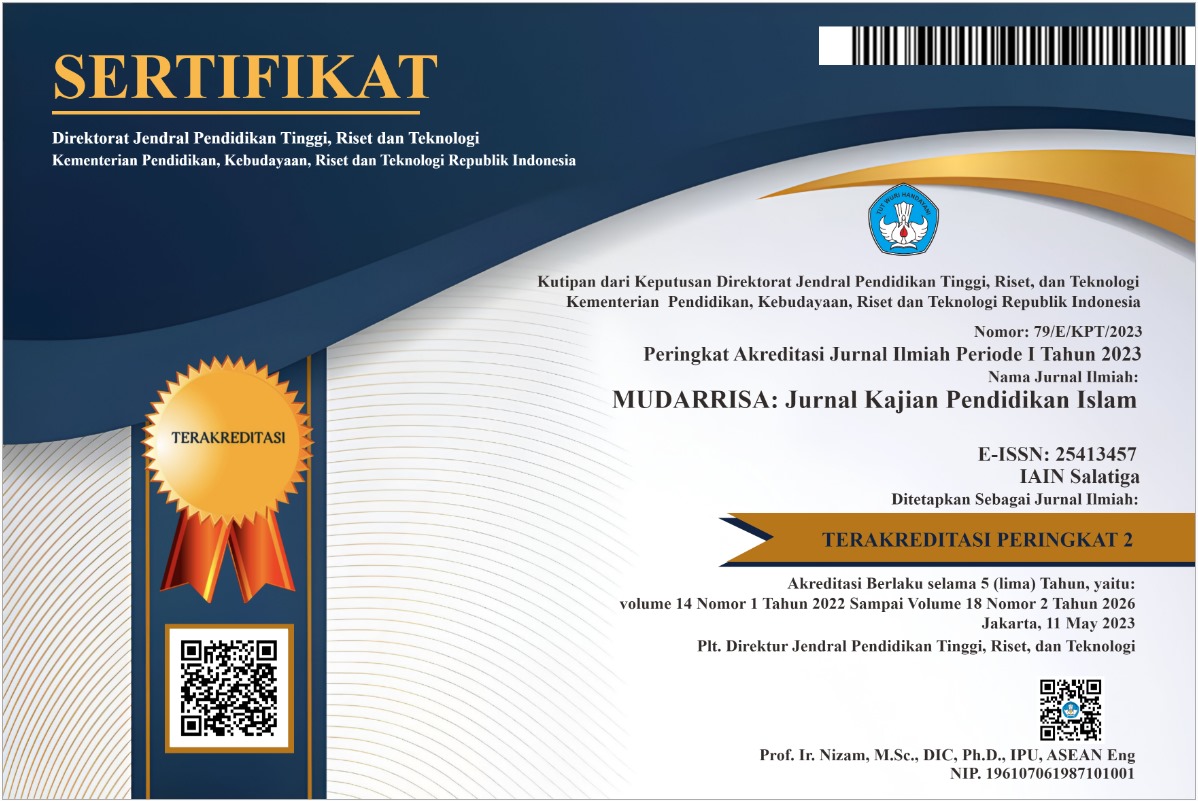
SINTA 2 Indexed

MUDARRISA: Jurnal Kajian Pendidikan Islam, published by Universitas Islam Negeri Salatiga, is committed to maintaining academic integrity, originality, transparency, and accountability in scholarly publishing. The journal does not tolerate plagiarism, misappropriation of intellectual contributions, or misleading presentation of previously published materials as original research.
This policy is implemented in accordance with the journal's Publication Ethics and relevant guidance from the Committee on Publication Ethics (COPE). All allegations of plagiarism shall be assessed fairly, confidentially, and on the basis of available evidence.
Definition and Scope of Plagiarism
Plagiarism refers to the use or presentation of another person's original words, ideas, data, images, research findings, methods, or other intellectual contributions as one's own without appropriate acknowledgment or attribution. Plagiarism may occur through direct copying, inadequate paraphrasing, unattributed translation, unauthorized reproduction of research materials, or misleading representation of the originality of scholarly content.
Authors must accurately acknowledge all sources used in their manuscripts, clearly distinguish quoted material from their own writing, and obtain permission for copyrighted materials when required. Permission to reproduce material does not eliminate the obligation to provide appropriate attribution.
The journal also requires authors to disclose substantial overlap with their previous publications, including journal articles, conference papers, preprints, theses, dissertations, and other scholarly outputs. Legitimate reuse of previously disseminated material may be considered when transparently disclosed, properly attributed, and consistent with applicable copyright and publication requirements. Undisclosed substantial overlap or misleading redundant publication is unacceptable.
Similarity Screening and Editorial Assessment
MUDARRISA: Jurnal Kajian Pendidikan Islam uses Turnitin as a similarity-checking tool to assist the editorial team in identifying potential textual overlap between submitted manuscripts and existing sources.
Similarity reports are evaluated by the Editor-in-Chief or a designated handling editor. The assessment considers the nature, extent, originality, and context of the matched material; the adequacy of quotation and citation practices; the relationship between the submitted manuscript and previously published work; and any relevant explanation provided by the authors.
A similarity score does not, by itself, establish plagiarism or determine an editorial decision. High textual similarity may result from appropriately cited quotations, references, standardized methodological descriptions, or legitimate reuse of material. Conversely, a low similarity score does not guarantee that a manuscript is free from plagiarism or other forms of research misconduct.
Editorial decisions shall not be based solely on automated similarity percentages or unverified allegations. All suspected cases require appropriate editorial assessment before corrective or disciplinary measures are considered.
Categories of Plagiarism and Editorial Responses
The journal considers the nature and seriousness of potential plagiarism when determining an appropriate editorial response. The following categories provide general guidance rather than automatic classifications based on similarity percentages.
1. Minor Plagiarism or Inadequate Attribution
Minor plagiarism or inadequate attribution may involve limited unattributed textual overlap, insufficient paraphrasing, or incomplete acknowledgment of sources without substantial misappropriation of original data, findings, or intellectual contributions.
Editorial Response: The editor may request clarification, appropriate citation, accurate quotation, rewriting of affected passages, or revision of the manuscript. The adequacy of the corrections shall be assessed before further editorial consideration. Rejection may be considered when the concerns are not satisfactorily resolved.
2. Substantial Plagiarism
Substantial plagiarism may involve significant unattributed reproduction of text, research ideas, analytical content, data, or findings from existing sources. Such cases raise serious concerns regarding originality, attribution, and the reliability of the submitted manuscript.
Editorial Response: The editor shall examine the available evidence and may request an explanation or supporting documentation from the authors. Where substantial plagiarism is established and the manuscript fails to meet the journal's standards of originality and academic integrity, the submission may be rejected. Further investigation or consultation with relevant institutions may be undertaken when justified by the circumstances.
3. Severe Plagiarism or Serious Misappropriation
Severe plagiarism may involve extensive reproduction of another work, appropriation of substantial original research findings or data, unauthorized presentation of another researcher's intellectual contributions, or other serious forms of scholarly misrepresentation.
Editorial Response: When credible evidence indicates serious plagiarism, the editorial assessment may be suspended while the concern is examined. If severe plagiarism is substantiated, the manuscript may be rejected. The journal may also consult the publisher, relevant research integrity officers, or the authors' institutions when appropriate. Any action shall be proportionate, documented, and consistent with the journal's Publication Ethics and applicable COPE guidance.
Investigation and Author Response
Suspected plagiarism shall be assessed by the Editor-in-Chief or a designated independent editor with no relevant competing interests. The editorial team shall document the concern, review supporting evidence, and determine whether additional clarification or investigation is required.
Authors shall be given a fair opportunity to respond to substantive allegations and provide relevant explanations or supporting documentation. Where necessary, the journal may consult independent experts, the publisher, other journals, or appropriate institutional authorities while protecting confidential information.
The journal distinguishes between allegations, verified evidence, and established findings. Unsubstantiated allegations shall not be presented as proven misconduct. Editorial decisions shall be reasoned and documented, and affected parties shall be informed of the outcome as far as confidentiality and applicable legal obligations permit.
Plagiarism Identified After Publication
Concerns regarding potential plagiarism in published articles may be submitted to the editorial office for assessment. The journal shall evaluate such concerns in accordance with its Publication Ethics and relevant COPE guidance.
When a material attribution error can be corrected without undermining the reliability or originality of the principal findings, the journal may issue a correction. An expression of concern may be considered when serious questions remain unresolved and readers need to be informed while an investigation continues.
Retraction may be warranted when substantial plagiarism, serious misappropriation, or other established misconduct undermines the integrity or reliability of a published article. Retraction is intended to correct the scholarly record rather than punish authors.
Any correction, expression of concern, or retraction notice shall be appropriately identified, dated, freely accessible, and linked to the affected article in accordance with the journal's Publication Ethics and applicable COPE guidance.
Confidentiality, Complaints, and Editorial Appeals
All plagiarism-related concerns shall be handled with appropriate confidentiality, impartiality, and respect for the rights of the parties involved. Editors with relevant competing interests must recuse themselves from the assessment.
Authors and other stakeholders may submit documented complaints or editorial appeals concerning plagiarism assessments, procedural irregularities, or potential conflicts of interest to the editorial office of MUDARRISA: Jurnal Kajian Pendidikan Islam via email at [email protected].
Complaints and appeals shall be considered fairly in accordance with the journal's Publication Ethics. An appeal does not guarantee reversal of an editorial decision, manuscript acceptance, or additional peer review.
SINTA 2 Indexed
Journal Information
Publication Ethics & Rights
Journal Management
Manuscript Template Download

Reference Manager Applications

Mudarrisa: Jurnal Kajian Pendidikan IslamISSN (electronic): 2541-3457 | ISSN: 2085-2061
Mailing address :
Editorial Office of Mudarrisa: Jurnal Kajian Pendidikan Islam
Universitas Islam Negeri (UIN) Salatiga Jl. Lingkar Salatiga Km. 2 Pulutan, Sidorejo, Kota Salatiga, Jawa Tengah, Indonesia Technical issues email: [email protected] Contact information |
Content Use Policy |