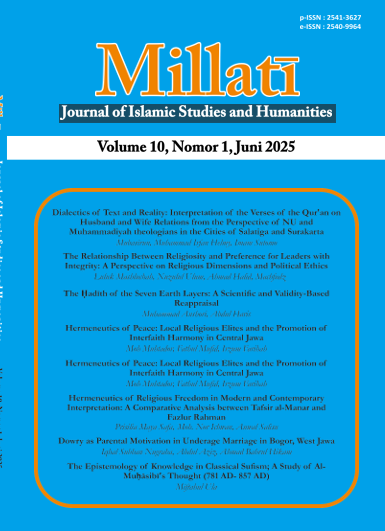
Dialectics of Text and Reality: Interpretation of the Verses of the Qur’an on Husband and Wife Relations from the Perspective of NU and Muhammadiyah theologians in the Cities of Salatiga and Surakarta
DOI:
https://doi.org/10.18326/millati.v10i1.4071Keywords:
husband-wife relations , Qs. Al-Nisa: 34, interpretationAbstract
The fact that in society there are married women who work and have careers outside the home, raises debates in the interpretation of verses related to husband-wife relations. The purpose of this research is to reveal how NU and Muhammadiyah theologians interpret verses about husband-wife relations and the factors that influence these interpretations. The approach used in this research is a normative-sociological approach to highlight the views and ideas of NU and Muhammadiyah theologians about husband-wife relations. The use of a normative approach is to examine husband-wife relations in the verses of the Qur’an about husband-wife relations. Meanwhile, the sociological approach is used to see the views of theologians from Nahdlatul Ulama (NU) and Muhammadiyah circles about husband-wife relations as an interpretation of the verses of the Qur’an about husband-wife relations. For the purposes of analysis, the theory of Sociology of interpretation is used which refers to the view of Peter L Berger who states that the reality and knowledge that a person obtains are not given for free but are a dialect process between that person and the social reality that surrounds him which is then constructed into a text (interpretation). The research found that the interpretation of the NU and Muhammadiyah theologians of Salatiga and Surakarta regarding the shurah an-Nisa’[4];34 and al-Ahzab [33];33 did not have a problem with wives working and having careers outside the home as long as they obtained permission from their husbands.
References
Adz-Dzahabi, Muhammad Husain. At-Tafsir Wa Al-Mufassirun. Kairo: MaktabahWahdah, 1976.
Afriati, Intan. “Relasi Suami Isteri Dalam Al-Qur’an Ditinjau Dari Dimensi Pendidikan (Metode Tafsir Maudhu’i).” Gender Equality: International Journal of Child and Gender Studies 5, no. 2 (November 26th, 2019): 83–94. https://doi.org/10.22373/equality.v5i2.5599.
Al-Bantani, Nawawi. Marah Labid Li Kashf Ma’na al-Qur’an al-Majid. Surabaya: Dar al-Nasyr al Miṣriyyah, n.d.
Ar-Razi, Fakhruddin. Mafatih Al-Ghaib. Beirut: Dar Al-Fikr, 1977.
Basyar, Fahmi. “Relasi Suami Istri Dalam Keluarga Menurut Hukum Islam Dan Undang-Undang Nomor 1 Tahun 1974.” Istidlal: Jurnal Ekonomi Dan Hukum Islam 4, no. 2 (October 15, 2020): 138–50. https://doi.org/10.35316/istidlal.v4i2.269
Dewi, Putri, Arifka Budia Warman, Wardatun Nabilah, Siska Elesta Putri, and Mami Nofrianti. “Reinterpretasi Relasi Suami Istri Dalam Membangun Keharmonisan Rumah Tangga (Sebuah Pendekatan Kontekstual Terhadap QS. an-Nisaa’ (4): 34) | Islamika : Jurnal Ilmu-Ilmu Keislaman” 24, no. 02 (2024). https://ejournal.iainkerinci.ac.id/index.php/islamika/article/view/4499.
Dharma, Ferry. “Konstruksi Realitas Sosial:Pemikiran Peter L. Berger Tentang Kenyataan Sosial.” Kanal Ilmu Jurnal Komunikasi 7, no. 1 (2018). https://doi.org/10.21070/kanal.v6i2.101.
Fatahillah, Wilnan, and Muhammad Hariyadi. “Konsep Self Management Pasangan Suami Istri Dalam Mencegah KDRT Menurut Psikologi Dan Perspektif Al-Quran.” Coution: Journal Counseling and Education 5, no. 2 (November 15, 2024): 16–47. https://doi.org/10.47453/coution.v5i2.2736.
Downloads
Published
Versions
- 20-10-2026 (2)
- 26-06-2025 (1)
How to Cite
Issue
Section
License
Copyright (c) 2025 Mubasirun, Muhammad Irfan Helmy, Imam Sutomo

This work is licensed under a Creative Commons Attribution-ShareAlike 4.0 International License.
Authors publishing in MILLATI: Journal of Islamic Studies and Humanities retain copyright in their scholarly works and grant the journal the right of first publication. Published articles are licensed under the Creative Commons Attribution-ShareAlike 4.0 International License (CC BY-SA 4.0), unless otherwise indicated. This license permits readers to share, reproduce, distribute, and adapt published material, including for commercial purposes, provided that appropriate attribution is given, changes are indicated, and distributed adaptations are licensed under the same or a compatible ShareAlike license. Authors may share and deposit their published articles in institutional repositories, personal websites, and other scholarly platforms, with appropriate acknowledgment of their original publication in MILLATI.