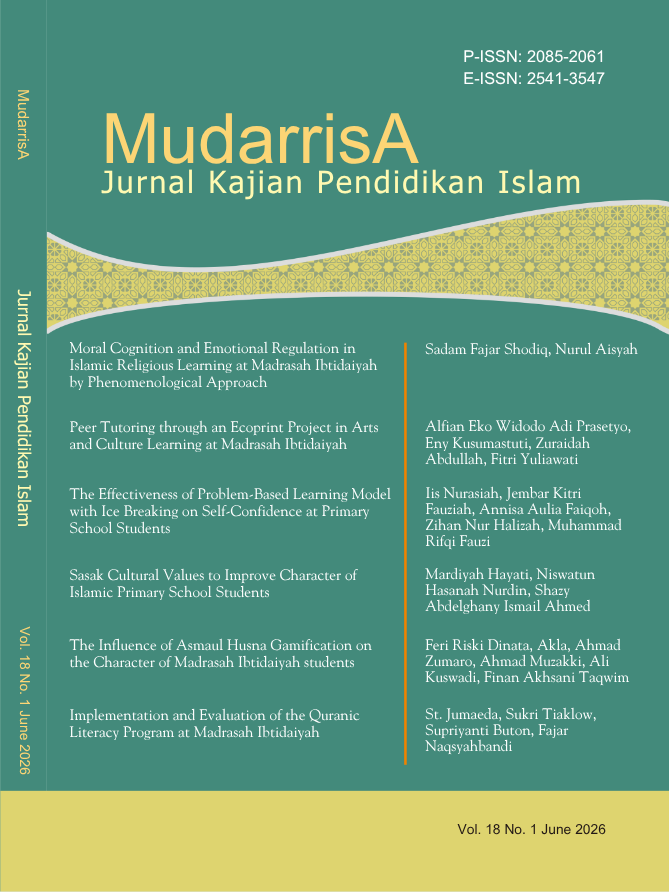
Moral Cognition and Emotional Regulation in Islamic Religious Learning at Madrasah Ibtidaiyah by Phenomenological Approach
DOI:
https://doi.org/10.18326/mudarrisa.v18i1.5856Keywords:
emotion regulation, Islamic religious education, madrasah ibtidaiyah, empathy and justice, students' moral cognitionAbstract
Objectives: This research aims to explore the construction of moral cognition and emotional regulation in Madrasah Ibtidaiyah (Islamic Primary School) students during Islamic Religious Education (IRE), with a focus on their lived experiences in daily classroom interactions.
Method: A qualitative descriptive phenomenological approach was employed. Students aged 8–11 years and Islamic Religious Education teachers from Madrasah Ibtidaiyah Jogonalan in Yogyakarta, Indonesia, were selected as research participants. Data were collected through classroom observations, semi-structured interviews, and document analysis. Analysis followed Colaizzi’s phenomenological method to identify essential experiential themes.
Results: The findings indicate that students construct moral meaning through concrete, relational, and religiously grounded experiences rather than abstract reasoning. Emotional regulation appears developmental and context-dependent, marked by performance-related anxiety and shaped through teacher-mediated classroom interactions.
Theoretical Contribution: This study provides phenomenological insight into the co-emergence of moral cognition and emotional regulation within Islamic elementary education. The findings extend developmental perspectives by highlighting the role of teacher co-regulation in Islamic faith-based learning environments.
Implication: Islamic Religious Education classrooms can be understood as moral–emotional learning spaces where relational pedagogy plays a crucial role. Emotion-sensitive and dialogical teaching practices may support more meaningful moral internalization in Madrasah Ibtidaiyah contexts.
References
Acerbi, A., & Sacco, P. L. (2023). Self-Interest, prosociality, and the moral cognition of markets: A comparative analysis of the Theory of Moral Sentiments and the Wealth of Nations. Rationality and Society, 35(4), 502–524. https://doi.org/10.1177/10434631231170460
Al-Bukhari, M. ibn I. (n.d.). Sahih al-Bukhari.
Al-Hajjaj, M. ibn. (n.d.). Sahih Muslim.
Al-Tirmidhi, M. ibn ‘Isa. (n.d.). Jami‘ al-Tirmidhi.
Álvarez-Couto, M., & Sáez‑Suanes, G. P. (2023). Influence of executive functioning and emotional regulation on effective career choice. Environment and Social Psychology, 8(3). https://doi.org/10.54517/esp.v8i3.1672
Aqodiah, Hasanah, N., & Humaira. (2023). The Role of Scout Extracurriculars in Shaping The Character of Social Care. Mudarrisa: Jurnal Kajian Pendidikan Islam, 15(2), 158–195. https://doi.org/10.18326/mudarrisa.v15i2.404
Berkowitz, M. W., & Bier, M. C. (2005). What works in character education: A research-driven guide for educators. Journal of Character Education, 3(1), 29–48.
Bock, R. C., Baker, L. D., Kalantar, E. A., Berghoff, C. R., Stroman, J. C., Gratz, K. L., & Tull, M. T. (2024). Clarifying relations of emotion regulation, emotional avoidance and anxiety symptoms in a community-based treatment-seeking sample. Psychology and Psychotherapy: Theory, Research and Practice, 97(2), 393–404. https://doi.org/10.1111/papt.12523
Campos-Berga, L., Moreno-Giménez, A., Almansa, B., Ghosn, F., Buesa, J., Lizaran, M., Diago-Almela, V., Vento, M., & García-Blanco, A. (2025). Psychomotor development, emotional regulation, and executive functions in 2-years-old children after threatened preterm labour: a prospective cohort study. European Child and Adolescent Psychiatry, 34(7), 2035–2045. https://doi.org/10.1007/s00787-024-02612-6
Cheung, H. Y. L., Brown, T., Yu, M.-L., & Cheung, P. P. P. (2024). The Relationship Between School-Age Children’s Self-Reported Perceptions of Their Interoceptive Awareness and Emotional Regulation: An Exploratory Study. Journal of Occupational Therapy, Schools, and Early Intervention, 17(3), 704–730. https://doi.org/10.1080/19411243.2023.2215764
Colaizzi, P. F. (1978). Psychological research as a phenomenologist views it. In R. S. Valle & M. King (Eds.), Existential-Phenomenological Alternatives for Psychology (pp. 48–71). Oxford University Press.
Croitoru, I., & Munteanu, H. (2014). The Moral-religious Education – A Support of Self-conscience Training. Procedia - Social and Behavioral Sciences, 116, 2155–2163. https://doi.org/10.1016/j.sbspro.2014.01.536
Dillman-Taylor, D. D., Starrett, A., Carlson, R., Barden, S., & Thompson, K. (2023). Examining the stability of emotional regulation and psychological distress for low-income individuals: A latent transition analysis. Family Process, 62(3), 1217–1232. https://doi.org/10.1111/famp.12821
Durlak, J. A., Weissberg, R. P., Dymnicki, A. B., Taylor, R. D., & Schellinger, K. B. (2011). The impact of enhancing students’ social and emotional learning: A meta-analysis of school-based universal interventions. Child Development, 82(1), 405–432. https://doi.org/10.1111/j.1467-8624.2010.01564.x
Farahani, H., & Dabbagh, H. (2025). Social exclusion’s effect on psychological needs, sense of agency and moral cognition from an embodied cognition perspective. Acta Psychologica, 261. https://doi.org/10.1016/j.actpsy.2025.105973
Halstead, J. M. (2004). An Islamic Concept of Education. Comparative Education, 40(4), 517–529.
Husserl, E. (1970). The Crisis of European Sciences and Transcendental Phenomenology. Northwestern University Press.
John, A., & Bates, S. (2023). Barriers and Facilitators: The Contrasting Roles of Media and Technology in Social–Emotional Learning. Social and Emotional Learning: Research, Practice, and Policy, 3(December 2023), 100022. https://doi.org/10.1016/j.sel.2023.100022
Johnson, E. B. (2002). Contextual Teaching and Learning: What It Is and Why It’s Here to Stay. Corwin Press.
Kohlberg, L. (1984). The Psychology of Moral Development: The Nature and Validity of Moral Stages. Vol. 2. Harpercollins College Div.
Kurniawan, R., Bakti, I. K., Firmansyah, M., Bahri, R., Kholis, N., & Kusaeri, K. (2025). Islamic emotional-cognitive integration: how Islamic education shapes students’ cognitive processes and outcomes through expressive writing. British Journal of Religious Education, 47(2), 1–14. https://doi.org/10.1080/01416200.2025.2523385
Le Pargneux, A. (2025). Contractualist Moral Cognition: From the Normative to the Descriptive at Three Levels of Analysis. Wiley Interdisciplinary Reviews: Cognitive Science, 16(4). https://doi.org/10.1002/wcs.70011
Lickona, T. (1991). Educating for Character: How Our Schools Can Teach Respect and Responsibility. Bantam Books.
Madjid, A., Sutoyo, D. A., & Shodiq, S. F. (2021). Academic Procrastination Among Students: The Influence of Social Support and Resilience Mediated By Religious Character. Jurnal Cakrawala Pendidikan, 40(1), 56–69. https://doi.org/10.21831/cp.v40i1.34641
Mahfud, M., Razak, A. Z. A., & Gahlan, W. Y. (2024). Improving the Islamic Education Learning Quality through Classroom Management in Madrasah Ibtidaiyah. Mudarrisa: Jurnal Kajian Pendidikan Islam, 16(2), 161–180. https://doi.org/https://doi.org/10.18326/mudarrisa.v16i2.902
Marín-Morales, A., Pérez-García, M., Catena, A., & Verdejo-Román, J. (2022). Emotional Regulation in Male Batterers When Faced With Pictures of Intimate Partner Violence. Do They Have a Problem With Suppressing or Experiencing Emotions? Journal of Interpersonal Violence, 37(11–12), NP10271–NP10295. https://doi.org/10.1177/0886260520985484
Metcalfe, J., & Moulin-Stożek, D. (2021). Religious education teachers’ perspectives on character education. British Journal of Religious Education, 43(3), 349–360. https://doi.org/10.1080/01416200.2020.1713049
Nikooyeh, E., Zarani, F., & Fathabadi, J. (2017). The mediating role of social skills and sensation seeking in the relationship between trait emotional intelligence and school adjustment in adolescents. Journal of Adolescence, 59(33), 45–50. https://doi.org/10.1016/j.adolescence.2017.05.012
Nucci, L., Narvaez, D., & Krettenauer, T. (2014). Handbook of moral and character education. In Handbook of Moral and Character Education (2nd ed.). Routledge. https://doi.org/10.4324/9780203114896
Piaget, J. (2013). The Moral Judgment Of The Child. In The Moral Judgment of the Child. Routledge. https://doi.org/10.4324/9781315009681
Pianta, R. C., Hamre, B. K., & Allen, J. P. (2012). Teacher-Student Relationships and Engagement: Conceptualizing, Measuring, and Improving the Capacity of Classroom Interactions. Springer.
Roorda, D. L., Koomen, H. M. Y., Spilt, J. L., & Oort, F. J. (2017). The influence of affective teacher–student relationships on students’ school engagement and achievement: A meta-analytic approach. Review of Educational Research, 87(4), 717–751. https://doi.org/10.3102/0034654316669438
Santrock, J. W. (2014). CHILD DEVELOPMENT. In McGraw-Hill Education (14th ed.). McGraw-Hill Education.
Shodiq, S. F., Makrufi, A. D., Dahliyana, A., Valencia, N. P., Nurunisa, F. A., & Goselfa, L. (2025). The impact of religious education in mitigating the effects of family environment on students’ mental health. Frontiers in Education, 10, 1–8. https://doi.org/https://doi.org/10.3389/feduc.2025.1523461
Songhorian, S. (2022). Adam Smith’s relevance for contemporary moral cognition. Philosophical Psychology, 35(5), 662–683. https://doi.org/10.1080/09515089.2021.2014442
Tambun, A. R. Y. T., Yudoko, G., & Aldianto, L. (2025). Neural Development in Early Childhood and the Emergence of Moral Cognition: A Developmental Perspective. International Journal of Early Childhood. https://doi.org/10.1007/s13158-025-00449-x
The Qur’an. (n.d.).
Xu, W., Zhang, K., & Wang, F. (2024). Perspective Differences of Moral Cognition in Close Others’ Moral Transgressions. Journal of Psychological Science, 47(2), 375–383. https://doi.org/10.16719/j.cnki.1671-6981.20240215
Yani, M. T., Hazin, M., Ahmadi, A., Hanafi, Y., Rahmawati, N. W. D., Ladiqi, S., & Saiban, K. (2026). The phenomenon of intolerance in Islamic educational institutions (madrasahs): An analysis of its manifestations, causes, and prevention policies. Multidisciplinary Reviews, 9(7). https://doi.org/10.31893/multirev.2026353
Zamsiswaya, Z., Mounadil, A. I., & Abdel-Latief, S. (2024). Teacher identity, Islamic behavior, and project-based learning methods for madrasah teachers: A phenomenological approach. Cakrawala Pendidikan, 43(2), 344–357. https://doi.org/10.21831/cp.v43i2.51909
Downloads
Published
How to Cite
Issue
Section
License
Copyright (c) 2026 Sadam Fajar Shodiq

This work is licensed under a Creative Commons Attribution-NonCommercial-ShareAlike 4.0 International License.