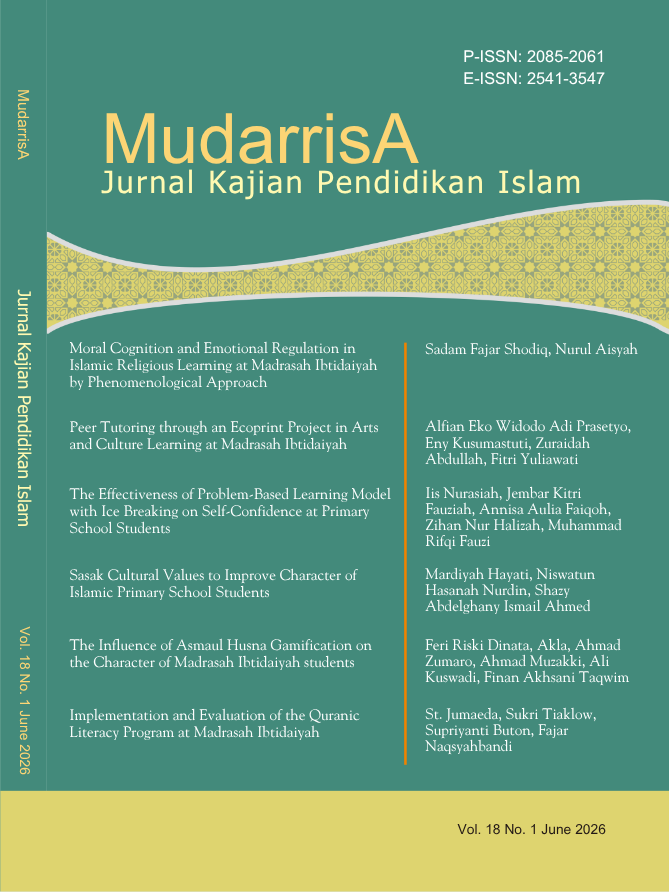
The Influence of Asmaul Husna Gamification on the Character of Madrasah Ibtidaiyah students
DOI:
https://doi.org/10.18326/mudarrisa.v18i1.5711Keywords:
Gamification, Asmaul Husna, Optimism, Self-control, Madrasah IbtidaiyahAbstract
Objectives: This research aims to: 1) identify the elements of Asmaul Husna gamification; 2) explore the implementation of Asmaul Husna gamification in Islamic learning; and 3) examine the influence of Asmaul Husna gamification on the character development of Madrasah Ibtidaiyah (Islamic Primary School) students.
Method: A quantitative quasi-experimental design with a pretest–posttest control group was employed. Forty students were divided into experimental and control groups. The experimental group received structured character education integrating gamification elements aligned with Asmaul Husna values, while the control group experienced conventional, memorization-based instruction. Data were collected using validated optimism and self-control scales and analyzed using ANCOVA to control for baseline differences.
Results: The research reveals that: 1) the core elements of Asmaul Husna gamification include points, levels, badges, challenges, and feedback that integrate Islamic spiritual values; 2) the implementation follows a five-stage framework consisting of orientation, challenges, rewards, reflection, and progression; and 3) Asmaul Husna gamification significantly improves optimism and self-control in Madrasah Ibtidaiyah students.
Theoretical Contribution: This research conceptualizes Islamic educational media by synthesizing Self-Determination Theory, positive psychology, self-regulation theory, and the Islamic concept of tazkiyatun nafs into an integrated educational framework.
Implication: Asmaul Husna gamification offers a spiritually oriented educational tool to strengthen character development in Islamic primary school students.
References
Abo-Zena, M. M., & Rana, M. (2020). Ecological perspectives on religion and positive youth development. Religions, 11(8), 406. https://doi.org/10.3390/rel11080406
Alessandri, G., Zuffianò, A., & Perinelli, E. (2017). Evaluating intervention programs with a pretest-posttest design: A structural equation modeling approach. Frontiers in Psychology, 8, 223. https://doi.org/10.3389/fpsyg.2017.00223
Altmeyer, M., Lessel, P., Jantwal, S., Muller, L., Daiber, F., & Krüger, A. (2021). Potential and effects of personalizing gameful fitness applications using behavior change intentions and Hexad user types. User Modeling and User-Adapted Interaction, 31(4), 675–712. https://doi.org/10.1007/s11257-021-09288-6
An, F., Xi, L., & Yu, J. (2023). The relationship between technology acceptance and self-regulated learning: The mediation roles of intrinsic motivation and learning engagement. Education and Information Technologies, 29, 2605–2623. https://doi.org/10.1007/s10639-023-11959-3
Aparecida, S., Costa, G., Souza, C. A. de, Oliveira, E. D. de, & Lima, G. S. (2025). Gamification in education: A systematic review of the literature. Journal of Tertiary Education and Learning, 3(3). https://doi.org/10.54536/jtel.v3i3.5590
Asrifah, M. N., Havifah, B., Khosiyono, C., & Henucahyani, B. (2025). Analysis of the use of interactive learning media on student learning motivation. Jurnal Pendidikan Anak, 8(2), 271–279. https://doi.org/10.21831/jpa.v14i2.1793
Baghaei, A., Lovreglio, R., Feng, Z., Paes, D., & Miller, C. (2025). Gamification for air quality education: A systematic literature review. Building and Environment, 270, 112526. https://doi.org/10.1016/j.buildenv.2025.112526
Bai, S., Hew, K. F., & Huang, B. (2020). Does gamification improve student learning outcome? Evidence from a meta-analysis and synthesis of qualitative data in educational contexts. Educational Research Review, 30, 100322. https://doi.org/10.1016/j.edurev.2020.100322
Baumeister, R. F., Tice, D. M., & Vohs, K. D. (2018). The strength model of self-regulation: Conclusions from the second decade of willpower research. Perspectives on Psychological Science, 13(2), 141–145. https://doi.org/10.1177/1745691617716946
Brandão, T. (2025). Religion and emotion regulation: A systematic review of quantitative studies. Journal of Religion and Health, 64, 2083–2100. https://doi.org/10.1007/s10943-024-02216-z
Bujang, M. A., Omar, E. D., & Baharum, N. A. (2018). A review on sample size determination for Cronbach’s alpha test: A simple guide for researchers. Malaysian Journal of Medical Sciences, 25(6), 85–99. https://doi.org/10.21315/mjms2018.25.6.9
Creswell, J. W., & Creswell, J. D. (2018). Research design: Qualitative, quantitative, and mixed methods approaches. SAGE Publications.
Dichev, C., & Dicheva, D. (2017). Gamifying education: What is known, what is believed and what remains uncertain: A critical review. International Journal of Educational Technology in Higher Education, 14(9), 1–36. https://doi.org/10.1186/s41239-017-0042-5
Duterte, J. P. (2024). The impact of educational gamification on student learning outcomes. International Journal of Research and Innovation in Social Science, 8, 477–487. https://doi.org/10.47772/IJRISS
Elsawah, W. (2025). Exploring the effectiveness of gamification in adult education: A learner-centric qualitative case study in a Dubai training context. International Journal of Educational Research Open, 9, 100465. https://doi.org/10.1016/j.ijedro.2025.100465
Fauzeh, F., Revelancya, D. P. T. T., & Kiromi, I. H. (2024). The use of educational media in introducing Asmaul Husna to early childhood: A literature review. Journal of Childhood Development, 4(1), 223–234. https://doi.org/10.25217/jcd.v4i1.4436
Gianistika, C., Tanjung, R., Supriatna, A., Permana Suryadipraja, R., & Saepudin, S. (2025). The role of madrasah ibtidaiyah teachers in building students’ Islamic character through integrative thematic learning in the digital era. Edukasi Islami: Jurnal Pendidikan Islam, 14(1), 189–200. https://doi.org/10.30868/ei.v14i01.8140
Gopalan, M., Rosinger, K., & Ahn, J. B. (2020). Use of quasi-experimental research designs in education research: Growth, promise, and challenges. Review of Research in Education, 44(1), 218–243. https://doi.org/10.3102/0091732X20903302
Hamzah, I. F., & Publik, K. (2019). Aplikasi self-determination theory pada kebijakan publik era industri 4.0. Jurnal Berkala Psikologi, 1, 66–73.
Hardy, S. A., Baldwin, C. R., Herd, T., & Kim-Spoon, J. (2020). Dynamic associations between religiousness and self-regulation across adolescence into young adulthood. Developmental Psychology, 56(1), 180–197. https://doi.org/10.1037/dev0000841
Hopipah, E. N., Mansurnoor, I. A., & Rahman, Y. (2025). Integration of the spiritual emotional freedom technique (SEFT) model and the concept of tazkiyatun nafs from Imam Ghazali’s perspective for the recovery process of clients with psychological disorders. Journal of Islamic Communication and Counseling, 4(2), 152–170. https://doi.org/10.18196/jicc.v4i2.102
Imamah, E. S. (2025). Islamic education in preserving mental health based on the Qur’an in the contemporary era. Al-Ishlah: Jurnal Pendidikan, 17, 5885–5904. https://doi.org/10.35445/alishlah.v17i4.8390
Jihadillah, M. (2025). The effectiveness of gamification-based learning in science education: A systematic review of student motivation, engagement, and cognitive learning outcomes. Journal of Educational Innovation and Transformation Global, 1(1), 29–40. https://e-journal.nusantaraglobal.ac.id/index.php/jeitg/article/view/22/23
Julieth, J., Ruiz, R., Dolores, A., & Sanchez, V. (2024). Impact of gamification on school engagement: A systematic review. Frontiers in Education, 13. https://doi.org/10.3389/feduc.2024.1466926
Khuzzan, S. M. S., Yushaa, N. S. M., & Hanid, M. (2021). Gamification elements and its impact on students. Journal of Technology and Operations Management, 16(2), 62–75. https://doi.org/10.32890/jtom2021.16.2.6
Kibtiyah, A., Bahrodin, A., Muaz, Y. A., & Umam, K. (2025). The impact of school-parent collaboration and family environment on character education of students at madrasah ibtidaiyah. Mudarrisa: Jurnal Kajian Pendidikan Islam, 17(2), 161–180. https://doi.org/10.18326/mudarrisa.v17i2.4070
Kurniawan, B., Letasado, M. R., Nuriyah, Hasyda, S., & Amri, N. (2026). Pemanfaatan platform digital untuk meningkatkan aktivitas belajar peserta didik. Jurnal Pendidikan Indonesia: Teori, Penelitian, dan Inovasi, 6(1), 342–351. https://jurnal.penerbitwidina.com/index.php/JPI/article/view/2719
Lena, H., & Anwar, K. (2025). Madrasah ibtidaiyah as a laboratory for morality: Exploring the potential for holistic character building in the digital age. Journal of Theory and Research in Islamic Elementary School Education, 2(1), 24–34. https://ejournal.staimabayang.ac.id/index.php/jtriese/article/view/17
Ma’muroh, Abqorina, & Amrin. (2024). The concept of tazkiyatun nafs by Al-Ghazali and its implementation at Pesantren Darut Tasbih Tangerang. Edu Cendikia: Jurnal Ilmiah Kependidikan, 4(2), 833–844. https://doi.org/10.47709/educendikia.v4i02.4989
Mahardika, D. M., & Ahmad, J. B. (2017). E99: Desktop game application for learning Asmaul Husna. Jurnal Pendidikan Usia Dini, 4(2), 23–43. http://doi.org/10.13140/RG.2.2.19928.32002
Marar, S., Hamza, M. A., Ayyash, M., & Abu-Shaheen, A. (2023). Development and validation of an instrument to assess the knowledge and perceptions of predatory journals. Heliyon, 9(11), e22270. https://doi.org/10.1016/j.heliyon.2023.e22270
Marcus, Z. J., & McCullough, M. E. (2021). Does religion make people more self-controlled? A review of research from the lab and life. Current Opinion in Psychology, 40, 167–170. https://doi.org/10.1016/j.copsyc.2020.12.001
Meulenbroeks, R., Van Rijn, R., & Reijerkerk, M. (2024). Fostering secondary school science students’ intrinsic motivation by inquiry-based learning. Research in Science Education, 54(3), 339–358. https://doi.org/10.1007/s11165-023-10139-0
Micheli, P., Wilner, S. J. S., Bhatti, S. H., Mura, M., & Beverland, M. B. (2019). Doing design thinking: Conceptual review, synthesis, and research agenda. Journal of Product Innovation Management, 36(2), 124–148. https://doi.org/10.1111/jpim.12466
Mitani, H. (2021). Test score gaps in higher order thinking skills: Exploring instructional practices to improve the skills and narrow the gaps. AERA Open, 7, 1–23. https://doi.org/10.1177/23328584211016470
Mohsen, W. A., Al-Rashaida, M., & Alkaabi, A. M. (2025). Navigating generation alpha in the digital age: Parental surveillance and children’s online engagement. Social Sciences & Humanities Open, 12, 101875. https://doi.org/10.1016/j.ssaho.2025.101875
Muhlison. (2025). Growing character through wisdom of heart: Implementation of sufi education integration in student character development. Tafkir: Interdisciplinary Journal of Islamic Education, 6(3), 653–669. https://doi.org/10.31538/tijie.v6i3.1906
Muntasir, Bahri, S., Yusfriadi, Muttaqien, Nidal, A., & Fadlon. (2019). Human communication with God through Asmaul Husna (99 names of Allah): Study of Asmaul Husna’s understanding in Islamic theology. Britain International of Humanities and Social Sciences Journal, 1(2), 140–148. https://doi.org/10.33258/biohs.v1i2.45
Musslifah, A. R., Cale Deporos, S. R., & Purnomosidi, F. (2025). Implementation of deep learning based on local wisdom “Bhineka Tunggal Ika, Tan Hana Dharma Mangrwa” in MI Central Java: An ethnographic study of education. Attadrib: Jurnal Pendidikan Guru Madrasah Ibtidaiyah, 8(2), 340–352. https://doi.org/10.54069/attadrib.v8i2.915
Nurfadilla, A., Puspitasari, A., & Amin, S. (2023). Gamification in Qur’anic learning: Evidence from Muslim students in hybrid classrooms. Jurnal Komunikasi dan Media Pendidikan, 1(2), 60–67. https://doi.org/10.61292/cognoscere.285
Nurhayati, F. (2025). Gamification in school education: A systematic review of its effectiveness in improving student motivation and academic outcomes. Al-Ishlah: Jurnal Pendidikan, 17, 2356–2368. https://doi.org/10.35445/alishlah.v17i2.6516
Nurhayati, I. (2022). Penanaman nilai-nilai Asmaul Husna dalam pembentukan akhlak di taman kanak-kanak. Risalah: Jurnal Pendidikan dan Studi Islam, 8(2), 720–735. https://jurnal.faiunwir.ac.id/index.php/Jurnal_Risalah/article/view/287
Peker, M. (2024). Willing, able, and engaged: Roles of action-state orientation, intrinsic academic motivation, and time management on academic engagement. Journal of Personality Assessment, 104(5), 637–649. https://doi.org/10.1080/00223891.2021.1981344
Ramdhani, M., Wicaksono, D., Pascasarjana, S., & Muhammadiyah, U. (2025). Pengembangan media pembelajaran IPA berbasis gamifikasi untuk meningkatkan minat belajar siswa kelas VII di SMK Muhammadiyah Cipanas. SULIWA: Jurnal Multidisiplin Teknik, Sains, Pendidikan dan Teknologi, 2(2), 168–170. https://doi.org/10.62671/suliwa.v2i2.90
Rosmani, A. F., & Shuhaimi, N. A. A. (2022). Asmaul Husna web-based system: Acquainting the 99 names of Allah. Journal of Computing Research and Innovation, 7(2), 35–42. https://doi.org/10.24191/jcrinn.v7i2.285
Rosmani, A. F., & Zakaria, M. H. (2018). Asmaul Husna learning through gamifications and adaptation of signalling principle. Journal of Physics: Conference Series, 1019, 012080. https://doi.org/10.1088/1742-6596/1019/1/012080
Rothman, A., & Coyle, A. (2018). Toward a framework for Islamic psychology and psychotherapy: An Islamic model of the soul. Journal of Religion and Health, 57, 1731–1744. https://doi.org/10.1007/s10943-018-0651-x
Sahin, A. (2018). Critical issues in Islamic education studies: Rethinking Islamic and Western liberal secular values of education. Religions, 9(11), 335. https://doi.org/10.3390/rel9110335
Sailer, M., & Homner, L. (2020). The gamification of learning: A meta-analysis. Educational Psychology Review, 32, 77–112. https://doi.org/10.1007/s10648-019-09498-w
Sari, H., Adiansyah, R., & Palopo, U. M. (2025). Technology integration in education management: A systematic review of Scopus-indexed studies. Al-Ishlah: Jurnal Pendidikan, 17(4), 6581–6597. https://doi.org/10.35445/alishlah.v17i4.7290
Saudah, S., & Hidayah, U. (2024). Pembentukan karakter religious melalui pembiasaan nilai Asmaul Husna di MI Nur Aziz Probolinggo. Imtiyaz: Jurnal Ilmu Keislaman, 8(1). https://doi.org/10.46773/imtiyaz.v8i1.1022
Timm, J., Block, H., Boanca, G., & Acquaye, H. E. (2022). An exploratory study on the relationship between completion of Erikson’s fourth psychosocial stage and assurance of salvation. Journal of Spirituality in Mental Health, 24(1), 53–73. https://doi.org/10.1080/19349637.2020.1798326
Tutz, G. (2021). Hierarchical models for the analysis of Likert scales in regression and item response analysis. International Statistical Review, 89(1), 18–35. https://doi.org/10.1111/insr.12396
Wagner, L., Pindeus, L., & Ruch, W. (2021). Character strengths in the life domains of work, education, leisure, and relationships and their associations with flourishing. Frontiers in Psychology, 12, 597534. https://doi.org/10.3389/fpsyg.2021.597534
Wang Li. (2018). Research methods in education. International Journal of STEM Education, 7(11), 1–16. https://doi.org/10.1186/s40594-020-00207-6
Yan, Z., Panadero, E., Wang, X., & Zhan, Y. (2023). A systematic review on students’ perceptions of self-assessment: Usefulness and factors influencing implementation. Educational Psychology Review, 35, 81. https://doi.org/10.1007/s10648-023-09799-1
Zainuddin, Z., Rasyidin, R., Zanzibar, Z., Aruni, F., & Nurmasyahyati, N. (2023). Andragogical principles in a gamification concept: How does it work for adult learners in an online class? Journal of Applied Research in Higher Education, 15(5), 1632–1648. https://doi.org/10.1108/JARHE-04-2022-0127
Zebua, N., Malik, P. F. P., Al-Hilmiyah, N. A., Zebua, E. N. K., Pebrianti, P. E., Sari, M. S., & Rudiyanto, R. (2024). Analisis penggunaan metode gamifikasi untuk meningkatkan motivasi. Jurnal Cakrawala Pendidikan dan Biologi, 1(4), 183–188. https://ejournal.aripi.or.id/index.php/jucapenbi/article/view/80
Zhai, N., Huang, Y., Ma, X., & Chen, J. (2023). Can reflective interventions improve students’ academic achievement? A meta-analysis. Thinking Skills and Creativity, 49, 101373. https://doi.org/10.1016/j.tsc.2023.101373
Downloads
Published
How to Cite
Issue
Section
License
Copyright (c) 2026 Feri Riski Dinata, Akla, Ahmad Zumaro, Ahmad Muzakki, Ali Kuswadi, Finan Akhsani Taqwim

This work is licensed under a Creative Commons Attribution-NonCommercial-ShareAlike 4.0 International License.