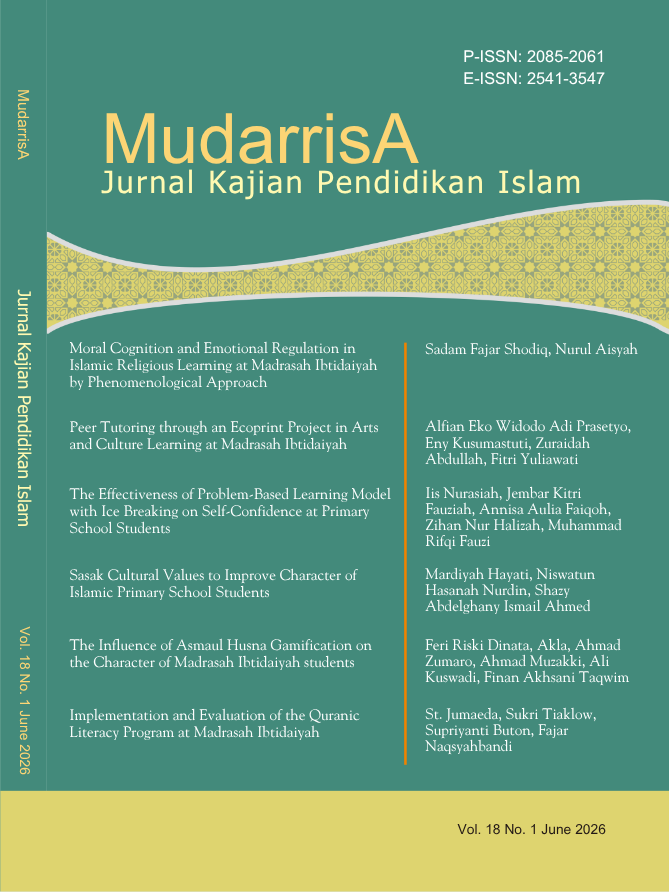
Implementation and Evaluation of the Quranic Literacy Program at Madrasah Ibtidaiyah
DOI:
https://doi.org/10.18326/mudarrisa.v18i1.5519Keywords:
CIPP model, extracurricular programs, Al-Quran literacy, Islamic education, program evaluationAbstract
Objectives: This research aims to examine the implementation, evaluate the process, and evaluate the product of the Quranic literacy program at Madrasah Ibtidaiyah (Islamic primary school) in Ambon City, Indonesia.
Method: This research employed a mixed-methods design. The sample consisted of 92 students from Grades V and VI across three Madrasah Ibtidaiyah in Ambon City, Indonesia. Data were collected through interviews, questionnaires, classroom observations, documentation, and performance-based tests. Qualitative data were analyzed using thematic analysis, while quantitative data were analyzed using paired-samples t-test, Cohen’s d effect size calculations, and multiple regression analysis.
Results: The findings mapped key aspects of the implementation of the Quranic literacy program in Madrasah Ibtidaiyah in Ambon City, including objectives, activities, teaching methods, participants, infrastructure, student grouping, assessment, parental involvement, strengths, and challenges. Process evaluation indicated that the overall learning process was categorized as “Good”, with an average score of 3.87 on a 5-point scale. Product evaluation demonstrated that the Quranic literacy program had a statistically significant effect on student’ competency, resulting in an average competency score increase of 11.5 points.
Theoretical Contribution: This research contributes to the development of Islamic education evaluation theory and extends Stufflebeam's CIPP evaluation model within the context of Quranic literacy programs.
Implication: The findings offers a new framework for implementing and evaluating Quranic literacy programs in Islamic primary schools.
References
Al-Kitbi, M. S. B.-A. (2020). Quran recitation styles as sources of Arabic grammatical rules: Grammarians' perspectives. Quranika: International Journal of Quranic Research, 12(1), 69-87. https://doi.org/10.22452/quranica.vol12no1.4
Al-Zarnuji. (1991). Taʿlim al-Mutaʿallim: Thariq al-Taʿallum. Dar al-Kutub al-Ilmiyyah.Aripin, A. M., & Noviani, D. (2025). Integrasi teknologi dalam pembelajaran Pendidikan Agama Islam: Peluang dan tantangan. El-Mujtama: Jurnal Pengabdian Masyarakat, 5(1), 1–6. https://doi.org/10.47467/elmujtama.v5i1.5625
Arifain, S., Sapar, A. A., Hussin, M., & A.H., S. (2024). A need analysis for developing Arabic phonetics: A strategy for mastering the pronunciation of Arabic letters. Forum for Linguistic Studies, 6(6), 742–752. https://doi.org/10.30564/fls.v6i6.7412
Ashur, M. A.-T. I. (2006). Ibn Ashur treatise on Maqasid al-Shariah. The International Institute of Islamic Thought.
Aziz, S., Mahmood, M., & Rehman, Z. (2018). Implementation of CIPP model for quality evaluation at school level: A case study. Journal of Education and Educational Development, 5(1), 189-206. https://doi.org/10.22555/joeed.v5i1.1553
Baharun, H. (2018). Konstruksi pendidikan karakter di madrasah berbasis pesantren. Jurnal Pendidikan Islam, 8(1), 149-173.
Basir, A., Tamjidnor, Suraijiah, Karoso, S., Saidi, S., & Sholihah, M. (2024). Enhancing Qurʺan reading proficiency in madrasahs through teaching strategies. Nazhruna: Jurnal Pendidikan Islam, 7(2), 373–389. https://doi.org/10.31538/nzh.v7i2.4985
Bourdieu, P. (1986). The forms of capital. In J. G. Richardson (Ed.), Handbook of Theory and Research for the Sociology of Education (pp. 241-258). Greenwood Press.
Creswell, J. W., & Plano Clark, V. L. (2017). Designing and Conducting Mixed Methods Research (3rd ed.). SAGE Publications.
Dahar, R. W. (2011). Teori-Teori Belajar dan Pembelajaran. Bandung: Erlangga.
Damri, D., Indra, R., Tsaputra, A., Ediyanto, E., & Jatiningsiwi, T. G. (2023). Leadership evaluation and effective learning in an inclusive high school in Padang, Indonesia. Cogent Education, 10(2), Article 2282807. https://doi.org/10.1080/2331186X.2023.2282807
Danielson, C. (2013). The Framework for Teaching Evaluation Instrument. The Danielson Group.
Dzulkifli, I., Suhid, A., & Fakhruddin, F. M. (2021). Activity-based teaching of Quran for deaf students in the Special Education Integration Program. Pertanika Journal of Social Sciences and Humanities, 29(1), 1-16. https://doi.org/10.47836/pjssh.29.1.01
Espihani, R. (2025). Reconstructing multicultural Islamic education: A Qur'anic framework for inclusive pedagogy. Journal of Islamic Education, 37(1), 16-23.
Espinosa Andrade, A., Padilla, L., & Carrington, S. J. (2024). Educational spaces: The relation between school infrastructure and learning outcomes. Heliyon, 10(19), Article e38361. https://doi.org/10.1016/j.heliyon.2024.e38361
Finney, T. L. (2019). Confirmative evaluation: New CIPP evaluation model. Journal of Modern Applied Statistical Methods, 18(2), 2-24. https://doi.org/10.22237/jmasm/1598889893
Hakim, R., Ritonga, M., Khodijah, K., Zulmuqim, Z., Remiswal, R., & Jamalyar, A. R. (2022). Learning strategies for reading and writing the Quran: Improving student competence as preservice teachers at the Faculty of Tarbiyah and Teacher Training. Education Research International, 2022, Article 3464265. https://doi.org/10.1155/2022/3464265
Hallinger, P., & Heck, R. H. (2010). Collaborative leadership and school improvement: Understanding the impact on school capacity and student learning. School Leadership & Management, 30(2), 95–110. https://doi.org/10.1080/13632431003663214
Hamdani, M., & Aminah, S. (2020). Manajemen kegiatan ekstrakurikuler dalam pembentukan karakter religius peserta didik di MI Unggulan Riyadlul Qori'in Ajung Jember. Leaderia: Jurnal Manajemen Pendidikan Islam, 1(2), 1-15. https://doi.org/10.35719/leaderia.v1i2.28
Hartini, L. (2025). Implementasi model problem-based learning untuk meningkatkan kemampuan baca tulis Al-Qur'an pada siswa Madrasah Ibtidaiyah Negeri. Jurnal Indonesia Kajian Pendidikan Islam, 1(3), 111-119.
Hattie, J. (2023). Visible learning: The sequel (1st ed.). Routledge. https://doi.org/10.4324/9781003380542
Indrianto, N., & Nurdin, A. (2024). Evaluation of primary school inclusive education curriculum based on Context, Input, Process, and Product (CIPP) model. Al-Hayat: Journal of Islamic Education, 8(2), 408-420. https://doi.org/10.35723/ajie.v8i2.471
Jennah, R., Khadavi, M. J., Ahmad, I., & Probolinggo, D. (2026). Enhancing Quranic recitation quality through the An-Nahdliyah method: A case study at Madrasah Diniyah. Hayula: Indonesian Journal of Multidisciplinary Islamic Studies, 6(1), 47-57. https://doi.org/10.14421/hjie.2026.61-04
Johnson, D. W., & Johnson, R. T. (2014). Cooperative learning in 21st century. Anales de Psicología, 30(3), 841-851. https://doi.org/10.6018/analesps.30.3.201251
Junanto, S., & Kusna, N. A. (2018). Evaluasi program pembelajaran di PAUD inklusi dengan model context, input, process, and product (CIPP). INKLUSI: Journal of Disability Studies, 5(2), 179-194. https://doi.org/10.14421/ijds.050202
Kholidi, A. K. (2020). Konstruksi pendidikan karakter sebuah konsep dan model terhadap siswa full day school di era pandemi Covid-19. Jurnal Psikologi, 13(2), 134-143.
Klein, M., & Sosu, E. M. (2024). School attendance and academic achievement: Understanding variation across family socioeconomic status. Sociology of Education, 97(1), 22–40. https://doi.org/10.1177/00380407231191541
Langgulung, H. (2003). Asas-asas pendidikan Islam. Pustaka Al-Husna Baru.
Miles, M. B., Huberman, A. M., & Saldaña, J. (2018). Qualitative Data Analysis: A Methods Sourcebook (3rd ed.). SAGE Publications.
Mufid, M. (2020). Evaluasi model context, input, process and product (CIPP) program baca tulis Al-Qur'an di Institut Agama Islam Negeri Pekalongan. Quality, 8(1), 1-20. https://doi.org/10.21043/quality.v8i1.6908
Nata, A. (2016). Pendidikan dalam Perspektif Al-Qur’an, Jakarta: Prenadamedia Group.
Nurkholifah, S. (2024). The role of Al-Quran literacy in deepening understanding of Islamic Religious Education. Journal of Islamic Education Research, 9(1), 47-60.
Prayogo, D. (2022). CIPP evaluation model and its effect on e-learning. AL-ISHLAH: Jurnal Pendidikan, 14(1), 177-188. https://doi.org/10.35445/alishlah.v14i1.1071
Riyadi, S., Rozaanah, & Abdulghani, N. A. (2025). Integrasi teknologi dalam pendidikan Islam. Tasqif: Journal of Islamic Pedagogy, 2(2), 1-14. https://doi.org/10.51590/tsqf.v2i2.17
Rohman, A., Muhtamiroh, S., Imron, A., Miyono, N., & Pastore, S. (2023). Integrating traditional-modern education in madrasa to promote competitive graduates in the globalization era. Cogent Education, 10(2), Article 2268456. https://doi.org/10.1080/2331186X.2023.2268456
Rozaq, M. K., & Nugroho, P. (2024). Increasing literacy in reading the Qur'an Hadith in class IX students through the application of the talaqqi method at MTsN 1 Kudus. Jurnal Pendidikan Islam, 14(2), 282-295.
Ryan, R. M., & Deci, E. L. (2000). Self-determination theory and the facilitation of intrinsic motivation, social development, and well-being. American Psychologist, 55(1), 68–78. https://doi.org/10.1037/0003-066X.55.1.68
Sanusi. (2020). Al-Attas’ philosophy of Islamic education (pp. 341–350). UIN Sunan Kalijaga Press.
Sideridis, G., & Alamri, H. (2023). Predicting academic achievement and student absences in high school: The roles of student and school attributes. Frontiers in Psychology, 14. https://doi.org/10.3389/fpsyg.2023.987127
Sirin, M. Z., Sari, Y., Ramadhani, F., & Jamasir, D. (2021). The Qur'an learning in Islamic education institutions in Indonesia: An analysis study of the problems and solutions. Al-Hayat: Journal of Islamic Education, 4(2), 146-155.
Sow, M., Saha, S., Wang, Z., Saha, G., & Saha, C. (2025). A meta-analysis of the effect of peer tutoring in Science, Technology, Engineering and Mathematics (STEM) subjects. Teaching and Teacher Education, 157. https://doi.org/10.1016/j.tate.2025.104960
Steenbergen-Hu, S., Makel, M. C., & Olszewski-Kubilius, P. (2016). What one hundred years of research says about the effects of ability grouping and acceleration on K-12 students' academic achievement: Findings of two second-order meta-analyses. Review of Educational Research, 86(4), 849-899. https://doi.org/10.3102/0034654316675417
Stufflebeam, D. L. (2002). CIPP Evaluation Model Checklist. The Evaluation Center, Western Michigan University.
Sujarwo, S., & Herwin, H. (2023). Parental involvement and student achievement: A meta-analysis of publications in the Scopus database. International Journal of Instruction, 16(2), 107–124. https://e-iji.net/ats/index.php/pub/article/view/133
Supovitz, J., & Spillane, J. P. (2015). Translating research into educational policy and practice. American Journal of Education, 121(3), 305–308. https://doi.org/10.1086/680607
Supriyadi, T. (2022). Al-Qur'an literacy: A strategy and learning steps in improving Al-Qur'an reading skills through action research. Jurnal Pendidikan Agama Islam, 21(1), 323-339.
Surul Shahbudin bin Hassan, & Muhammad Azhar bin Zailaini. (2024). Enhancing Al-Quran reading proficiency in higher education: The implementation of the Focused Mad & Idgham Technique. Journal of Cognitive Sciences and Human Development, 10(1), 1–14. https://doi.org/10.33736/jcshd.6019.2024
Vygotsky, L. S. (1978). Mind in Society: Development of Higher Psychological Processes. Harvard University Press. https://doi.org/10.2307/j.ctvjf9vz4
Wang, C., Syed, M. A., & Tahir, L. (2024). Self-determination theory in education: A meta-analysis. Learning and Motivation, 87. https://doi.org/10.1016/j.lmot.2024.102015
Zhang, G., & Stufflebeam, D. S. (2017). The CIPP Evaluation Model: How to Evaluate for Improvement and Accountability. Guilford Press.
Downloads
Published
How to Cite
Issue
Section
License
Copyright (c) 2026 St. Jumaeda, Sukri Tiaklow, Supriyanti Buton, Fajar Naqsyahbandi

This work is licensed under a Creative Commons Attribution-NonCommercial-ShareAlike 4.0 International License.