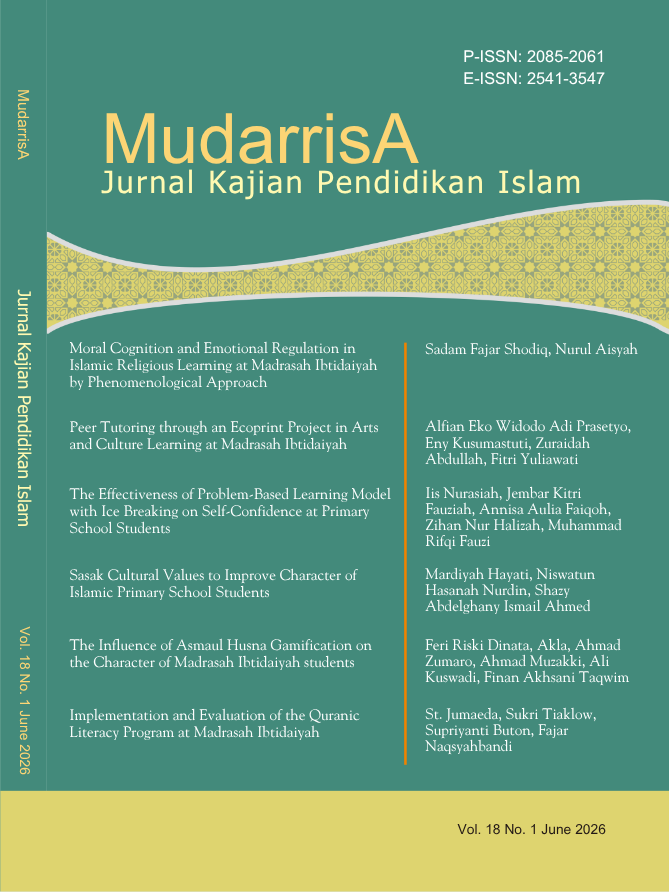
Sasak Cultural Values to Improve Character of Islamic Primary School Students
DOI:
https://doi.org/10.18326/mudarrisa.v18i1.4826Keywords:
Sasak Cultural Values, Character Education, Social Attitudes, Cultural Integration in Education, Islamic Primary SchoolAbstract
Objectives: This research investigates internalization strategies, types of values, supporting factors, inhibiting factors, and the impact of Sasak cultural values to improve character of Islamic primary school students in Mataram, Indonesia.
Method: A qualitative phenomenological approach was adopted and conducted at Sekolah Dasar (Islamic primary school) ‘Aisyiyah 1 Mataram, in Mataram City, Indonesia. Participants consisted of upper-grade students, classroom teachers, the school principal, and local traditional leaders selected through purposive sampling. Data were collected through participant observation, in-depth interviews, and document analysis. The data were analyzed using the interactive model proposed by Miles, Huberman, and Saldaña.
Results: The findings indicate that the internalization of Sasak cultural values occurs through structured morning activities, the integration of local folklore, teacher role modeling, and participation in community-based activities. Sasak cultural values for character education include besiru (cooperation), bekelangan (empathy and social concern), pelungguh (ethical conduct), isin (moral restraint and self-awareness), and jari diri (positive personal behavior). Internalization of these values is supported by strong school leadership, a conducive school environment, the active involvement of traditional community leaders, and parental engagement. Conversely, limited learning time and a lack of teacher understanding hinder the internalization process. Ultimately, Sasak cultural values contribute to the development of students’ respectfulness, discipline, courtesy, responsibility, cooperation, self-regulation, and social sensitivity.
Theoretical Contribution: This research contributes to the discourse on teaching the values of ta'āwun (mutual assistance) and haya' (politeness) through culturally rooted Islamic education.
Implication: These findings imply the importance of integrating local cultural values into character education within Islamic primary schools.
References
Abdurahman, A., Marni, S., Putra, L. D., & Mukminin, M. S. (2026). A literature review on the implementation of character values in culture-based literature of Minangkabau. Alinea: Jurnal Bahasa, Sastra Dan Pengajaran, 6(1), 298–309. https://doi.org/10.58218/alinea.v6i1.2671
Adiyono, A., Ni’am, S., & Anshor, A. M. (2024). Islamic character education in the era of industry 5.0: navigating challenges and embracing opportunities. al-hayat: Journal of Islamic Education, 8(1), 287. https://doi.org/10.35723/ajie.v8i1.493
Ahmar, D. S., & Azzajjad, M. F. (2025). Empowering local wisdom for enhancing students’ social skills in the global era. Journal of Education, Social & Communication Studies, 2(2), 112–127. https://doi.org/10.71028/jescs.v2i2.120
Ahmed, S. K. (2024). The pillars of trustworthiness in qualitative research. Journal of Medicine, Surgery, and Public Health, 2, 100051. https://doi.org/10.1016/j.glmedi.2024.100051
Alam, A., & Mohanty, A. (2023). Cultural beliefs and equity in educational institutions: exploring the social and philosophical notions of ability groupings in teaching and learning of mathematics. International Journal of Adolescence and Youth, 28(1). https://doi.org/10.1080/02673843.2023.2270662
Aldi, M., & Khairanis, R. (2025). History and culture of minangkabau in educational perspective: integrating traditional values for character development. Jurnal Penelitian Ilmu-Ilmu Sosial, 6(1), 52–67. https://doi.org/10.23917/sosial.v6i1.8197
Anwar, S., In’am, A., Faridi, & Ikhwan, A. (2025). Etiquette learning through the team teaching model. Al-Hayat: Journal of Islamic Education, 9(4), 821–843. https://doi.org/10.35723/ajie.v9i4.281
Aqodiah, A., Astini, B. I., & Hasanah, N. (2023). Teachers’ perceptions in educational concepts (study on independent learning application at MIN 1 Mataram). Syekh Nurjati International Conference on Elementary Education, 1, 320. https://doi.org/10.24235/sicee.v1i0.14626
Aqodiah, A., Hasanah, N., & Humaira. (2023). The role of scout extracurriculars in shaping the character of social care. MUDARRISA: Jurnal Kajian Pendidikan Islam, 15(2), 158–195. https://doi.org/10.18326/mudarrisa.v15i2.404
Astini, B. I., Aqodiah, A., & Hasanah, N. (2023). Inovasi kepemimpinan kepala madrasah dalam menerapkan kurikulum merdeka. Jurnal Cendekia Media Komunikasi Penelitian Dan Pengembangan Pendidikan Islam, 15(01), 80–97. https://doi.org/10.37850/cendekia.v15i01.408
Aswasulasikin, A., Fadilah, D., & Hadi, Y. A. (2022). Inculcating of sasak local cultural values in learning at elementary school. Jurnal EDUCATIO: Jurnal Pendidikan Indonesia, 8(2), 96. https://doi.org/10.29210/1202222460
Ataman, A., Baharun, H., Sanjani, M. A. F., & Safitri, S. D. (2024). Exploring complementary leadership styles in madrasahs by aiming at their impact on integrity and character development. Business and Applied Management Journal, 1(2), 118–133. https://doi.org/10.61987/bamj.v1i2.487
Astini, B. I., Aqodiah., & Hasanah, N. (2025). Persepsi guru fiqih dalam konsep pendidikan (studi penerapan kurikulum merdeka di MIN 1 Mataram). Pendas : Jurnal Ilmiah Pendidikan Dasar, 10(01), 2588–2593.
Bajovic, M., & Rizzo, K. (2021). Meta-moral cognition: Bridging the gap among adolescents’ moral thinking, moral emotions and moral actions. International Journal of Adolescence and Youth, 26(1), 1–11. https://doi.org/10.1080/02673843.2020.1867206
Bates, A. (2019). Character education and the ‘priority of recognition.’ Cambridge Journal of Education, 49(6), 695–710. https://doi.org/10.1080/0305764X.2019.1590529
Birhan, W., Shiferaw, G., Amsalu, A., Tamiru, M., & Tiruye, H. (2021). Exploring the context of teaching character education to children in preprimary and primary schools. Social Sciences & Humanities Open, 4(1), 100171. https://doi.org/10.1016/j.ssaho.2021.100171
Boorman, R. J., Creedy, D. K., Fenwick, J., & Muurlink, O. (2019). Empathy in pregnant women and new mothers: A systematic literature review. Journal of Reproductive and Infant Psychology, 37(1), 84–103. https://doi.org/10.1080/02646838.2018.1525695
Buchanan, R. A., Forster, D. J., Douglas, S., Nakar, S., Boon, H. J., Heath, T., Heyward, P., D’Olimpio, L., Ailwood, J., Eacott, S., Smith, S., Peters, M., & Tesar, M. (2022). Philosophy of education in a new key: Exploring new ways of teaching and doing ethics in education in the 21st century. Educational Philosophy and Theory, 54(8), 1178–1197. https://doi.org/10.1080/00131857.2021.1880387
Burgos-Videla, C., Parada-Ulloa, M., & Martínez-Díaz, J. (2025). Critical thinking in the classroom: The historical method and historical discourse as tools for teaching social studies. Frontiers in Sociology, 10. https://doi.org/10.3389/fsoc.2025.1526437
Bustomi, A. A., Khosiah, N., & Fathurrohman, A. (2025). Developing pancasila learning strategies through culture-based interactive media in elementary schools. Assyfa Learning Journal, 3(1), 43–56. https://doi.org/10.61650/alj.v3i1.622
Chand, S. P. (2025). Methods of data collection in qualitative research: interviews, focus groups, observations, and document analysis. Advances in Educational Research and Evaluation, 6(1), 303–317. https://doi.org/10.25082/AERE.2025.01.001
Chiang, J. L., Kim, D., Siu, C., White, B., Zhu, M., Switzer-McIntyre, S., & Gibson, B. E. (2024). What is ‘disability’? Exploring the conceptions of internationally educated learners in a Canadian physical therapy bridging program. Physiotherapy Theory and Practice, 40(2), 276–287. https://doi.org/10.1080/09593985.2022.2113942
Crawford, J., Allen, K.-A., Sanders, T., Baumeister, R., Parker, P., Saunders, C., & Tice, D. (2024). Sense of belonging in higher education students: an Australian longitudinal study from 2013 to 2019. Studies in Higher Education, 49(3), 395–409. https://doi.org/10.1080/03075079.2023.2238006
Curren, R., & Ryan, R. M. (2020). Moral self-determination: The nature, existence, and formation of moral motivation. Journal of Moral Education, 49(3), 295–315. https://doi.org/10.1080/03057240.2020.1793744
Cuthbertson, L. M., Robb, Y. A., & Blair, S. (2020). Theory and application of research principles and philosophical underpinning for a study utilising interpretative phenomenological analysis. Radiography, 26(2), e94–e102. https://doi.org/10.1016/j.radi.2019.11.092
Darling-Hammond, L., Flook, L., Cook-Harvey, C., Barron, B., & Osher, D. (2020). Implications for educational practice of the science of learning and development. Applied Developmental Science, 24(2), 97–140. https://doi.org/10.1080/10888691.2018.1537791
Darong, H. C., Jem, Y. H., & Niman, E. M. (2021). Character building: the insertion of local culture values in teaching and learning. JHSS (Journal Of Humanities And Social Studies), 5(3), 252–260. https://doi.org/10.33751/jhss.v5i3.4001
Dodgson, J. E. (2023). Phenomenology: Researching the lived experience. Journal of Human Lactation, 39(3), 385–396. https://doi.org/10.1177/08903344231176453
Dong, S., Dong, Q., & Chen, H. (2022). Mothers’ parenting stress, depression, marital conflict, and marital satisfaction: The moderating effect of fathers’ empathy tendency. Journal of Affective Disorders, 299, 682–690. https://doi.org/10.1016/j.jad.2021.12.079
Dyson, B., Howley, D., & Shen, Y. (2021). ‘Being a team, working together, and being kind’: Primary students’ perspectives of cooperative learning’s contribution to their social and emotional learning. Physical Education and Sport Pedagogy, 26(2), 137–154. https://doi.org/10.1080/17408989.2020.1779683
Filho, L. W., Vargas, V. R., Salvia, A. L., Brandli, L. L., Pallant, E., Klavins, M., Ray, S., Moggi, S., Maruna, M., Conticelli, E., Ayanore, M. A., Radovic, V., Gupta, B., Sen, S., Paço, A., Michalopoulou, E., Saikim, F. H., Koh, H. L., Frankenberger, F., … Vaccari, M. (2019). The role of higher education institutions in sustainability initiatives at the local level. Journal of Cleaner Production, 233, 1004–1015. https://doi.org/10.1016/j.jclepro.2019.06.059
Fitrianto, I. & Farisi, M. (2025). Integrating local wisdom into 21st century skills: a contextual framework for culturally relevant pedagogy in rural classrooms. International Journal of Post Axial: Futuristic Teaching and Learning, 109–121. https://doi.org/10.59944/postaxial.v3i2.444
Fung, A. L. C. (2019). Adolescent reactive and proactive aggression, and bullying in Hong Kong: Prevalence, psychosocial correlates, and prevention. Journal of Adolescent Health, 64(6), S65–S72. https://doi.org/10.1016/j.jadohealth.2018.09.018
Gamage, K. A. A., Dehideniya, D. M. S. C. P. K., & Ekanayake, S. Y. (2021). The role of personal values in learning approaches and student achievements. Behavioral Sciences, 11(7), 102. https://doi.org/10.3390/bs11070102
Glock, S., Kleen, H., & Morgenroth, S. (2019). Stress among teachers: exploring the role of cultural diversity in schools. The Journal of Experimental Education, 87(4), 696–713. https://doi.org/10.1080/00220973.2019.1574700
Gong, Y. (Frank), Gao, X. (Andy), Li, M., & Lai, C. (2021). Cultural adaptation challenges and strategies during study abroad: New Zealand students in China. Language, Culture and Curriculum, 34(4), 417–437. https://doi.org/10.1080/07908318.2020.1856129
Gould, R. K., Ardoin, N. M., Thomsen, J. M., & Wyman Roth, N. (2019). Exploring connections between environmental learning and behavior through four everyday-life case studies. Environmental Education Research, 25(3), 314–340. https://doi.org/10.1080/13504622.2018.1510903
Gravett, K. (2019). Story completion: Storying as a method of meaning-making and discursive discovery. International Journal of Qualitative Methods, 18. https://doi.org/10.1177/1609406919893155
Hadianto, D., S. Damaianti, V., Mulyati, Y., & Sastromiharjo, A. (2022). Effectiveness of literacy teaching design integrating local culture discourse and activities to enhance reading skills. Cogent Education, 9(1). https://doi.org/10.1080/2331186X.2021.2016040
Halimah, L., Arifin, R. R. M., Yuliariatiningsih, M. S., Abdillah, F., & Sutini, A. (2020). Storytelling through “Wayang Golek” puppet show: Practical ways in incorporating character education in early childhood. Cogent Education, 7(1). https://doi.org/10.1080/2331186X.2020.1794495
Hanafiah, H., Kushariyadi, K., Wakhudin, W., Rukiyanto, B. A., Wardani, I. U., & Ahmad, A. (2024). Character education’s impact on student personality: curriculum and school practices review. At-Ta’dib, 19(1), 51–69. https://doi.org/10.21111/attadib.v19i1.12047
Hasanah, N. (2021). The role of madrasah ibtidaiyah in building student characters in the era of the 4.0 industrial revolution. Nazhruna: Jurnal Pendidikan Islam, 4(2), 310–319. https://doi.org/10.31538/nzh.v4i2.1304
Ibrahim, A., & El Zaatari, W. (2020). The teacher–student relationship and adolescents’ sense of school belonging. International Journal of Adolescence and Youth, 25(1), 382–395. https://doi.org/10.1080/02673843.2019.1660998
Ibrahim, F., & Sundawa, D. (2023). Instilling national values through local culture-based character education. QALAMUNA: Jurnal Pendidikan, Sosial, Dan Agama, 15(1), 147–154. https://doi.org/10.37680/qalamuna.v15i1.2114
Iglesias-Pradas, S., Hernández-García, Á., Chaparro-Peláez, J., & Prieto, J. L. (2021). Emergency remote teaching and students’ academic performance in higher education during the COVID-19 pandemic: A case study. Computers in Human Behavior, 119, 106713. https://doi.org/10.1016/j.chb.2021.106713
Iruka, I. U., DeKraai, M., Walther, J., Sheridan, S. M., & Abdel-Monem, T. (2020). Examining how rural ecological contexts influence children’s early learning opportunities. Early Childhood Research Quarterly, 52, 15–29. https://doi.org/10.1016/j.ecresq.2019.09.005
Ismail, D., Amin, H., Nurhayati, N., Adibah, I. Z., Jamin, N. S., & Setyawulan, E. S. (2025). Revitalization of the role of islamic education teachers in internalizing the values of islamic dress among female students. Scaffolding: Jurnal Pendidikan Islam Dan Multikulturalisme, 7(3), 260–279. https://doi.org/10.37680/scaffolding.v7i3.7934
Jubhari, Y., Sasabone, L., & Nurliah, N. (2022). The effectiveness of contextual teaching and learning approach in enhancing Indonesian EFL Secondary Learners’ Narrative Writing Skill. REiLA : Journal of Research and Innovation in Language, 4(1), 54–66. https://doi.org/10.31849/reila.v4i1.8633
Juliane Fostersti, Mateozare Sánchezen, Emiliana Taralloto, Jhonson Thomas Antique, & Hassan, H. A. M. R. (2024). Innovative theories in education bridging tradition and modern learning practices. Journal of Studies in Academic, Humanities, Research, and Innovation, 1(1), 67–87. https://doi.org/10.71305/sahri.v1i1.134
Kaliisa, R., Rienties, B., Mørch, A. I., & Kluge, A. (2022). Social learning analytics in computer-supported collaborative learning environments: A systematic review of empirical studies. Computers and Education Open, 3, 100073. https://doi.org/10.1016/j.caeo.2022.100073
Kumar, R., Zusho, A., & Bondie, R. (2018). Weaving cultural relevance and achievement motivation into inclusive classroom cultures. Educational Psychologist, 53(2), 78–96. https://doi.org/10.1080/00461520.2018.1432361
Kurian, N. (2024). Building inclusive, multicultural early years classrooms: Strategies for a culturally responsive ethic of care. Early Childhood Education Journal, 52(5), 863–878. https://doi.org/10.1007/s10643-023-01456-0
Lähdesmäki, T., Baranova, J., Ylönen, S. C., Koistinen, A.-K., Mäkinen, K., Juškiene, V., & Zaleskiene, I. (2022). Tolerance, empathy, and inclusion. In Learning Cultural Literacy through Creative Practices in Schools (pp. 45–61). Springer International Publishing. https://doi.org/10.1007/978-3-030-89236-4_4
Lee, H., Hernandez, P. R., Tise, J. C., & Du, W. (2023). How role models can diversify college students in STEM: A social-cognitive perspective. Theory Into Practice, 62(3), 232–244. https://doi.org/10.1080/00405841.2023.2226554
Lerner, N., & Gillespie, P. (2024). Landmark Essays in Contemporary Writing Center Studies. Routledge. https://doi.org/10.4324/9781003571940
Li, X. (2018). Teaching beliefs and learning beliefs in translator and interpreter education: an exploratory case study. The Interpreter and Translator Trainer, 12(2), 132–151. https://doi.org/10.1080/1750399X.2017.1359764
Litaay, S. C. H., Manuputty, F. M. L., Afdhal, A., & Makaruku, N. D. (2025). Local culture-based education in the hidden curriculum: A strategy for fostering tolerance and peace in Maluku secondary schools. Society, 13(1), 192–207. https://doi.org/10.33019/society.v13i1.777
Maharani, S. & Habibullah, S.M. (2023). Mewujudkan nilai-nilai pancasila melalui kegiatan sosial di perguruan tinggi. Pendekar : Jurnal Pendidikan Berkarakter, 1(6), 196–203. https://doi.org/10.51903/pendekar.v1i6.501
Mappaenre, A., Hasanah, A., Samsul Arifin, B., Nuraini, Y., & Satria Wiwaha, R. (2023). The implementation of character education in madrasah. Attadrib: Jurnal Pendidikan Guru Madrasah Ibtidaiyah, 5(2), 166–181. https://doi.org/10.54069/attadrib.v5i2.302
Maulidi, A., Girindratama, M. W., Putra, A. R., Sari, R. P., & Nuswantara, D. A. (2024). Qualitatively beyond the ledger: Unravelling the interplay of organisational control, whistleblowing systems, fraud awareness, and religiosity. Cogent Social Sciences, 10(1). https://doi.org/10.1080/23311886.2024.2320743
Muliadi, E., Rasyidi, H.A., & Nasri, U. (2024). Islamic educational values in the patuq tradition:a local culture of Kuta Village, Central Lombok. Al-Hayat: Journal of Islamic Education, 8(3), 1072–1085. https://doi.org/10.35723/ajie.v8i3.694
Mulianah, B. (2024). Moderate character education in sasak cultural institutions. EL-HIKMAH: Jurnal Kajian dan Penelitian Pendidikan Islam, 18(2), 257–288. https://doi.org/10.20414/elhikmah.v18i2.13066
Mensah, R. O., Acquah, A., & Oteng, B. (2025). Exploring the role of social studies and religious education in shaping student behavior in a selected tertiary institution in Ghana. Religious Education, 1–27. https://doi.org/10.1080/00344087.2025.2593192
Murcahyanto, H., & Mohzana, M. (2023). Evaluation of character education program based on school culture. IJE : Interdisciplinary Journal of Education, 1(1), 38–52. https://doi.org/10.61277/ije.v1i1.8
Mushawir, A., Arqam, M. L., Rambe, M. S., & Lubis, R. (2025). Understanding the role of educators: teachers’ awareness of character education in Indonesia. Urwatul Wutsqo: Jurnal Studi Kependidikan Dan Keislaman, 14(1), 180–195. https://doi.org/10.54437/urwatulwutsqo.v14i1.2014
Muzakkir, Hussin, Z., & Razak, R. A. (2024). Teachers’ beliefs towards character education curriculum in primary school: A systematic literature review. Education 3-13, 52(8), 1178–1192. https://doi.org/10.1080/03004279.2022.2142478
Nadeem, M. (2024). Distributed leadership in educational contexts: A catalyst for school improvement. Social Sciences & Humanities Open, 9, 100835. https://doi.org/10.1016/j.ssaho.2024.100835
Nashuddin, N. (2020). Islamic values and sasak local wisdoms: the pattern of educational character at NW Selaparang Pesantren, Lombok. Ulumuna, 24(1), 155–182. https://doi.org/10.20414/ujis.v24i1.392
Nayar, S., & Stanley, M. (2023). Qualitative Research Methodologies for Occupational Science and Occupational Therapy. Routledge. https://doi.org/10.4324/9781003456216
Nishina, A., Lewis, J. A., Bellmore, A., & Witkow, M. R. (2019). Ethnic diversity and inclusive school environments. Educational Psychologist, 54(4), 306–321. https://doi.org/10.1080/00461520.2019.1633923
Nurjanah, S., Pebianti, V., & Handaru, A. W. (2020). The influence of transformational leadership, job satisfaction, and organizational commitments on Organizational Citizenship Behavior (OCB) in the inspectorate general of the Ministry of Education and Culture. Cogent Business & Management, 7(1), 1793521. https://doi.org/10.1080/23311975.2020.1793521
Nursobah, A., Arjuna, A., Ulhaq, M. M., & Ariska, M. (2025). Integrative model of religious habituation in building students religious character. Fitrah: Journal of Islamic Education, 6(2), 310–325. https://doi.org/10.53802/fitrah.v6i2.1142
Osher, D., Cantor, P., Berg, J., Steyer, L., & Rose, T. (2020). Drivers of human development: How relationships and context shape learning and development 1. Applied Developmental Science, 24(1), 6–36. https://doi.org/10.1080/10888691.2017.1398650
Pike, M. A., Hart, P., Paul, S.-A. S., Lickona, T., & Clarke, P. (2021). Character development through the curriculum: Teaching and assessing the understanding and practice of virtue. Journal of Curriculum Studies, 53(4), 449–466. https://doi.org/10.1080/00220272.2020.1755996
Podschuweit, S., & Bernholt, S. (2018). Composition-effects of context-based learning opportunities on students’ understanding of energy. Research in Science Education, 48(4), 717–752. https://doi.org/10.1007/s11165-016-9585-z
Poom-Valickis, K., Eisenschmidt, E., & Leppiman, A. (2022). Creating and developing a collaborative and learning-centred school culture: views of estonian school leaders. Center for Educational Policy Studies Journal, 12(2), 217–237. https://doi.org/10.26529/cepsj.1029
Rino, P. P., & Setiawan, D. (2025). Disciplined behaviour and students’ responsibility through the role of the classroom environment: A qualitative study. JTP - Jurnal Teknologi Pendidikan, 27(1). https://doi.org/10.21009/jtp.v27i1.54148
Rismawati, L., & Al-Pansori, M. J. (2025). Integrasi kearifan lokal dalam pembelajaran ips untuk menumbuhkan nilai karakter pada siswa sekolah dasar. KASTA Jurnal Ilmu Sosial Agama Budaya Dan Terapan, 5(1), 43. https://doi.org/10.58218/kasta.v5i1.1335
Ritonga, A. W. (2022). Role of teachers and parents in realizing character education in the digital era. Indonesian Values and Character Education Journal, 5(1), 9–18. https://doi.org/10.23887/ivcej.v5i1.39729
Riyanto, R., Ferdhianzah, H. J., & Trilaksono, H. (2024). Culture-based education innovation for children’s character building in the context of educational tourism destinations. AL-ISHLAH: Jurnal Pendidikan, 16(2). https://doi.org/10.35445/alishlah.v16i2.4861
Salmia, Kadir, D., & Alka, M. (2025). Integrating sipakatau and sipakalebbi values into deep learning approaches for character education in elementary schools. Journal of Local Wisdom in Education, 1(1), 1–17. https://doi.org/10.26618/vz382n59
Salmona, M., & Kaczynski, D. (2024). Qualitative data analysis strategies. In How to Conduct Qualitative Research in Finance (pp. 80–96). Edward Elgar Publishing. https://doi.org/10.4337/9781803927008.00012
Setyono, B., & Widodo, H. P. (2019). The representation of multicultural values in the Indonesian Ministry of Education and Culture-Endorsed EFL textbook: a critical discourse analysis. Intercultural Education, 30(4), 383–397. https://doi.org/10.1080/14675986.2019.1548102
Sheard, L. (2022). Telling a story or reporting the facts? Interpretation and description in the qualitative analysis of applied health research data: A documentary analysis of peer review reports. SSM - Qualitative Research in Health, 2, 100166. https://doi.org/10.1016/j.ssmqr.2022.100166
Silaturahim, R., Nasution, S., & Zarkasih. (2025). Adab of learning in kitāb al-ʿilm of ṣaḥīḥ al-bukhārī: a ḥadīth-based conceptual model for islamic education. Al-Hayat: Journal of Islamic Education, 9(4), 927–940. https://doi.org/10.35723/ajie.v9i4.307
Simamora, R. M., De Fretes, D., Purba, E. D., & Pasaribu, D. (2020). Practices, challenges, and prospects of online learning during covid-19 pandemic in higher education: lecturer perspectives. Studies in Learning and Teaching, 1(3), 185–208. https://doi.org/10.46627/silet.v1i3.45
Skinner, E. A., Rickert, N. P., Vollet, J. W., & Kindermann, T. A. (2022). The complex social ecology of academic development: A bioecological framework and illustration examining the collective effects of parents, teachers, and peers on student engagement. Educational Psychologist, 57(2), 87–113. https://doi.org/10.1080/00461520.2022.2038603
Spohrer, K. (2024). Resilience, self-discipline and good deeds – examining enactments of character education in English secondary schools. Pedagogy, Culture & Society, 32(1), 1–20. https://doi.org/10.1080/14681366.2021.2007986
Stevenson, N. (2019). Developing cultural understanding through story-telling. Journal of Teaching in Travel & Tourism, 19(1), 8–21. https://doi.org/10.1080/15313220.2018.1560528
Suherman, U., Cipta, E. S., Anwar, S., Kadir, W. A., Fakhrurrozi, M. F., Namira, S. H., & Halimatussadiyah, W. (2025). Implementing a kindness-based leadership strategy in islamic elementary education. EDUKASIA Jurnal Pendidikan Dan Pembelajaran, 6(1), 281–292. https://doi.org/10.62775/edukasia.v6i1.1384
Sundler, A. J., Lindberg, E., Nilsson, C., & Palmér, L. (2019). Qualitative thematic analysis based on descriptive phenomenology. Nursing Open, 6(3), 733–739. https://doi.org/10.1002/nop2.275
Susilo, D., Anwar, K., & Masuwd, M. A. (2026). A value-based islamic education management model: a case study of love-based curriculum implementation in developing humanistic school culture. Journal of General Education and Humanities, 5(2). https://doi.org/10.58421/gehu.v5i2.1245
Ting, K.-H., Cheng, C.-T., & Ting, H.-Y. (2021). Introducing the problem/project based learning as a learning strategy in University Social Responsibility Program - A study of local revitalization of Coastal Area, Yong-An District of Kaohsiung City. Marine Policy, 131, 104546. https://doi.org/10.1016/j.marpol.2021.104546
Uswah, A. Y., Hartono, H., & Baihaqi, W. A. (2023). Formation of the religious character of students through internalization of the values of the Hadrah and Dhuha Prayer Programs at Madrasah Ibtidaiyah. EDUCARE: Journal of Primary Education, 4(1), 67–80. https://doi.org/10.35719/educare.v4i1.135
Utama, M. M. A. (2022). Method of habituation pillars character building students in covid era. At-Tarbawi: Jurnal Pendidikan, Sosial Dan Kebudayaan, 9(1), 130–147. https://doi.org/10.32505/tarbawi.v9i1.4242
Wahyuni, R., Firdaus, Putra, A.R., Linggasari, N.M., Wulandara, M. F. (2025). Implementation of inclusive student character in boarding school culture-based learning at darul aziziyah amilin integrated islamic middle school in Subulussalam City. Journal of Educational Sciences, 9(2), 876–885. https://doi.org/10.31258/jes.6.3.p.444-458
Waller, R., & Hyde, L. W. (2018). Callous-unemotional behaviors in early childhood: the development of empathy and prosociality gone awry. Current Opinion in Psychology, 20, 11–16. https://doi.org/10.1016/j.copsyc.2017.07.037
Wang, K., & Moonsuwan, T. (2024). Yangge: Cultural Identity of native drama in the context of modern China. The International Journal of Critical Cultural Studies, 22(2), 93–113. https://doi.org/10.18848/2327-0055/CGP/v22i02/93-113
Yusoff, M. Z., Safrilsyah, S., Haji Othman, M. K., Fajri, I., Yusuf, S. M., Ibrahim, I., & Mohd Zain, W. H. W. (2022). The effect of moral reasoning and values as the mediator towards student’s prosocial behaviour. International Journal of Adolescence and Youth, 27(1), 32–44. https://doi.org/10.1080/02673843.2021.2021959
Zidny, R., Sjöström, J., & Eilks, I. (2020). A multi-perspective reflection on how indigenous knowledge and related ideas can improve science education for sustainability. Science & Education, 29(1), 145–185. https://doi.org/10.1007/s11191-019-00100-x
Zobi Mazhabia, Muhammad Yunusb, N. H. (2026). Investigating multilingual education in early childhood education in Central Lombok, West Nusa Tenggara, Indonesia. At Turots: Jurnal Pendidikan Islam, 8(1), 290–308. https://journal.stitmadani.ac.id/index.php/JPI/article/view/1389
Zou, Y., & Yu, Q. (2022). Sense of safety toward tourism destinations: A social constructivist perspective. Journal of Destination Marketing & Management, 24, 100708. https://doi.org/10.1016/j.jdmm.2022.100708
Downloads
Published
How to Cite
Issue
Section
License
Copyright (c) 2026 Mardiyah Hayati, Niswatun Hasanah Nurdin, Shazy Abdelghany Ismail Ahmed

This work is licensed under a Creative Commons Attribution-NonCommercial-ShareAlike 4.0 International License.