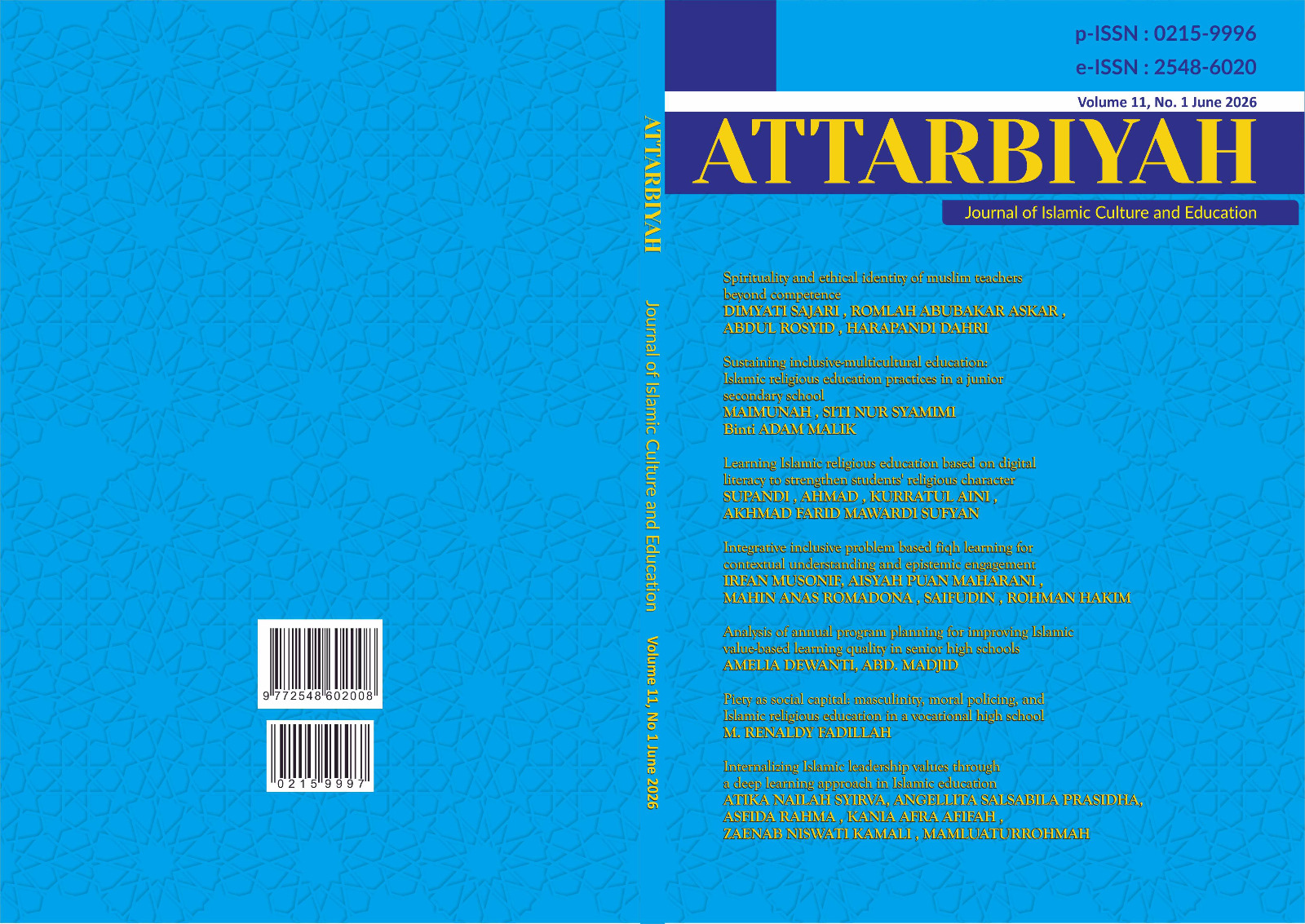
Spirituality and ethical identity of muslim teachers beyond competence
DOI:
https://doi.org/10.18326/attarbiyah.v11i1.1-18Kata Kunci:
spirituality , ethical identity, muslim teachers, Islamic education, professionalismAbstrak
Contemporary discussions on teacher professionalism are largely dominated by competence-based paradigms emphasizing technical skills, performance indicators, and measurable outcomes. Such approaches, while necessary, often marginalize the ethical and spiritual dimensions that sustain the moral integrity of teaching. Within Islamic educational thought, teaching is traditionally understood as a moral and spiritual vocation rather than a technical profession. This study examines the role of spirituality in shaping the ethical identity of Muslim teachers beyond competence-oriented frameworks. Employing a qualitative conceptual approach based on normative–philosophical analysis, this research synthesizes classical Islamic educational texts and contemporary scholarly literature on teacher ethics and spirituality. The findings reveal four interrelated dimensions that constitute ethical identity: spiritual intentionality (niyyah), moral exemplarity (uswah) grounded in adab, spiritual self- regulation, and service-oriented professionalism (khidmah and raḥmah). These dimensions form an integrated framework in which spirituality functions as a foundational orientation rather than a supplementary attribute. The study argues that pedagogical competence is ethically insufficient without spiritual grounding and offers a conceptual framework for teacher formation that integrates ethical integrity, resilience, and moral responsibility in contemporary educational contexts.
Referensi
Al-Attas, S. M. N. (1999). The Concept of Education in Islam: A Framework for an Islamic Philosophy of Education. ISTAC.
Al-Ghazālı,̄ A. Ḥāmid. (1962). The Book of Knowledge (N. A. Faris (Ed.)). Islamic Book Service.
Al-Ghazālı,̄ A. Ḥāmid. (2011). Iḥyāʾ ʿUlūm al-Dīn, Kitāb Riyāḍat al-Nafs wa-Tahdhīb al-Khuluq wa-Muʿālajat Amrāḍ al-Qalb. Dār al-Minhāj.
Al-Zarnūjı,̄ B. al-D. (2004). Taʿlīm Al-Mutaʿallim Ṭarīq Al-Taʿallum. Al-Dār al-Soudāniyah lil Kutub.
Asiah, N., Erfayliana, Y., Negara, H. S., & Desky, H. (2025). Integrating Spirituality, Ethics, and Innovation in Islamic Educational Leadership: A Holistic Model from Indonesian Secondary Education. Itqan: Jurnal Ilmu-Ilmu Kependidikan, 16(2), 178–196. https://doi.org/10.47766/itqan.v16i2.6751.
Biesta, G. (2009). Good education in an age of measurement: On the need to reconnect with the question of purpose in education. Educational Assessment, Evaluation and Accountability, 21(1), 33–46. https://doi.org/10.1007/s11092-008-9064-9.
Biesta, G. (2020). Risking Ourselves in Education Qualification, Socialization, and Subjectifification Revisited. Educational Theory, 70(1), 89–104. https://doi.org/10.1111/edth.12411.
Biesta, G., Priestley, M., & Robinson, S. (2015). The role of beliefs in teacher agency. Teachers and Teaching, 21(6), 624–640. https://doi.org/10.1080/13540602.2015.1044325.
Boylan, M., Adams, G., Perry, E., & Booth, J. (2023). Re-imagining transformative professional learning for critical teacher professionalism: a conceptual review. Professional Development in Education, 49(4), 651–669. https://doi.org/10.1080/19415257.2022.2162566.
Chaaban, Y., Alkhateeb, H., Abu-tineh, A., & Romanowski, M. (2023). Exploring teachers' perspectives on career development: Q methodology research. Teaching and Teacher Education, 122, 1–10. https://doi.org/10.1016/j.tate.2022.103987.
Cholili, A. H., K, M. N. Y., Amelia, N., Paputungan, R., Mahbubi, A. R., & Mubarok, A. S. (2025). Correlation Between Muraqabah and Self-control in Students Using Social Media. KnE Social Sciences The International Conference of Psychology, April 2024, 441–449. https://doi.org/10.18502/kss.v10i25.19919.
Coppe, T., Parmentier, M., Kelchtermans, G., Raemdonck, I., März, V., & Colognesi, S. (2024). Beyond traditional narratives about teacher professional development: A critical perspective on teachers' working life. Teaching and Teacher Education, 139, 1–15. https://doi.org/10.1016/j.tate.2023.104436.
Emans, A., Oolbekkink-Marchand, H., Bakker, C., & De Bruijn, E. (2024). Teacher agency in the dynamics of educational practices: a theory synthesis. Frontiers in Education, 9. https://doi.org/10.3389/feduc.2024.1515123.
Gilson, L. L., & Goldberg, C. B. (2015). So , What Is a Conceptual Paper? Group & Organization Management, 40(2), 127–130. https://doi.org/10.1177/1059601115576425.
Higgins, K. M. (2022). 6. Negative Virtues: Zhuangzi's Wuwei. In Philosophy Study (Vol. 12, Issue 6). https://doi.org/10.17265/2159-5313/2022.06.001.
Jaakkola, E. (2020). Designing conceptual articles: four approaches. AMS Review, 10, 18–26. https://doi.org/10.1007/s13162-020-00161-0.
Jabareen, Y. (2009). Building a Conceptual Framework: Philosophy, Definitions, and Procedure. International Journal of Qualitative Methods, 8(4), 49–62. https://doi.org/10.1177/160940690900800406.
Juharyanto, J., Rafidah, D., Lesmana, I., Kholish, A., & Shobiry, F. (2024). Escalating the Spirituality Values Integration into School Curriculum and Holistic Implementation : Strong Leadership Supports. Al-Tanzim: Jurnal Manajemen Pendidikan Islam, 08(04), 1070–1082. https://doi.org/10.33650/altanzim.v8i4.8497.
Kusters, M., Rushton, E. A. C., van der Rijst, R., & Admiraal, W. (2026). Relational dimensions of teacher agency: Five purposes for exercising agency in university. Teaching and Teacher Education, 176(September 2025). https://doi.org/10.1016/j.tate.2026.105467.
Leijen, Ä., Malva, L., Pedaste, M., & Mikser, R. (2022). What constitutes teachers' general pedagogical knowledge and how it can be assessed: A literature review. Teachers and Teaching, 28(2), 206–225. https://doi.org/10.1080/13540602.2022.2062710.
Mockler, N., & Groundwater-Smith, S. (2018). Questioning the Language of Improvement and Reform in Education: Reclaiming Meaning. In Questioning the Language of Improvement and Reform in Education: Reclaiming Meaning. https://doi.org/10.4324/9781315519579.
Mukadimah, H. (2025). Exploring Teacher Resilience in Indonesia: A Scoping Review of Challenges, Strategies, and Support Mechanisms. Jurnal Ilmiah WUNY, 7(2), 44–54. https://doi.org/10.21831/jwuny.v7i2.84213.
Najafov, R. (2025). Socio-psychological determinants of value development in students: A meta-analytical review of negative behaviors and the educational-social dynamic. Revista Mexicana de Investigación e Intervención Educativa, 4(3), 275–289. ttps://doi.org/10.62697/rmiie.v4i3.243.
Noddings, N. (2013). Caring: A relational approach to ethics and moral education: Second edition. In Caring: A Relational Approach to Ethics and Moral Education: Second Edition.
Payot, L. B., & Nebria, E. L. (2025). Spirituality as Mediator of Professional Identity and Personal Resilience of Teachers. European Journal of Education Studies, 12(8), 309–327. https://doi.org/10.46827/ejes.v12i8.6134.
Qamariah, H., & Herch, M. (2026). Mapping the Self: Exploring Teachers' Professional Identity and Development Through Ego-Centred Network Card Analysis. Education Sciences, 16(35), 1–22. https://doi.org/10.3390/educsci16010035.
Rawls, J. (1999). A Theory of Justice: Revised Edition. the belknap press of harvard university press.
Ruswandi, A. (2025). Students' Perceptions of Islamic Religious Education Teachers' Exemplary. Al-Hayat: Journal of Islamic Education, 9(4), 782–799. https://doi.org/10.35723/ajie.v9i4.198.
Sahin, A. (2018). Critical issues in islamic education studies: Rethinking islamic and western liberal secular values of education. Religions, 9(11). https://doi.org/10.3390/rel9110335.
Samad, S. A. A., Gade, S., Basri, H., Silahuddin, & Ariani, S. (2023). Teacher's Spiritual Competence and Its Implication in Islamic Religious Education Learning in Pidie, Aceh. Ulumuna, 27(2), 624–648. https://doi.org/10.20414/ujis.v27i2.710.
Szymańska, M. (2024). The Teacher Spiritual Development in the Reference to the Metaphorical Understanding of “Education as a Spiritual Journey” by Parker J. Palmer. Multidisciplinar y Journal of School Education, 13(25), 29–44. https://doi.org/10.35765/mjse.2024.1325.02.
Zuki, N. S. M., Hoque, M., & Mohamed, Y. (2024). The Role of Intention (Niyyah) in Education: Based on al-Quran and Sunnah. Al-Azkiyaa - International Journal of Language and Education, 3(2), 207–219. https://doi.org/10.33102/alazkiyaa95.
Unduhan
Diterbitkan
Cara Mengutip
Terbitan
Bagian
Lisensi
Hak Cipta (c) 2026 Dimyati Sajari, Askar, Rosyid, Harapandi Dahri

Artikel ini berlisensiCreative Commons Attribution-ShareAlike 4.0 International License.