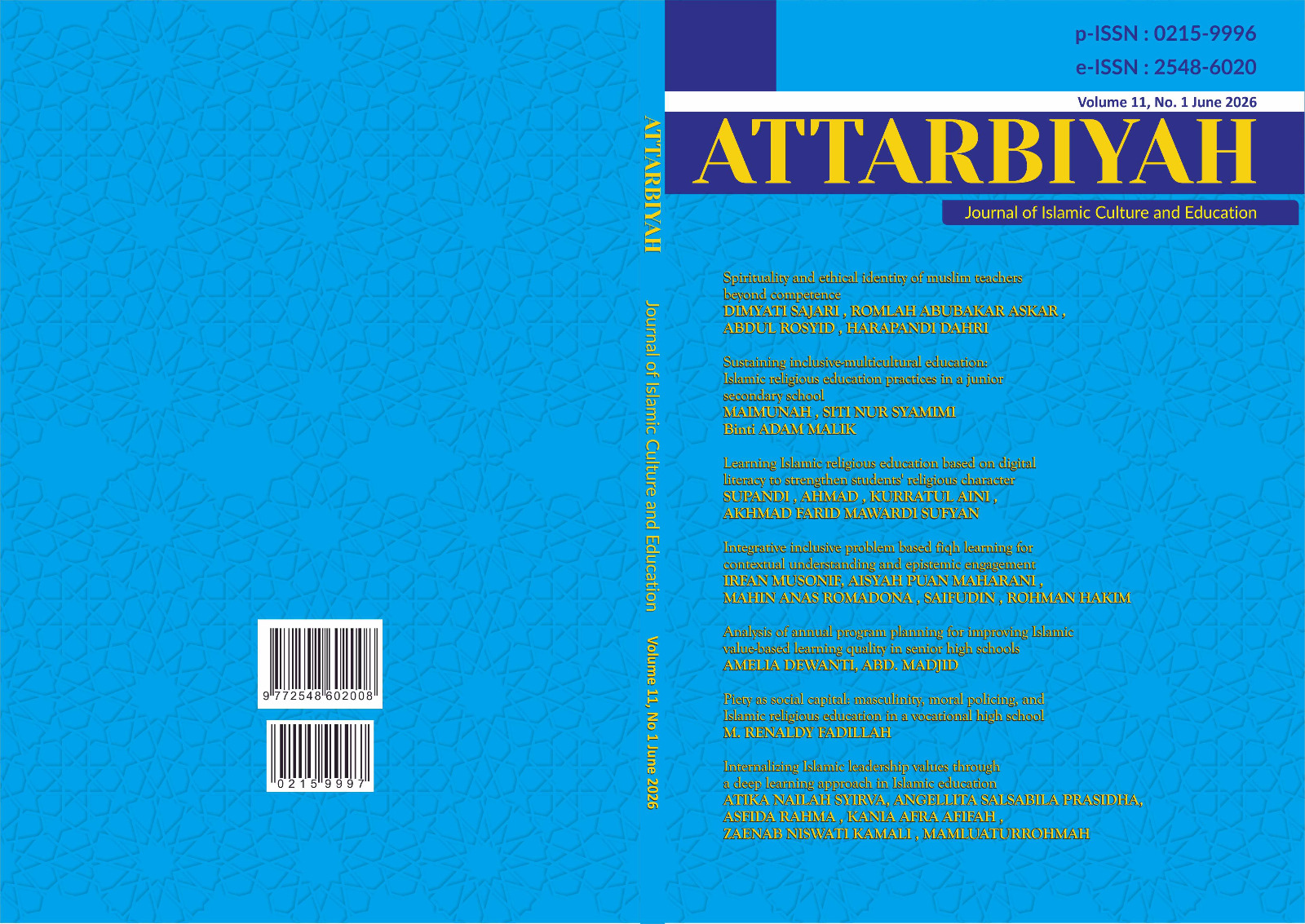
Integrative inclusive problem based fiqh learning for contextual understanding and epistemic engagement
DOI:
https://doi.org/10.18326/attarbiyah.v11i1.63-81Kata Kunci:
fiqh education, problem-based learning, inclusive pedagogy, epistemic tension, contextual understandingAbstrak
The dominance of text-centered and normative pedagogies in Islamic religious education often limits students' ability to engage critically, contextually, and inclusively with fiqh learning. This study examines how an integrative–inclusive problem-based learning model can transform fiqh learning toward more contextual and interpretive engagement. Using a qualitative case study design, the research was conducted in an eleventh-grade classroom at a Madrasah Aliyah in Indonesia from January to February 2026, involving one teacher and 32 students. Data were collected through classroom observations, semi-structured interviews, and document analysis, then analyzed using reflexive thematic analysis. The findings reveal that fiqh learning exists within a transitional space where normative transmission coexists with emerging contextual approaches. Problem-based learning increases student engagement and supports contextual reasoning, although its implementation remains situational rather than systematically embedded. The study also identifies a gap between procedural and epistemic inclusion, indicating that classroom participation does not necessarily ensure equitable knowledge construction. Furthermore, epistemic tension between normative legalism and contextual meaning-making emerges as a productive aspect of learning. This study contributes to Islamic education discourse by introducing the concepts of closed epistemic structures, situated pedagogical innovation, and productive epistemic friction as frameworks for reflective and context-responsive fiqh learning.
Referensi
Abdurrahman, M. S., Abdullah, A. H., Shamsuddin, N. S., Rahman, S. N. S. A., Ashari, Z. M., Jumaat, N. F., Samah, N. A. S., & Ali, D. F. (2020). Pupil's behaviour pattern and non-routine mathematical problem-solving strategy based on multiple intelligences. Journal of Advanced Research in Dynamical and Control Systems, 12(3), 466–485. https://doi.org/10.5373/JARDCS/V12I3/20201214.
Ahmad, B. K. (2015). Educational practice: Lessons to be learned from madrasah and religious schools in contemporary Southeast Asia. Indonesian Journal of Islam and Muslim Societies, 5(1), 29–48. https://doi.org/10.18326/ijims.v5i1.29-48.
Ainscow, M. (2020). Promoting inclusion and equity in education: Lessons from international experiences. Nordic Journal of Studies in Educational Policy, 6(1), 7–16. https://doi.org/10.1080/20020317.2020.1729587.
Alkouatli, C. (2018). Pedagogies in Becoming Muslim: Contemporary Insights from Islamic Traditions on Teaching, Learning, and Developing. In Religions (Vol. 9, Number 11, p. 367). https://doi.org/10.3390/rel9110367.
Anugrah, D. S., Supriadi, U., Anwar, S., & Muhammad Lathif, N. (2025). Integrating Problem-Based Learning With Islamic Practice: a Systematic Review of Educational Outcomes and Religious Engagement. Al-Qalam, 31(1), 1–19. https://doi.org/10.31969/alq.v31i1.1606.
Arizona, K., Rokhmat, J., Ramdani, A., Gunawan, G., & Sukarso, A. A. (2025). Integrating Islamic Values and Local Wisdom into Science Education: Enhancing Character Development in Higher Education. Ulumuna, 29(1 SE-Articles). https://doi.org/10.20414/ujis.v29i1.1308.
Azis, D. K., Musonif, I., Salsabila, S., Fatah, M. A., & Aji, M. (2026). Integrating Artificial Intelligence And Humanistic Values In Islamic Elementary Education : A Case Study At Madrasah Ibtidaiyah NU Ma'Arif Karangnangka. Edukasi Islami: Jurnal Pendidikan Islam, 15(02), 635–654. https://doi.org/10.30868/ei.v15i02.10039.
Biesta, G. (2020). Risking ourselves in education: Qualification, socialization, and subjectification revisited. Educational Theory, 70(1), 89–104. https://doi.org/10.1111/edth.12411.
Braun, V., & Clarke, V. (2021). Thematic analysis: A practical guide. SAGE.
Chen, C.-H., Hung, H.-T., & Yeh, H.-C. (2021). Virtual reality in problem-based learning contexts: Effects on the problem-solving performance, vocabulary acquisition and motivation of English language learners. Journal of Computer Assisted Learning, 37(3), 851–860. https://doi.org/https://doi.org/10.1111/jcal.12528.
Chen, Y., Hmelo-Silver, C. E., Lajoie, S. P., Zheng, J., Huang, L., & Bodnar, S. (2021). Using Teacher Dashboards to Access Group Collaboration in Problem-based Learning. Interdisciplinary Journal of Problem-Based Learning, 15(2). https://doi.org/10.14434/ijpbl.v15i2.28792.
Dolmans, D. H. J. M., Loyens, S. M. M., Marcq, H., & Gijbels, D. (2016). Deep and surface learning in problem-based learning: a review of the literature. Advances in Health Sciences Education, 21(5), 1087–1112. https://doi.org/10.1007/s10459-015-9645-6.
Fahrezi, F., Athoillah, M. I., A'yun, S. Q., Hasanah, U., & Musonif, I. (2026). Psychosocial Adaptation Of Santri From Dysfunctional Families In Islamic Boarding Schools: A Humanistic Educational Approach. Jurnal Ilmiah IJGIE, 6(2), 399–417. http://webcache.googleusercontent.com/search?q=cache:wyUyNvdZOGYJ:journal.iaisambas.ac.id/index.php/IJGIE/ar ticle/download/113/182/+&cd=1&hl=id&ct=clnk&gl=id.
Fahrezi, F., Musonif, I., Labibah, H. S., Athoillah, M. I., & Munip, A. (2026). A Psycho-Sociolinguistic-Based Project-Based Learning Model For Arabic Language Learning : A Case Study At Mts Al-Ma ' Arif Rakit. Abjadia : International Journal of Education, 11(1), 143–154. https://doi.org/10.18860/abj.v11i1.39835.
Florian, L., & Black-Hawkins, K. (2011). Exploring inclusive pedagogy. British Educational Research Journal, 37(5), 813–828. https://doi.org/10.1080/01411926.2010.501096.
Halstead, J. M. (2018). Islamic Education in the West and Its Challenges BT - Handbook of Contemporary Islam and Muslim Lives (M. Woodward & R. Lukens-Bull, Eds.; pp. 1–15). Springer International Publishing. https://doi.org/10.1007/978-3-319-73653-2_51-2.
Ilham, D. (2020). The challenge of Islamic education and how to change. International Journal of Asian Education.
Kamali, M. H. (2021). Maqasid al-Shariah: Made simple. Islamic Texts Society. https://its.org.uk/catalogue/maqasid-al-shariah-made-simple/
Lincoln, Y. S., & Guba, E. G. (2020). Naturalistic inquiry. SAGE Publications. https://doi.org/https://doi.org/10.1016/B978-0-08-044894-7.01533-0.
Maharani, A. P., & Musonif, I. (2026). Model Pembelajaran Berbasis Media Interaktif untuk Meningkatkan Keterampilan Kritis Siswa di Sekolah. An-Nahdlah: Jurnal Pendidikan Islam, 5(3 SE-Articles), 1065–1073. https://doi.org/10.51806/an-nahdlah.v5i3.872.
Mardiana, D., Razaq, Abd. R., & Umiarso, U. (2020). Development of Islamic Education: The Multidisciplinary, Interdisciplinary and Transdisciplinary Approaches. Al-Hayat: Journal of Islamic Education; Vol 4 No 1 (2020): Al-Hayat: Journal of Islamic EducationDO - 10.35723/Ajie.V4i1.97 . https://www.alhayat.or.id/index.php/alhayat/article/view/97.
Musonif, I., & Azis, D. K. (2026). Teori-Teori Pendidikan Integratif Educating the Whole Person. In Qriset indonesia. Qriset Indonesia. https://qrisetindonesia.com/buku/teori-teori-pendidikan-integratif-educating-the-whole-person/.
Musonif, I., Baeti, A. N., Athoillah, M. I., Azis, D. K., & Fahrezi, F. (2026). Religious Habitus Formation Through Madrasah-Pesantren Collaboration: A Sociological Analysis. Jurnal Ilmiah IJGIE International Journal Of Graduate Of Islamic Education, 7(1), 399–417. https://doi.org/https://doi.org/10.37567/ijgie.v7i1.4892.
Musonif, I., & Misbah, M. (2026). A Conceptual Model of Integrating Deliberative Transformative and Authentic Learning in Multicultural Religious Education. Kasyafa: Jurnal Pendidikan Agama Islam, 3(2 SE-Articles), 181–193. https://doi.org/10.61166/kasyafa.v3i2.164.
Musonif, I., Pranoto, A. H., Nurhuda, A., & Munis, I. D. (2026). The Relevance Of Human Nature In Islam To Education And The Modern Era. Journal of Social Research and Innovation, 2(1), 1–7.
Musonif, I., Romadona, M. A., Fatah, M. A., Zaman, M. F., Azis, K., & Nasrin, S. (2026). Integrating Multiple Intelligences in Problem-Solving Approaches to Enhance Fiqh Learning for Middle School Students. Al-Tadzkiyyah: Jurnal Pendidikan Islam, 17(1), 1–15. https://doi.org/https://doi.org/10.24042/atjpi.v17i1.30145.
Musonif, I., Salsabila, S., Syifa, R. N., & Azis, D. K. (2026). Reconstructing the Meaning of Fiqh Learning through Accelerated and Quantum Learning in the Digital Generation. Al-Afkar, Journal For Islamic Studies, 9(2 SE-Articles), 2191–2205. https://doi.org/10.31943/afkarjournal.v9i2.3455.
Panjwani, A. A. (2020). Perspectives on Inclusive Education: Need for Muslim Children's Literature. In Religions (Vol. 11, Number 9, p. 450). https://doi.org/10.3390/rel11090450.
Patton, M. Q. (2020). Qualitative research & evaluation methods (4th ed.). SAGE Publications. https://us.sagepub.com/en-us/nam/qualitative-research-evaluation methods/book232962.
Ramadona, M. A., Musonif, I., & Priyatno, S. (2026). Muslim Students In Catholic Religious Education In Indonesia: Interfaith Learning And Socio-Religious Identity Negotiation. Jurnal Ilmiah IJGIE, 6(2), 399–417. http://webcache.googleusercontent.com/search?q=cache:wyUyNvdZOGYJ:journal.iaisambas.ac.id/index.php/IJGIE/article/download/113/182/+&cd=1&hl=id&ct=clnk&gl=id.
Sahin, A. (2018). Critical Issues in Islamic Education Studies: Rethinking Islamic and Western Liberal Secular Values of Education. In Religions (Vol. 9, Number 11, p. 335). https://doi.org/10.3390/rel9110335.
Saifudin, Aji, M., Musonif, I., Darmawan, Z. G., & Maharani, A. P. (2026). Between Adab And Digital Learning: A Qualitative Case Study In Indonesian Pesantren-Based Madrasah. Jurnal Ilmiah IJGIE, 6(2), 399–417. http://webcache.googleusercontent.com/search?q=cache:wyUyNvdZOGYJ:journal.iaisambas.ac.id/index.php/IJGIE/article/download/113/182/+&cd=1&hl=id&ct=clnk&gl=id.
Saiin, A., Mohd Faizulamri Mohd Saad, & Humaira Ahmad. (2025). Fiqh of Moderation: An Inclusive, Flexible, and Contextual Approach for Contemporary Muslim Societies. Al-Wasatiyah: Journal of Religious Moderation, 4(1), 144–162. https://doi.org/10.30631/jrm.v4i1.74.
Selwyn, N. (2021). Education and technology. Bloomsbury.
Yin, R. K. (2021). Case study research and applications: Design and methods (6th ed.). SAGE. Publications. https://us.sagepub.com/en-us/nam/case-study-research-and-applications/book250150
Unduhan
Diterbitkan
Cara Mengutip
Terbitan
Bagian
Lisensi
Hak Cipta (c) 2026 Irfan Musonif, Aisyah Puan Maharani, Mahin Anas Ramadona, Saifudin, Rohman Hakim

Artikel ini berlisensiCreative Commons Attribution-ShareAlike 4.0 International License.