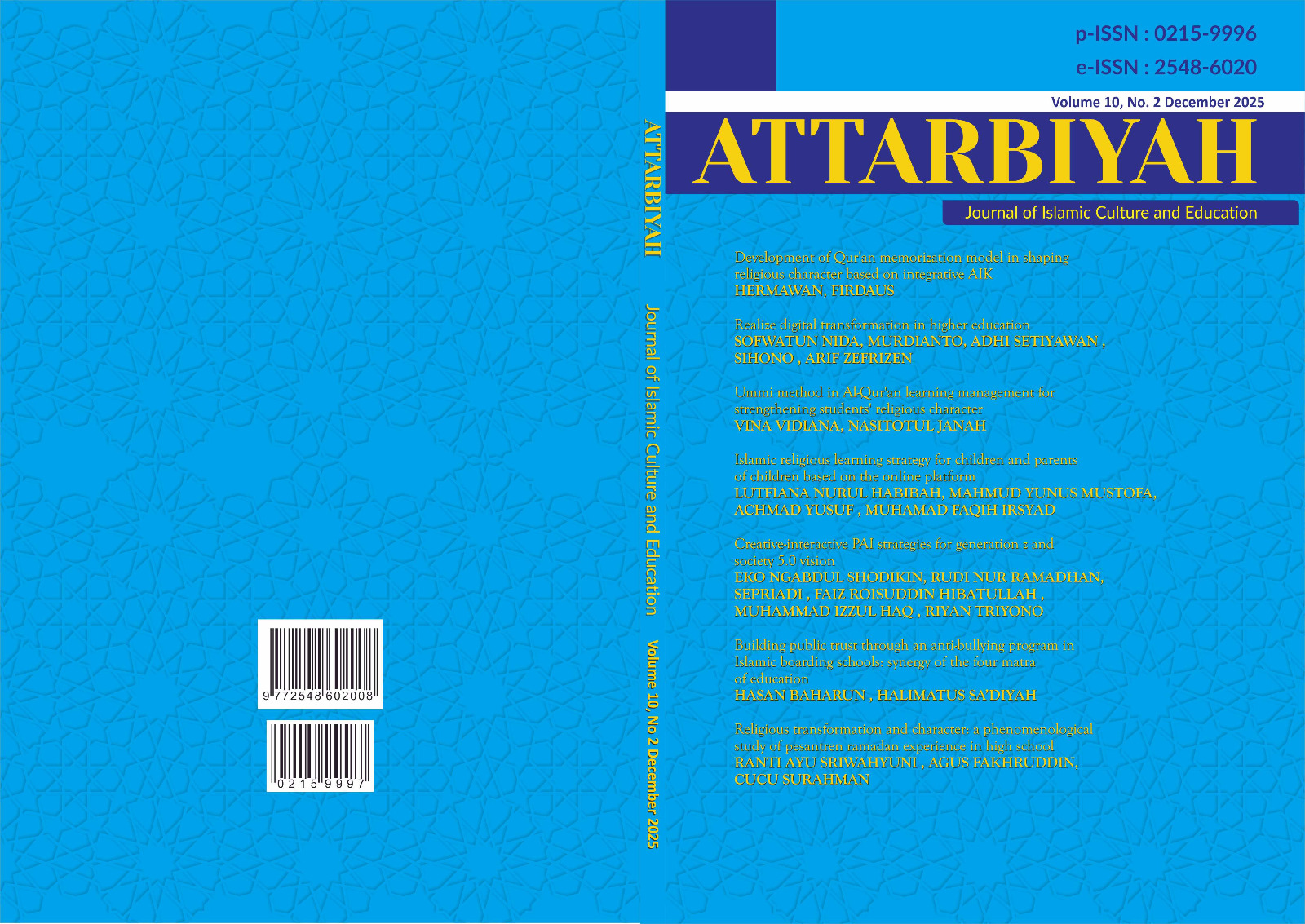
Creative-interactive PAI strategies for generation z and society 5.0 vision
DOI:
https://doi.org/10.18326/attarbiyah.v10i2.189-203Kata Kunci:
Creative-Interactive Strategy, PAI, Generation Z Society 5.0Abstrak
This study examines the use of creative–interactive Islamic Education (PAI) strategies through social projects in a junior high school context. The approach aims to internalize religious values, increase student engagement, and align learning with the human-centered principles of Society 5.0. An exploratory qualitative single-case study was conducted at SMP Muhammadiyah Panggang involving 11 participants (two teachers and nine students) selected through purposive maximum variation sampling. Data were obtained from interviews, observations, and learning artifacts, and were analyzed thematically with credibility ensured through member checking and an audit trail. The findings show that social projects shifted PAI learning from passive knowledge delivery to an action–reflection–meaning cycle. Students displayed strong participation, collaboration, creativity, and improved digital skills through poster production, slogan creation, and video documentation. The value “cleanliness is part of faith” was internalized and sustained in daily behavior. Teachers considered this strategy highly suitable for Generation Z and consistent with Society 5.0, although successful implementation requires coordination, adequate time, and standardized authentic assessment.
Referensi
Abdul Jaleel, K. A., Abdul Khader Aneesh, A., Shahid, M., Abdul Rasheed, K. M., Razeena, S., Mubeena, M., & Nubeera, M. (2024). Cultivating Knowledge: A Comprehensive Examination of Madrasa Education System in India. In The AI Revolution: Driving Business Innovation and Research: Volume 2 (pp. 787-801). Cham: Springer Nature Switzerland. https://doi.org/10.1007/978-3-031-54383-860
Alimni, A., Amin, A., & Kurniawan, D. A. (2022). The role of Islamic education teachers in fostering students’ emotional intelligence. International Journal of Evaluation and Research in Education, 11(4), 1881–1892. https://doi.org/10.11591/ijere.v11i4.22116
Amalia, E. R., Dwi Bhakti Indri, M., Khoiriyati, S., Ummah, N., Oviani, M., Wardhani, J. K., & Umayyah, U. (2024). Bridging Educational Reform and Faith: Evaluating Kurikulum Merdeka’s Compatibility with Islamic Values in Madrasahs. Munaddhomah, 5(4), 483–500. https://doi.org/10.31538/munaddhomah.v5i4.1413
Aprilianto, D., Aslamiyah, S. S., Zahidi, S., Crisnasari, N. A., & Hidayatussholihah, R. (2025). Generation Z’s Perception of Religious Tolerance and Implementing Islamic Law in Indonesia. Al-Istinbath: Jurnal Hukum Islam, 10(1), 194–218. https://doi.org/10.29240/jhi.v10i1.11962
Asri, S., & Kaplan, İ. (2023a). Content Evaluation of Faith-Related Units in Secondary School Religious Culture and Moral Knowledge Textbooks; Ortaokul Din Kültürü ve Ahlak Bilgisi Ders Kitaplarında İnançla İlgili Ünitelerin İçerik Değerlendirmesi. Hitit Theology Journal, 22(2), 803–833. https://doi.org/10.14395/hid.1338663
Asri, S., & Kaplan, İ. (2023b). Content Evaluation of Faith-Related Units in Secondary School Religious Culture and Moral Knowledge Textbooks. Hitit Theology Journal, 22(2), 803–833. https://doi.org/10.14395/hid.1338663
Asrori, M., Asy’arie, B. F., Akhirudin, Yusup Sofian, G., Syakir Hidayat, A. F., Suja, A., & Roibin. (2025). Islamic educational and cultural values in Indonesian puppetry art: a systematic literature review. Cogent Education, 12(1). https://doi.org/10.1080/2331186X.2025.2490445
Aydinli, F. (2025). Insights into the Field Diary of the Research Project “Islamic Religious Education: a Medium for Social Integration or Islamist Radicalization?” Journal of Muslims in Europe, 14(2), 227–239. https://doi.org/10.1163/22117954-bja10128
Azman, N. A., Hamzah, M. I. Bin, & Baharudin, H. (2025). Digital Teaching Strategies of Islamic Education Teachers: A Case Study in Primary Schools. International Journal of Learning, Teaching and Educational Research, 24(3), 562–585. https://doi.org/10.26803/ijlter.24.3.27
Barus, J., Husaini, Ja’far, J., & Noor, U. M. (2024). ISLAMIC HIGHER EDUCATION IN POST-CONFLICT ACEH: Generation Z Students, Religious Knowledge and Professional Interests. Miqot: Jurnal Ilmu-Ilmu Keislaman, 48(1), 126–145. https://doi.org/10.30821/miqot.v48i1.836
Bhatnagr, P., & Rajesh, A. (2024). Artificial intelligence features and expectation confirmation theory in digital banking apps: Gen Y and Z perspective. Management Decision. https://doi.org/10.1108/MD-07-2023-1145
Creswell W. J. and Creswell J. D. (2018). Qualitative, quantitative, and mixed methods approaches. Research Design Qualitative Quantitative and Mixed Methods Approaches. In Research Design (Vol. 5, Issue June). SAGE Publications.
Gall, J. P., Gall, M. D., & Borg, W. R. (2013). Applying Educational Research: How to Read, Do, and Use Research to Solve Problems of Practice: Pearson New International Edition. Pearson Education. https://books.google.co.id/books?id=Kj-pBwAAQBAJ
Gonibala, M. L. (2022). Integrasi Nilai-Nilai Moderasi Beragama pada Mata Pelajaran PAI dan Budi Pekerti di SMA Kelas X. Journal of Islamic Education Policy, 7(1), 68–79. http://dx.doi.org/10.30984/jiep.v7i1.1905
Hadi, A. (2021). Penelitian kualitatif studi fenomenologi, case study, grounded theory, etnografi, biografi. CV. Pena Persada.
Hoang, L. P., Le, P. A., Le, H., Nguyen, D. T., Phan, T., Le, H., van Tran, H., & Tran-Duong, Q. H. (2025). Evaluating educational assessment competence of pre-service teachers: extended standards in the context of digital classroom assessment transformation. Education and Information Technologies, 30(12), 16347–16374. https://doi.org/10.1007/s10639-025-13467-y
Hussien, S. B., Wahab, M. K. A., & Hashim, R. (2021). Improving Students’ Inquiry Skills In Islamic Education Through Hikmah Pedagogy And Community Of Inquiry. Malaysian Journal of Learning and Instruction, 18(2), 189–214. https://doi.org/10.32890/mjli2021.18.2.7
Kamarudin, N. S., & Hishamudin, M. Z. (2024). Digital Dilemmas and Solutions: Addressing Financial Challenges and Exploring Islamic Educational Platforms. 117–150. https://doi.org/10.4018/979-8-3693-5653-1.ch005
Kistoro, H. C. A., Ru’iya, S., Husna, D., & Burhan, N. M. (2022). Dynamics of the Implementation of Experience-Based Religious Learning in Indonesian and Malaysian Senior High Schools. Jurnal Pendidikan Agama Islam, 19(2), 283–296. https://doi.org/10.14421/jpai.2022.192-08
Miftakhuddin, M. (2020). Pengembangan Model Pendidikan Agama Islam dalam Membentuk Karakter Empati pada Generasi Z. Jurnal Pendidikan Agama Islam, 17(1), 1–16. https://doi.org/10.14421/jpai.2020.171-01
Nahar, S., Suhendri, undefined, Zailani, Z., & Hardivizon, H. (2022). Improving Students’ Collaboration Thinking Skill under the Implementation of the Quantum Teaching Model. International Journal of Instruction, 15(3), 451–464. https://doi.org/10.29333/iji.2022.15325a
Rashed, Z. N., Zhaffar, N. M., Ihwani, S. S., & Iswantir, M. (2025). Driving Islamic Education in the Era of the Industrial Revolution 4.0: Challenges and Strategies. Global Journal Al-Thaqafah, 15(1), 18–33. https://doi.org/10.7187/GJAT072025-2
Razali, R., Sundana, L., & Ramli, R. (2024). Curriculum Development in Higher Education in Light of Culture and Religiosity: A Case Study in Aceh of Indonesia. International Journal of Society, Culture and Language, 12(1), 39–55. https://doi.org/10.22034/ijscl.2023.2010108.3144
Rosanawati, I. M. R., Warto, W., Djono, D., & Purwanta, H. (2025). Pedagogical Model Innovation Based on Ki Hajar Dewantara’s Among System for History Learning in the Merdeka Curriculum. Educational Process: International Journal, 14. https://doi.org/10.22521/edupij.2025.14.39
Prasetyo, M. P. S., & Halida, R. (2020). The correlation between perceptual threats to religious identity with conservatism for Indonesian Muslims.
Shaleh, M., Tobroni, Mundir, & Umiarso, U. (2024). Development of a Holistic-integrative Islamic Religious Education Curriculum in an Integrated Islamic School. Eurasian Journal of Educational Research, 2024(113), 227–241. https://doi.org/10.14689/ejer.2024.113.13
Sharma, B., Roy, A., & Rautray, P. (2020). A practice-based approach to design education. https://doi.org/10.35199/NORDDESIGN2020.27
Sugiyono. (2018). Metode Penelitian Pendidikan Pendekatan Kuantitatif, Kualitatif, dan R&D. Alfabeta.
Taufiqurrochman, R. (2025). Linking Environmental Education and Arabic Language Teaching: Curriculum Analysis of Madrasa and Pesantren in Indonesia. Studia Ecologiae et Bioethicae, 23(2), 73–85. https://doi.org/10.21697/seb.2024.5845
Wedi, A., Mardiana, D., & Umiarso, U. (2025). Digital Transformation Model of Islamic Religious Education in the AI Era: A Case Study of Madrasah Aliyah in East Java, Indonesia. International Journal of Learning, Teaching and Educational Research, 24(8), 842–863. https://doi.org/10.26803/ijlter.24.8.37
Unduhan
Diterbitkan
Cara Mengutip
Terbitan
Bagian
Lisensi
Hak Cipta (c) 2025 Eko Ngabdul Shidikin, Rudi Nur Ramadhan, Sepriadi, Faiz Roisuddin Hibatullah, Muhammad Izzul Haq, Riyan Triyono

Artikel ini berlisensiCreative Commons Attribution-ShareAlike 4.0 International License.