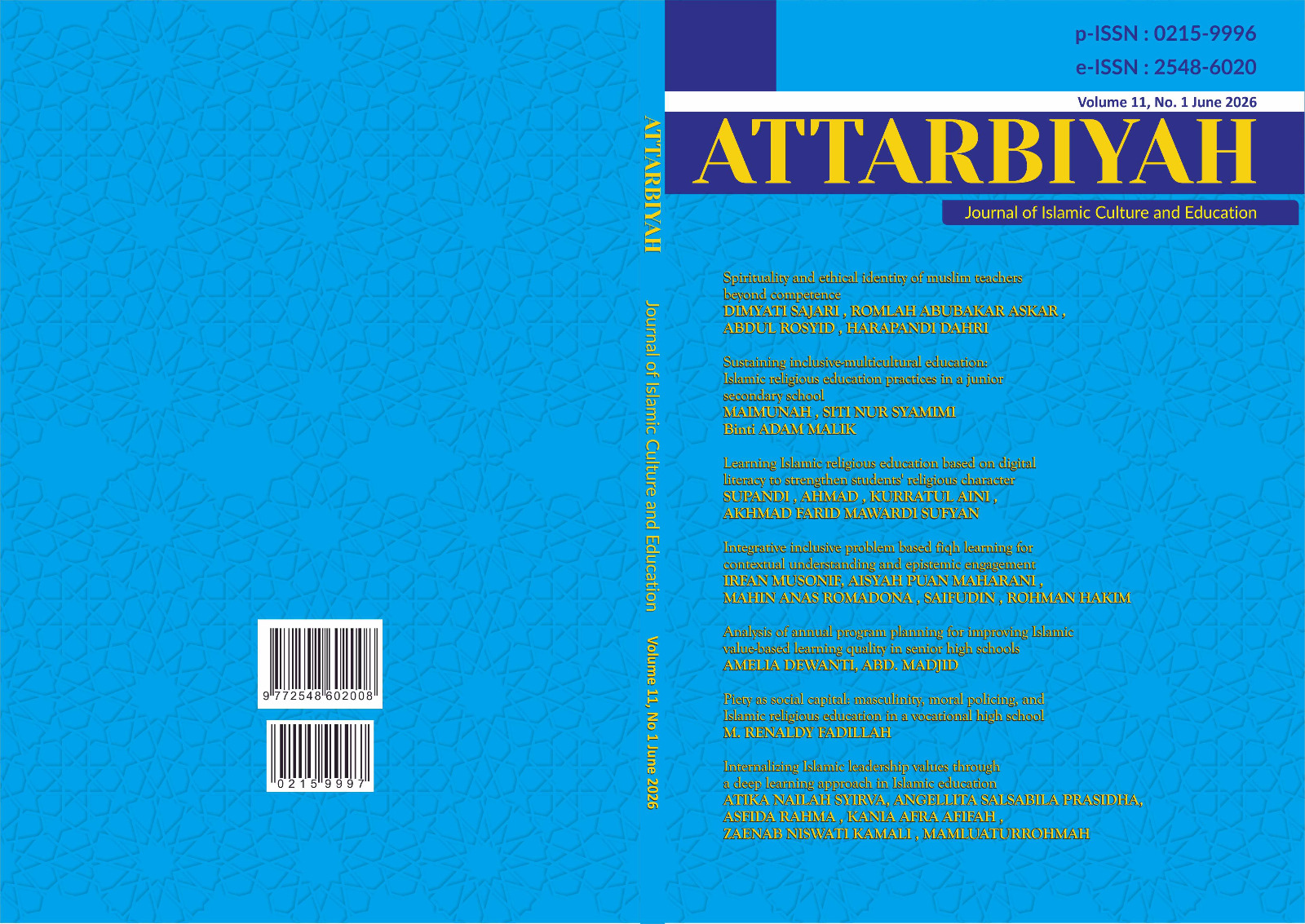
Learning Islamic religious education based on digital literacy to strengthen students' religious character
DOI:
https://doi.org/10.18326/attarbiyah.v11i1.41-62Keywords:
digital literacy, Islamic religious education, CharacterAbstract
This study analyzes the contribution of digital literacy-based Islamic Religious Education (IRE) learning to strengthening students' religious character at the Ummul Quro Putri Pamekasan Islamic Boarding School, Madura. Using a mixed-method sequential explanatory design, the study involved 100 student respondents in the quantitative phase and five informants in the qualitative phase, including a pesantren administrator, two IRE teachers, and two students. Quantitative data were collected through Likert-scale questionnaires and analyzed using Partial Least Squares Structural Equation Modeling, while qualitative data were obtained through semi-structured interviews and analyzed thematically. The findings show that digital literacy significantly influences digital literacy-based IRE learning, which in turn strengthens students' religious character. Mediation analysis confirms that IRE learning acts as a significant mediator between digital literacy and religious character. Qualitative findings reveal that character strengthening is supported through teacher guidance, credible Islamic digital sources, digital tabayyun practices, ethical media use, and pesantren culture emphasizing discipline, responsibility, worship awareness, and moral conduct. This study positions digital literacy as a critical, ethical, and religious pedagogical strategy for developing digitally and morally competent Muslim students
References
Ahmadi, A., Al-faini, A. F., Mun'im, M. A., & Jannah, S. (2025). Membangun Ekosistem Pendidikan Digital Di Pesantren: Bukti Empiris Dari Tmi Al-Amien Prenduan. Dirosat: Journal of Islamic Studies, 10(1), 111-124. https://doi.org/10.28944/dirosat.v10i1.2126.
Aisha, N., Mahilan, A., & Saefullah, A. (2025). Transformasi budaya organisasi dan dampaknya terhadap kinerja bisnis: Strategi adaptasi di era ekonomi digital. RIGGS: Journal of Artificial Intelligence and Digital Business, 4(3), 6196-6204. https://doi.org/10.31004/riggs.v4i3.2911.
All, M. A. A. H., Suhaeb, F. W., & Idrus, I. I. (2025). Penguatan Pendidikan Moderasi Beragama: Strategi Membangun Generasi Muda yang Toleran dan Inklusif di Era Disrupsi Digital. J-CEKI: Jurnal Cendekia Ilmiah , 4(4) , 679-680. https://doi.org/https://doi.org/10.56799/jceki.v4i4.8789.
Amin, M. S. (2025). Pengaruh Algoritma Media Sosial Terhadap Narasi keislaman di Ruang Digital. El-Wasathy: Journal of Islamic Studies, 3(1), 148-158. https://doi.org/https://doi.org/10.61693/elwasathy.vol31.2025.148-158.
Ammenwerth, E., Iller, C., & Mansmann, U. (2003). Can evaluation studies benefit from triangulation? A case study. International journal of medical informatics, 70(2-3), 237-248. https://doi.org/10.1016/S1386-5056(03)00059-5.
Asaniyah, N. (2017). Pelestarian informasi koleksi langka: Digitalisasi, restorasi, fumigasi. Buletin Perpustakaan(57), 85-94. https://journal.uii.ac.id/Buletin Perpustakaan/article/view/9105.
Aslan, A., & Pong, K. S. (2023). Understanding the Trend of Digital Da'wah Among Muslim Housewives in Indonesia. Fikroh: Jurnal Pemikiran Dan Pendidikan Islam, 16(1), 11-22. ttps://doi.org/10.37812/FIKROH.V16I1.681.
Aulia, F., & Arifin, F. (2023). Moderasi Beragama Dalam Ruang Digital: Studi Harmonisasi Moderasi Beragama Di Perguruan Tinggi Keagamaan Islam Negeri. MODERATIO: Jurnal Moderasi Beragama, 3(2), 205-217. https://doi.org/https://doi.org/https://doi.org/10.37302/jbi.v13i1.182.
Azzahra, F., Sunendar, D., & Fairus, F. (2025). Redesigning Gambar Lucu Mika Book to Enhance Digital Literacy Competencies. JPUD-Jurnal Pendidikan Usia Dini, 19(1), 60- 65. https://www.komdigi.go.id/berita/pengumuman/detail/digitalisasi-madrasah-tingkatkan-standar-mutu-dan-kualitas.
Bollard, S. M., Casalou, C., Howard, J., O'Donnell, K., Wynne, K., Yin, X., Brennan, L., Tobin, D., Kelly, P., & McCann, A. (2023). 1196 Circulating extracellular vesicles of patients with melanoma differ in concentration and composition compared to healthy controls. Journal of Investigative Dermatology, 143(5), S205. https://www. jidonline.org/article/S0022-202X(23)01385-4/fulltext.
Chan, S. H., & Lay, Y. F. (2018). Examining the reliability and validity of research instruments using partial least squares structural equation modeling (PLS-SEM). Journal of Baltic Science Education, 17(2), 239-251. https://www.ceeol.com/search/article-detail?id=966981.
Da Silva, F. P., Jerónimo, H. M., Henriques, P. L., & Ribeiro, J. (2024). Impact of digital burnout on the use of digital consumer platforms. Technological Forecasting and Social Change, 200, 123172.
Falloon, G. (2020). From digital literacy to digital competence: the teacher digital competency (TDC) framework. Educational technology research and development, 68(5), 2449-2472. https://link.springer.com/article/10.1007/S11423-020-09767-4.
Fauzi, A., Khasanah, U., Sada, H. J., Bahri, S., Octafiona, E., & Azizah, N. (2025). Learning Independence: How Correlation is the Innovation of PAI Learning through the Digital Literacy Program? JIIP-Jurnal Ilmiah Ilmu Pendidikan, 8(1), 91-100. https://doi.org/10.54371/jiip.v8i1.6521.
Gaol, R. L., & Hutasoit, R. (2021). Media sosial sebagai ruang sakral: Gereja yang bertransformasi bagi perkembangan spiritualitas generasi Z dalam era digital. KENOSIS: Jurnal Kajian Teologi, 7(1), 146-172. https://doi.org/10.37196/kenosis.v1i1.284.
Khorsan, R., & Crawford, C. (2014). External validity and model validity: A conceptual approach for systematic review methodology. Evidence-Based Complementary and Alternative Medicine, 2014(1), 694804. https://doi.org/10.1155/2014/694804.
Lenzerini, M. (2002). Data integration: A theoretical perspective. Proceedings of the twenty-first ACM SIGMOD-SIGACT-SIGART symposium on Principles of database systems.
Miftahussurur, W. (2026). Reconstructing Islamic Education Pedagogy in The Digital Age: Integrating Spiritual Ethics and Digital Literacy. Syaikhona: Jurnal Magister Pendidikan Agama Islam, 4(1), 137-153. https://doi.org/10.59166/syaikhona.v4i1.450.
Miles, M. B., & Huberman, A. M. (1994). Qualitative data analysis: An expanded sourcebook. Sage.
Moleong, L. (2004). Lexy J Moleong, Metodologi Penelitian Kualitatif. Remaja Rosda Karya. Nasution, H. S., Basri, H., Batubara, W. W., &
Mukhlasin, A. (2025). Islamic education teachers strategies for character building through digital literacy based Islamic values in the Society 5.0 era. Fitrah: Journal of Islamic Education, 6(1), 259-271. https://doi.org/10.53802/fitrah.v6i1.1172.
Nurlan, F. (2019). Metodologi penelitian kuantitatif. CV. Pilar Nusant ara. https://books.google.co.id/books?id=OXYqEAAAQBAJ.
Pratiwi, N., Soraya, S. Z., & Daryono, R. W. (2024). Teacher competence and religious character on learning achievement: The mediating role of islamic extracurriculars. FITRAH: Jurnal Kajian Ilmu-Ilmu Keislaman, 10(1), 79-98. https://doi.org/10.24952/fitrah.v10i1.10906.
Purnama, S., Ulfah, M., Machali, I., Wibowo, A., & Narmaditya, B. S. (2021). Does digital literacy influence students' online risk? Evidence from Covid-19. Heliyon, 7(6). https://www.cell.com/heliyon/fulltext/S2405-8440(21)01509-7.
Rahadi, D. (2023). Pengatar Partial Least Square Strctural Equation Model (PLS SEM). Lentara Ilmu Madani.
Ravindran, V. (2019). Data analysis in qualitative research. Indian Journal of Continuing Nursing Education, 20(1), 40-45. https://doi.org/10.4103/IJCN.IJCN_1_19.
Siskandar, S., Shunhaji, A., & Nurtianty, T. (2025). Boarding School Caregivers' Parenting Patterns in Shaping Students' Religious Character: A Qualitative Study at SMP Insan Cendekia Madani. AL -ISHLAH: Jurnal Pendidikan, 17(3), 5059-5067. https://doi.org/10.35445/alishlah.v17i3.7029.
Sugianto, E. (2024). The role of Islamic religious education in the development of students spirituality and morality in the digitalization era: Case study of students at Universitas Pertiba Pangkalpinang. Jurnal Sustainable, 7(2), 412-422. https://doi.org/10.32923/kjmp.v7i2.5135.
Sulastri, A., & Abrianto, D. (2024). Peningkatan Literasi Digital pada Mata Pelajaran Pendidikan Agama Islam dalam Mendukung Implementasi Kurikulum Merdeka di SMA Islam Al-Ulum Terpadu Medan. Jurnal Bilqolam Pendidikan Islam, 5(2), 101-114. https://doi.org/10.51672/jbpi.v5i2.449.
Supandi, d. (2025). Metodologi Penelitian Kualitatif Pendidikan (N. Nihayah, Ed. Pertama ed.,Vol. 1). Yayasan Pendidikan Nihayatun Nihayah. https://drive.google.com/file/d/1rzryEZaPcukhbOgkdokdu_kmsgWeKWQL/view.
Downloads
Published
How to Cite
Issue
Section
License
Copyright (c) 2026 Supandi Supandi, Ahmad Ahmad, Kurratul Aini, Akhmad Farid Mawardi Sufyan

This work is licensed under a Creative Commons Attribution-ShareAlike 4.0 International License.