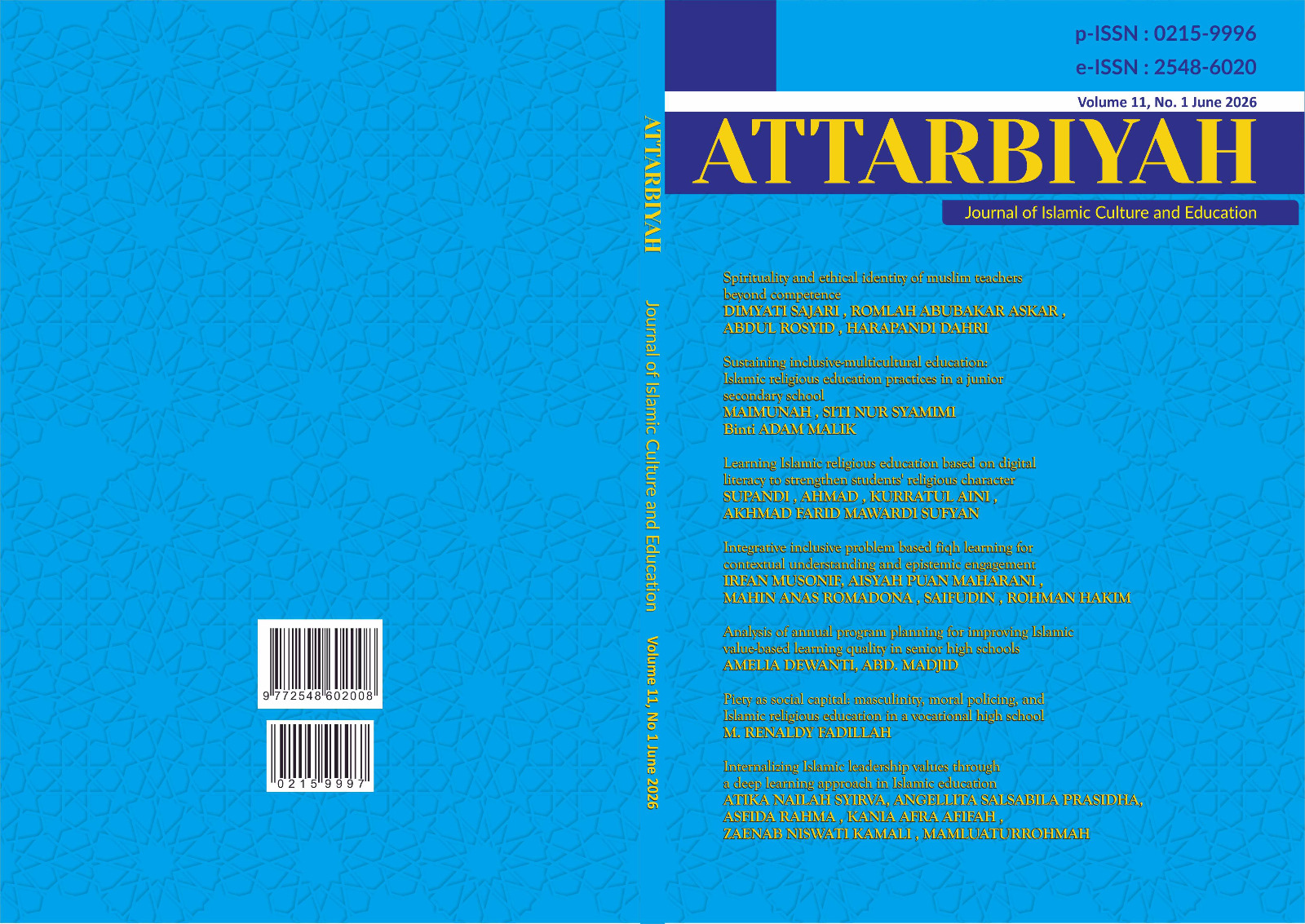
Piety as social capital: masculinity, moral policing, and Islamic religious education in a vocational high school
DOI:
https://doi.org/10.18326/attarbiyah.v11i1.99-118Keywords:
adolescent masculinity, Islamic religious education, piety, school cultureAbstract
This study examines how male identity and piety are constructed within school culture through Islamic Religious Education (IRE) at SMK Doa Bangsa Palabuhanratu. It explores how the “ideal male” is shaped in daily school life, how piety is negotiated within peer relationships, and how IRE may both redirect and reinforce certain forms of masculinity. Employing a qualitative approach, the research involved 18 participants, including IRE teachers, homeroom or student affairs staff, and male students from grades X–XII. Data were collected between January and February 2026 through classroom observations, semi-structured interviews, and document analysis. Thematic analysis focused on masculinity as a performative and relational practice, piety as social capital, and IRE as a mediating space for moral formation. The findings reveal that male identity is shaped through continuous negotiation between toughness, vocational discipline, peer recognition, and religious values. Piety functions both as a moral ethic that strengthens responsibility and adab and as a status marker that may encourage moral policing. Teacher role modelling and consistent school norms play an important role in fostering ethical and collaborative masculinities.
References
Aquila, D. A. (2020). Faculty perceptions of the relation between liberal arts and professional, vocational, and skills-based programs of study [Texas Tech University]. https://hdl.handle.net/2346/86522.
Charles, C., & Allan, A. (2022). More than a class act? dilemmas in researching elite school girls' feminist politics. Feminist Theory, 23(2), 266–284. https://doi.org/10.1177/1464700120973831.
Cho-Baker, S., & Purtell, K. M. (2022). Work and School Pathways Into the Transition to Adulthood: Adolescent Family, Individual, and Industry Precursors. Journal of Research on Adolescence, 32(2), 785–804. https://doi.org/10.1111/jora.12674.
Creswell, J. W., & Creswell, J. D. (2022). Research Design: Qualitative, Quantitative, and Mixed Methods Approaches. SAGE Publications. https://books.google.co.id/books?id=Rkh4EAAAQBAJ.
Cypress, B. (2018). Qualitative Research Methods. Dimensions of Critical Care Nursing, 37(6), 302–309. https://doi.org/10.1097/DCC.0000000000000322.
Domoff, S. E., Foley, R. P., & Ferkel, R. (2020). Addictive phone use and academic performance in adolescents. Human Behavior and Emerging Technologies, 2(1), 33–38. https://doi.org/10.1002/hbe2.171.
Donaldson, M. (1993). What is hegemonic masculinity? Theory and Society, 22(5), 643–657. https://doi.org/10.1007/BF00993540.
Fadli, A. (2024). Kontribusi Guru Pendidikan Agama Islam Terhadap Pembentukan Karakter Siswa Bermasalah Di Sekolah Menengah Kejuruan Kawung 2 Surabaya. Tarunaedu: Journal of Education and Learning, 2(2), 113–121. https://doi.org/10.59059/at-tadzkir.v3i1.921.
Fauzan, A., & Asrori, M. (2025). Examining the Urgency of Adab-Based Learning: A Hadith Perspective on the Global Ethical Crisis. Peradaban Journal of Religion and Society, 4(1), 47–59. https://doi.org/10.59001/pjrs.v4i1.189.
Fitria, T. N. (2025). The Profession of Content Creator in the Sharia-Compliant Creative Economy: Opportunities, Challenges, and Islamic Business Ethics On the Commercialization of Halal Content. Jurnal Ilmiah Ekonomi Islam, 11(03), 23–46. https://doi.org/https://doi.org/10.29040/jiei.v11i03.17242.
Golan, O. (2023). Introduction: Digital Youth and Religion. Religions, 14(6), 704. https://doi.org/10.3390/rel14060704.
Habibullah, A. (2014). Sikap Sosial Keagamaan Rohis di SMA pada Delapan Kota di Indonesia. EDUKASI: Jurnal Penelitian Pendidikan Agama Dan Keagamaan, 12(November 2014), 398–412. https://doi.org/10.32729/edukasi.v12i3.95.
Hayati, F., Nursobah, A., & Rosenda, D. (2019). Establishing Student`s Social Piety through Religious Activities. Proceedings of the 3rd Asian Education Symposium (AES 2018), 346–351. https://doi.org/10.2991/aes-18.2019.79.
Heino, M. T. J., Knittle, K., Noone, C., Hasselman, F., & Hankonen, N. (2021). Studying Behaviour Change Mechanisms under Complexity. Behavioral Sciences, 11(5), 77. https://doi.org/10.3390/bs11050077.
Hidayat, R. (2021). Maskulinisme dalam Konstruksi Ilmu. UGM PRESS. Johansson, T., & Andreasson, J. (2017). Fatherhood in Transition (1st ed.). Palgrave Macmillan UK. https://doi.org/10.1057/978-1-137-58953-8.
Luepker, E. T. (2022). Record Keeping in Psychotherapy and Counseling. Routledge. https://doi.org/10.4324/9781003150008.
Mullan, K., & Béal, C. (2021). The Use of Humour to Deal with Uncomfortable Moments in Interaction: A Cross-Cultural Approach. In The Palgrave Handbook of Humour Research (pp. 41–66). Springer International Publishing. https://doi.org/10.1007/978-3-030-78280-1_3.
Mulyani, E. S. (2025). Hubungan Budaya Kerja dan Kualitas Pembelajaran di SMK. JTPPm (Jurnal Teknologi Pendidikan Dan Pembelajaran): Edutech and Intructional Research Journal, 12(1), 58–70. https://doi.org/10.59059/jtppm.v12i1.1321.
Murray, J. (2022). Patriarchy, Honour, and Violence: Masculinities in Premodern Europe. Centre for Renaissance and Reformation Studies Toronto.
Nicholas, D. (2003). Urban Europe, 1100–1700. Bloomsbury Publishing Plc. https://doi.org/10.5040/9781350393400.
Nurhayati, N., Apriyanto, A., Ahsan, J., & Hidayah, N. (2024). Metodologi Penelitian Kualitatif: Teori dan Praktik. PT. Sonpedia Publishing Indonesia.
O'Brien, R. A. (2019). 'Who's that girl sitting with the boys?': negotiating researcher identity in fieldwork with adolescent boys. Sport, Education and Society, 24(9), 954–966. https://doi.org/10.1080/13573322.2018.1543653.
Peel, K. L. (2020). A beginner's guide to applied educational research using thematic analysis. Practical Assessment Research and Evaluation, 25(1), 1–15. https://doi.org/10.7275/ryr5-k983.
Pinkett, M., & Roberts, M. (2019). Boys don't try? Rethinking masculinity in schools. Routledge. https://doi.org/10.4324/9780429486128.
Rahman, R., Ilyas, I., Alwi, Z., & Zailani, Z. (2024). Nikah Muda: The Hijrah Movement of Anti-Dating Communities from Progressive to Conservative in Indonesia (A Critical Study of Hadith). Millah: Journal of Religious Studies, 23(1), 67–102. https://doi.org/ 10.20885/millah.vol23.iss1.art3.
Ramadhan, G., Nurjanna, U., Ardiyani Rahayu, N., Natasya, N., Marshela, M., & Amril, A. (2025). Dinamika Psikososial Dalam Perkembangan Remaja: Studi Kasus Pada Pengaruh Teman Sebaya. RELIGI: Jurnal Pendidikan Agama Islam, 2(2), 1–8. https://doi.org/10.51454/religi.v2i2.1189.
Reddy, R., Sharma, A. K., & Jha, M. (2019). Hegemonic masculinity or masculine domination. International Journal of Sociology and Social Policy, 39(3/4), 296–310. https://doi.org/10.1108/IJSSP-08-2018-0133.
Renold, E. (2001). Learning the “Hard” Way: Boys, Hegemonic Masculinity and the Negotiation of Learner Identities in the Primary School. British Journal of Sociology of Education, 22(3), 369–385. https://doi.org/10.1080/01425690120067981.
Søndergaard, D. M. (2018). The thrill of bullying. Bullying, humour and the making of community. Journal for the Theory of Social Behaviour, 48(1), 48–65. https://doi.org/.10.1111/jtsb.12153.
Stanaland, A., Gaither, S., & Gassman-Pines, A. (2023). When Is Masculinity “Fragile”? An Expectancy-Discrepancy-Threat Model of Masculine Identity. Personality and Social Psychology Review, 27(4), 359–377. https://doi.org/10.1177/10888683221141176.
Stubley, R., & Papen, U. (2025). Writing in vocational disciplines: values, practices and post-compulsory teacher education. Journal of Vocational Education & Training, 2(3), 1–17. https://doi.org/10.1080/13636820.2025.2597333.
Watts, T. W., Duncan, G. J., Clements, D. H., & Sarama, J. (2018). What Is the Long-Run Impact of Learning Mathematics During Preschool? Child Development, 89(2), 539–555. https://doi.org/10.1111/cdev.12713.
Yang, Y. (2020). What's Hegemonic about Hegemonic Masculinity? Legitimation and Beyond. Sociological Theory, 38(4), 318–333. https://doi.org/10.1177/0735275120960792.
Downloads
Published
How to Cite
Issue
Section
License
Copyright (c) 2026 M Renaldy Fadillah

This work is licensed under a Creative Commons Attribution-ShareAlike 4.0 International License.