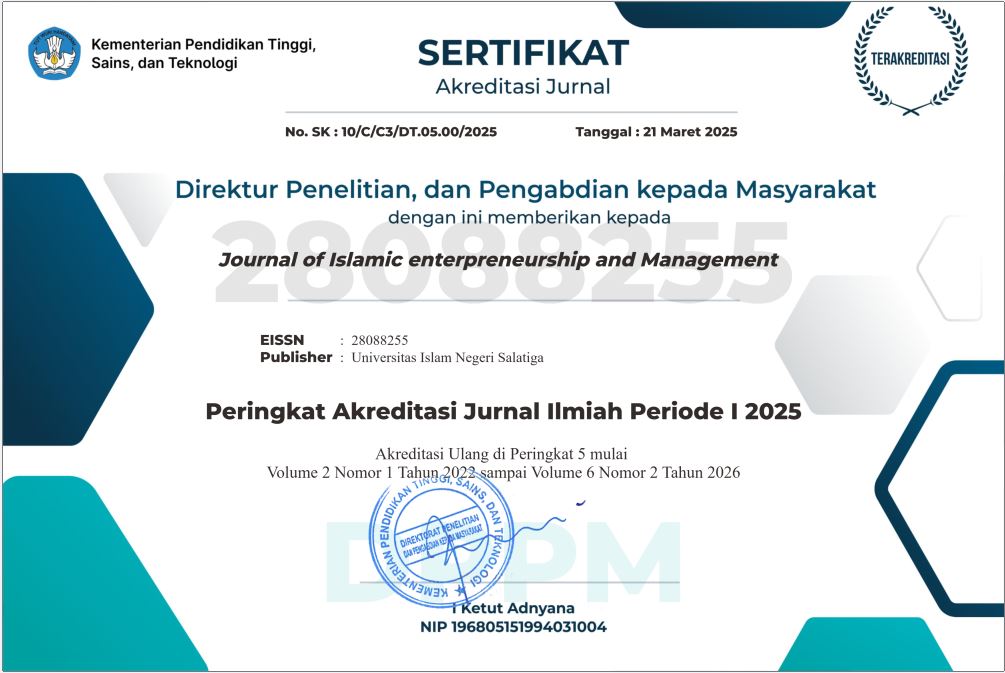
AUTHOR GUIDELINES
Journal of Islamic Enterpreneurship and Management, e -ISSN 2808-8255 is journal specializes in Islamic marketing and business, research and is intended to communicate original research and current issues on Islamic Marketing Management, Islamic Finance Management, Islamic Strategic Management, Operation Management, Human Resource Management, E-Business, Management Information System, International Business, Business Ethics and Sustainable, and Entrepeneurship.
The official language of Journal of Islamic Enterpreneurship and Management is English. Authors whose first language is not English are encouraged to have their manuscript checked for grammar and clarity before submission. The manuscript must not have been published or be under consideration for publication elsewhere.
General Author Guidelines
All manuscripts must be submitted through the online submission system at https://ejournal.uinsalatiga.ac.id/index.php/jiem/login. If authors have problems with the online submission, please contact the Editorial Office at [email protected]
The following documents should be uploaded as supplementary files:
- Signed Copyright Transfer Agreement (CTA) form (scan the document after signing);
- A covering letter outlining the main findings of the paper and their significance.
Manuscript Template
Manuscripts must be prepared using the journal template. Click here to download the MS Word template and here to download the PDF version.
Similarity Check
All manuscripts are checked using Turnitin. The maximum similarity index accepted is 25%, excluding references. Manuscripts above this limit are returned to the authors or rejected, as described in the Plagiarism Policy.
Reviewing of Manuscripts
Every submitted manuscript is reviewed by at least two independent reviewers through a double-blind peer review. The decision to accept, revise, or reject is made by the editor based on the reviewers' recommendations. Details are available in the Peer Review Process.
Revision of Manuscripts
Revised manuscripts should be returned through the online submission system within 6 weeks, together with a response to each reviewer comment. Revisions returned after this period may be treated as new submissions.
Use of Artificial Intelligence
Authors must disclose any use of generative AI tools in preparing the manuscript, following the AI Usage Policy. AI tools cannot be listed as authors.
Guideline for Online Submission
Authors must first register at https://ejournal.uinsalatiga.ac.id/index.php/jiem/user/register. After logging in, click "New Submission" and complete the five steps below:
- Step 1, Start: select the section (Research Article or Review Article), tick all items in the submission checklist, and write the covering letter in Comments for the Editor.
- Step 2, Upload Submission: upload the manuscript in MS Word format. Do not upload the covering letter or other supplementary files here.
- Step 3, Enter Metadata: enter the details of all authors, mark the corresponding author, and paste the title, abstract, and keywords.
- Step 4, Confirmation: upload the supplementary files (covering letter and signed CTA form) and check all documents.
- Step 5, Next Steps: click Finish Submission. The corresponding author will receive a confirmation email and can track the submission status by logging in.
User Rights
All articles are published open access and are immediately and permanently free to read and download under the Creative Commons Attribution-ShareAlike 4.0 International License (CC BY-SA 4.0).
Manuscript Preparation Guidelines
1. General Organization of Paper
The manuscript must present original research, theoretical studies, or relevant scholarly discussions related to Islamic entrepreneurship and management. Manuscripts should be written in clear and academic English and must follow the prescribed structure and formatting requirements. Authors are required to ensure that their manuscripts are properly prepared before submission using the official JIEM manuscript template.
The manuscript is organized in the following order: Title; Authors' Names; Affiliations; Abstract; Keywords; Introduction; Research Methods; Results and Discussion; Conclusions; Acknowledgments; Declarations; and References. Review articles may use headings suited to their structure.
After acceptance, the Editorial Office prepares the final layout. The corresponding author must check the proof before publication.
2. Section Headings
Level 1: 12 pt, Times New Roman bold, sentence case, left justified
Level 2: 12 pt, Times New Roman bold, left justified
Level 3: 12 pt, Times New Roman bold italic, left justified
3. Body Text
Use 12 pt Times New Roman, 1.5 line spacing, justified, with the first line of each paragraph indented 1 cm. The paper size is A4, one column, with margins of 2.5 cm (top, bottom, left) and 2 cm (right). Bullets and numbering within the body text are not allowed; write in descriptive paragraphs.
4. Tables
Tables are numbered sequentially with the title above the table and must be referred to in the text (e.g., Table 1). Use horizontal lines only, without vertical lines. Table text uses 10 pt, single spaced.
5. Figures
Figures are numbered sequentially with the title below the figure and must be referred to in the text (e.g., Figure 1). Figures must be clear and legible; black and white or color figures are allowed
6. Equations
Equations are numbered in parentheses at the right margin, for example (1), and prepared using an equation editor, not as images.
7. Title
The title should be accurate, specific, and concise, without uncommon abbreviations, in 16 pt Times New Roman bold, left justified, and must contain a maximum of 12 words.
8. Authors' Names and Affiliations
Write full names without academic titles or positions. Affiliations include department/study program, faculty, university, and country. Mark the corresponding author with an asterisk (*) and include the email address. Author names and affiliations must be identical to the metadata entered in the system.
9. Abstract and Keywords
The abstract is written in English, a maximum of 200 words, without citations, and states the purpose, method, main findings, and conclusion. Provide 3 to 5 keywords separated by semicolons (;).
10. Introduction
The introduction presents the background, a concise review of relevant studies grouped by topic or method, the research gap, the novelty of the study, and ends with the research objectives.
11. Literatur Review and Hypotheses Development
This section presents the theoretical foundations and relevant literature supporting the research. Authors should: Explain the theories and concepts related to the research variables, discuss relevant previous empirical studies, develop logical arguments linking the research variables, present the conceptual framework, where applicable, formulate research hypotheses based on theoretical arguments and previous findings.
12. Methods
The methods section is optional for research articles, as indicated in the journal template. When included, it should describe the research procedures in a clear and systematic manner. Describe the data, sources, sample, variables, and analysis methods in enough detail to allow replication. Methods already published should be cited rather than repeated.
13. Results and Discussion
This section presents the research findings and provides an in-depth discussion of their meaning and implications. Present the main findings clearly, interpret them, and compare them with previous studies, explaining similarities and differences. Explain how the results answer the research objectives.
14. Conclusion
The conclusion should summarize the main answers to the research objectives. Conclusion answer the research objectives, state the contribution of the study, its implications and limitations, and suggest directions for future research. The conclusion should not simply repeat the abstract or reproduce the results and discussion section.
15. References
All sources cited in the manuscript must be listed in the reference section. References follow the APA 7th edition style with author-year citations in the text. At least 80% of references should be primary sources (journal articles) published within the last 10 years. Every source cited in the text must appear in the reference list, and every item in the reference list must be cited in the text. Include the DOI for every reference that has one. Do not cite retracted articles. Authors are encouraged to use a reference manager such as Mendeley, Zotero, or EndNote. All in-text citations must correspond to entries in the reference list. Author should prioritize relevant and credible scholarly sources.