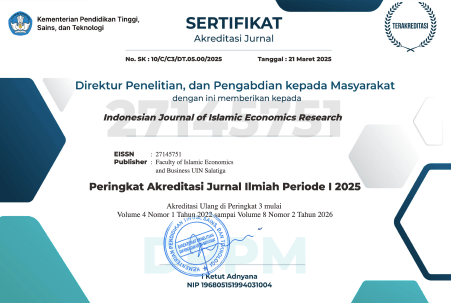
Exploring the relationship between economic activity, population, and energy consumption on environmental degradation in 10 OIC Countries
DOI:
https://doi.org/10.18326/ijier.v7i1.4921Keywords:
Environmental Degradation, Carbon Emissions, Panel VECM, Energy, Population, Economic ActivitiesAbstract
Environmental degradation is a manifestation of ecosystem damage caused by unsustainable activities, one of which is reflected in increased carbon emissions. This study aims to analyze the relationship between economic activities and environmental degradation in 10 member countries of the Organization of Islamic Cooperation (OIC) using quantitative data from 2008 to 2022. The Panel VECM method was used to identify long-term and short-term relationships between variables. The estimation results indicate that, in the long term, population, electricity consumption, economic growth, FDI, and renewable energy consumption have a significant impact on carbon emissions. Conversely, total energy consumption and the HDI are not significant. These findings encourage the government to shift from fossil fuel use to new and renewable energy and minimize the conversion of green areas into residential areas. Additionally, fossil fuel use must be balanced with investments in new and renewable energy to control rising carbon emissions alongside economic activities.
References
Abdouli, M., & Omri, A. (2021). Exploring the Nexus Among FDI Inflows , Environmental Quality , Human Capital , and Economic Growth in the Mediterranean Region. 788–810.
Adrian, M. A. (2023). Analisis Pengaruh Aktivitas Ekonomi terhadap Peningkatan Emisi Karbon : Studi Empiris Empat Negara ASEAN. Jurnal Ekonomi Indonesia, 12(2), 187–202.
Adrian, M. A., Zuhri, S., & Prajanti, S. D. W. (2023). Analysis of Increasing CO2 Emissions and Economic Activity: An Empirical Investigation in 4 ASEAN Countries. International Conference on Science, Education and Technology, 9(1), 514–523.
Akpan, G. E., & Akpan, U. F. (2012). Electricity consumption, carbon emissions and economic growth in Nigeria. International Journal of Energy Economics and Policy, 2(4), 292–306.
Ali, M., & Ali, M. (2020). Environmental degradation , economic growth , and energy innovation : evidence from European countries. 28306–28315.
Aslan, A., Ocal, O., Ozsolak, B., & Ozturk, I. (2022). Renewable energy and economic growth relationship under the oil reserve ownership: Evidence from panel VAR approach. Renewable Energy, 188, 402–410. https://doi.org/10.1016/j.renene.2022.02.039
Firdaus, M. (2020). Aplikasi Ekonometrika dengan E-Views, Stata, dan R (Elviana (ed.); 1st ed.). PT. Penerbit IPB Press.
Ganda, F. (2022). The nexus of financial development , natural resource rents , technological innovation , foreign direct investment , energy consumption , human capital , and trade on environmental degradation in the new BRICS economies. Environmental Science and Pollution Research, 74442–74457. https://doi.org/10.1007/s11356-022-20976-7
Grossman, G. M., & Krueger, A. B. (1991). Environmental impacts of a North American free trade agreement. 3914.
Kahouli, B., & Chaaben, N. (2022). Investigate the link among energy Consumption, environmental Pollution, Foreign Trade, Foreign direct Investment, and economic Growth: Empirical evidence from GCC countries. Energy and Buildings, 266, 112117. https://doi.org/10.1016/j.enbuild.2022.112117
Khan, I., Hou, F., & Le, H. P. (2021). The impact of natural resources, energy consumption, and population growth on environmental quality: Fresh evidence from the United States of America. Science of the Total Environment, 754, 142222. https://doi.org/10.1016/j.scitotenv.2020.142222
Majeed, M. T., & Tauqir, A. (2020). Effects of urbanization, industrialization, economic growth, energy consumption and financial development on carbon emissions: An extended STIRPAT model for heterogeneous income groups. Pakistan Journal of Commerce and Social Science, 14(3), 652–681.
Mehmood, U. (2022). Renewable energy and foreign direct investment : does the governance matter for CO2 emissions ? Application of CS ‑ ARDL. Environmental Science and Pollution Research, 19816–19822. https://doi.org/10.1007/s11356-021-17222-x
Mehrjo, A., Satari, S., Mohammad, Y., Eskandari, H., & Hadis, N. (2022). Economic complexity , ICT , biomass energy consumption , and environmental degradation : evidence from Iran. Environmental Science and Pollution Research, 69888–69902. https://doi.org/10.1007/s11356-022-20689-x
Muhammad, B., & Khan, M. K. (2021). Impact of foreign direct investment , natural resources , renewable energy consumption , and economic growth on environmental degradation : evidence from BRICS , developing , developed and global countries. 21789–21798.
Naseem, S., Mohsin, M., Zia-ur-rehman, M., Baig, S. A., Sarfraz, M., & Zia-ur-rehman, M. (2022). The influence of energy consumption and economic growth on environmental degradation in BRICS countries : an application of the ARDL model and decoupling index. 13042–13055.
Nasir, M., & Ur Rehman, F. (2011). Environmental Kuznets Curve for carbon emissions in Pakistan: An empirical investigation. Energy Policy, 39(3), 1857–1864. https://doi.org/10.1016/j.enpol.2011.01.025
Panayotou, T. (1993). Empirical tests and policy analysis of environmental degradation at different stages of economic development. Pacific and Asian Journal of Energy, 4(1), 23–42.
Poku, F. A. (2016). Carbon Dioxide Emissions, Urbanization and Population: Empirical Evidence in Sub Saharan Africa. Energy Economics Letters, 3(1), 1–16. https://doi.org/10.18488/journal.82/2016.3.1/82.1.1.16
Radmehr, R., Rastegari, S., & Shayanmehr, S. (2021). Renewable Energy Consumption , CO 2 Emissions , and Economic Growth Nexus : A Simultaneity Spatial Modeling Analysis of EU Countries. Structural Change and Economic Dynamics, 57, 13–27. https://doi.org/10.1016/j.strueco.2021.01.006
Radmehr, R., Shayanmehr, S., Ali, E. B., & Ofori, E. K. (2022). Exploring the Nexus of Renewable Energy , Ecological Footprint , and Economic Growth through Globalization and Human Capital in G7 Economics.
Rehman, M. U., & Rashid, M. (2017). Energy consumption to environmental degradation, the growth appetite in SAARC nations. Renewable Energy, 111, 284–294. https://doi.org/10.1016/j.renene.2017.03.100
Saqib, N., Usman, M., Radulescu, M., Sinisi, C. I., Secara, C. G., & Tolea, C. (2022). Revisiting EKC hypothesis in context of renewable energy , human development and moderating role of technological innovations in E-7 countries ? December, 1–18. https://doi.org/10.3389/fenvs.2022.1077658
Satrovic, E., & Fatai, F. (2022). An empirical assessment of electricity consumption and environmental degradation in the presence of economic complexities. Environmental Science and Pollution Research, 78330–78344. https://doi.org/10.1007/s11356-022-21099-9
Sohag, K., Al Mamun, M., Uddin, G. S., & Ahmed, A. M. (2017). Sectoral output, energy use, and CO2 emission in middle-income countries. Environmental Science and Pollution Research, 24(10), 9754–9764. https://doi.org/10.1007/s11356-017-8599-z
Tariq, G., Sun, H., Ali, I., Pasha, A. A., & Khan, M. S. (2022). Influence of green technology , green energy consumption , energy efficiency , trade , economic development and FDI on climate change in South Asia. Scientific Reports, 1–13. https://doi.org/10.1038/s41598-022-20432-z
Xu, D., Salem, S., Awosusi, A. A., & Abdurakhmanova, G. (2022). Load Capacity Factor and Financial Globalization in Brazil : The Role of Renewable Energy and Urbanization. 9(February), 1–13. https://doi.org/10.3389/fenvs.2021.823185
Yusuf, A. (2023). Dynamic effects of energy consumption , economic growth , international trade and urbanization on environmental degradation in Nigeria. Energy Strategy Reviews, 50(November), 101228. https://doi.org/10.1016/j.esr.2023.101228
Downloads
Published
How to Cite
Issue
Section
License
Copyright (c) 2025 Saifudin Zuhri, Adrian Muhammad Adi , Nadhifah Nisa An

This work is licensed under a Creative Commons Attribution-ShareAlike 4.0 International License.