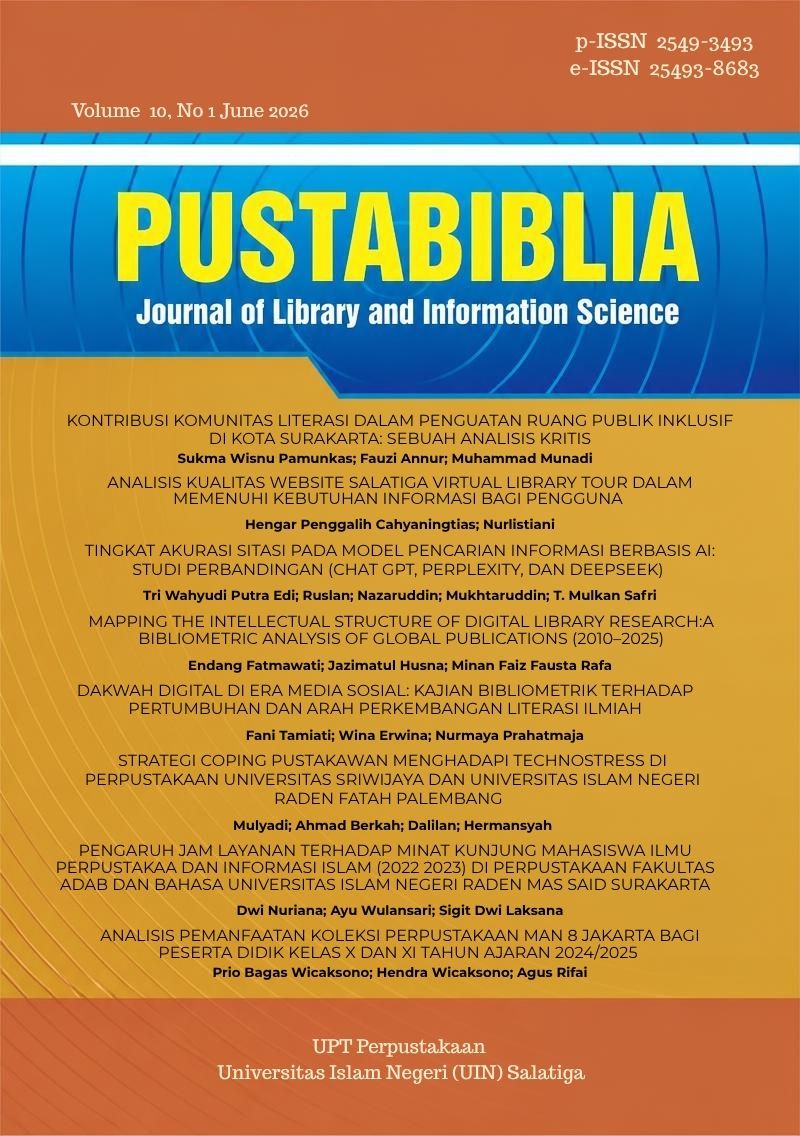
MAPPING THE INTELLECTUAL STRUCTURE OF DIGITAL LIBRARY RESEARCH:A BIBLIOMETRIC ANALYSIS OF GLOBAL PUBLICATIONS (2010–2025)
DOI:
https://doi.org/10.18326/pustabiblia.v10i1.43-57Keywords:
Bibliometrics, Digital library, science mapping, VOSviewer, Knowledge Structure, Information ScienceAbstract
Background: Digital library research has experienced exponential growth since 2010, yet no comprehensive bibliometric study has systematically mapped its global intellectual structure. Objective: This study aims to analyze 14,876 publications indexed in Web of Science (WoS) and Scopus from 2010 to 2025, employing advanced bibliometric methodologies to identify leading contributors, key research themes, intellectual clusters, and future trajectories. Methods: We employed performance analysis and science mapping techniques including co-citation analysis, keyword co-occurrence analysis, bibliographic coupling, and co-authorship network analysis. Software tools including VOSviewer, Bibliometrix (R-package), and CiteSpace were utilized for visualization. Results: The United States (n = 4,231), China (n = 3,876), and the United Kingdom (n = 2,145) emerged as the most productive nations. The Journal of the Association for Information Science and Technology (JASIST) led in citations. Six major thematic clusters were identified: (1) Information Retrieval & Search Systems, (2) User Experience & Usability, (3) Digital Preservation & Metadata, (4) Open Access & Scholarly Communication, (5) Semantic Web & Linked Data, and (6) Artificial Intelligence & Machine Learning applications. Conclusion: The field is shifting from traditional cataloging and retrieval paradigms toward AI-driven, user-centric, and interoperable architectures. Emerging themes include federated learning for privacy-preserving recommendation systems and large language model integration in digital curation workflows
References
Aria, M., & Cuccurullo, C. (2017). bibliometrix: An R-tool for comprehensive science mapping analysis. Journal of Informetrics, 11(4), 959–975. https://doi.org/10.1016/j.joi.2017.08.007
Borgman, C. L. (2015). Big Data, Little Data, No Data: Scholarship in the Networked World. MIT Press.
Chen, C. (2006). CiteSpace II: Detecting and visualizing emerging trends and transient patterns in scientific literature. Journal of the American Society for Information Science and Technology, 57(3), 359–377.
Donthu, N., Kumar, S., Mukherjee, D., Pandey, N., & Lim, W. M. (2021). How to conduct a bibliometric analysis: An overview and guidelines. Journal of Business Research, 133, 285–296.
Fox, E. A., & Urs, S. R. (2002). Digital libraries. Annual Review of Information Science and Technology, 36(1), 503–589.
Harzing, A. W., & Alakangas, S. (2016). Google Scholar, Scopus and the Web of Science: A longitudinal and cross-disciplinary comparison. Scientometrics, 106(2), 787–804.
IFLA (2019). IFLA Trend Report 2019 Update. International Federation of Library Associations and Institutions.
Larivière, V., Haustein, S., & Mongeon, P. (2015). The oligopoly of academic publishers in the digital era. PLOS ONE, 10(6), e0127502.
Meho, L. I., & Yang, K. (2007). Impact of data sources on citation counts and rankings of LIS faculty. Journal of the American Society for Information Science, 58(13), 2105–2125.
Noh, Y. (2015). Imagining library 4.0: Creating a model for future libraries. Journal of Academic Librarianship, 41(6), 786–797.
Priem, J., Taraborelli, D., Groth, P., & Neylon, C. (2010). Altmetrics: A manifesto. Retrieved from http://altmetrics.org/manifesto
Saracevic, T. (2000). Digital library evaluation: Toward evolution of concepts. Library Trends, 49(2), 350–369.
van Eck, N. J., & Waltman, L. (2010). Software survey: VOSviewer, a computer program for bibliometric mapping. Scientometrics, 84(2), 523–538.
Zupic, I., & Cater, T. (2015). Bibliometric methods in management and organization. Organizational Research Methods, 18(3), 429–472.
Zhao, D., & Strotmann, A. (2015). Analysis and visualization of citation networks. Synthesis Lectures on Information Concepts, Retrieval, and Services, 7(1), 1–207.
Additional Files
Published
Issue
Section
License
Copyright (c) 2026 Endang Fatmawati, Jazimatul Husna, Minan Faiz Fausta Rafa (Author)

This work is licensed under a Creative Commons Attribution-ShareAlike 4.0 International License.
Copyright
Authors retain copyright and grant the journal right of first publication with the work simultaneously licensed under a Creative Commons Attribution-ShareAlike 4.0 International License. In line with the license, authors are allowed to share and adapt the material. In addition, the material must be given appropriate credit, provided with a link to the license, and indicated if changes were made. If authors remix, transform or build upon the material, authors must distribute their contributions under the same license as the original.
Licensing

This work is licensed under a Creative Commons Attribution-ShareAlike 4.0 International License.