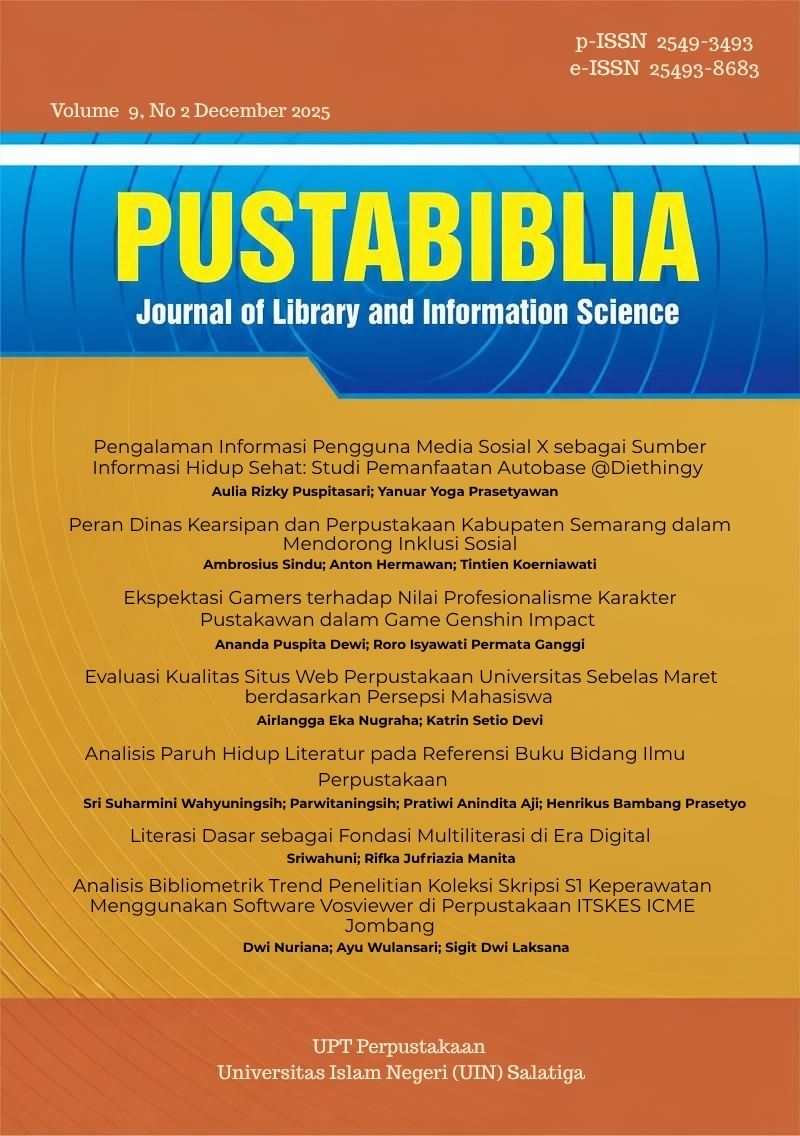
Literasi Dasar sebagai Fondasi Multiliterasi di Era Digital
DOI:
https://doi.org/10.18326/pustabiblia.v9i2.5227Keywords:
Basic literacy, digital literacy, multiliteracies, social practicesAbstract
The development of digital technology has expanded the meaning of literacy from merely reading and writing skills into a more complex competence encompassing digital, media, and information literacy. The main problem addressed in this study is how basic literacy supports multiliteracy skills in the digital era, and how the integration among various literacy types can shape critical and creative thinking capacities in facing modern information flows. This research aims to analyze the strategic role of basic literacy as the foundation for multiliteracy development and to examine its integration within Indonesia’s educational and literacy culture context. The method used is library research with a conceptual analysis of 30 recent national and international scholarly sources. The findings indicate that basic literacy plays a central role in developing effective multiliteracy, serving as the basis for critical, logical, and ethical reasoning in processing digital information. The integration of basic, media, technological, and visual literacy forms an adaptive multiliteracy framework suited for contemporary challenges. It is concluded that reading and writing literacy is not merely an initial learning stage but a strategic pillar sustaining all forms of modern literacy. The study recommends that strengthening basic literacy should become a national policy priority and be integrated into educational curricula to prepare Indonesian society to engage critically, creatively, and responsibly in the digital age.
References
Almah, H. (2018). Urgensi literasi informasi ( dalam era globalisasi: perpustakaan, masyarakat dan peradaban. Jurnal Komunika, 2(1), 49. http://ejournal.radenintan.ac.id/index.php/komunika/article/view/4756
Barton, D., Ivanič, R., Appleby, Y., Hodge, R., & Tusting, K. (2012). Literacy, lives and learning. In Literacy, Lives and Learning. https://doi.org/10.4324/9780203608302
Brian Street. (2003). What’s ‘New’ in New Literacy Studies? Critical Approaches to Literacy in Theory and Practice. Current Issues in Comparative Education, 5(2), 77–91. https://doi.org/10.52214/cice.v5i2.11369
Ferguson, B. (2003). Information Literacy. A Primer for Teachers, Librarians, and other Informed People. International Conference of Information Literacy in Prague. International Conference of Information Literacy in Prague, Cech.
Harjono, H. S. (2018). Literasi Digital: Prospek dan Implikasinya dalam Pembelajaran Bahasa. Pena, 8(1), 1–7. https://doi.org/https://doi.org/10.22437/pena.v8i1.6706
Hasanah, U., & Silitonga, M. (2020). Implementasi Gerakan Literasi Sekolah di Sekolah Dasar. Kemendikbud.
Hayat, B., & Yusuf, S. (2010). Benchmark Internasional Mutu Pendidikan. Bumi Aksara.
Kusnawa, D. (2011). Metode Penelitian Sosial. Pusaka Setia.
Muin, A. (2013). Information literasi skill strategi penelusuran informasi online. Alauddin Makassar Press.
Mustika Zed. (2004). Metode Penelitian Kepustakaaan. Yayasan Obor Indonesia.
Ranaweera, P. (2020). Importance of Information Literacy skills for an Information Literate society CORE View metadata, citation and similar papers at core.ac.uk provided by E-LIS. Senior Lecturer, National Institute of Library & Information Sciences, University of Colombo, 1–13.
Satriani, Ahmad, D., & Halimah, A. (2022). Pengaruh Kemampuan Literasi Informasi, Literasi Media, Dan Literasi Digital Terhadap Kompetensi Pedagogik Guru. Nazzama: Journal of Management Education, 2(1), 85–99. https://doi.org/10.24252/jme.v2i1.31513
Silalahi, D., & Dkk. (2022). Liteasi Digital berbasis Pendidikan: Teori, Praktek, dan Penerapan. Global Eksekutif Teknologi.
Silalahi, Mesi Pradrya, & Faizal. (2022). Peran mahasiswa dalam meningkatkan literasi digital. Jurnal Tonggak Pendidikan Dasar, 1(2), 59–71.
Downloads
Published
Issue
Section
License
Copyright (c) 2026 Sri Wahyuni, Rika Jufriazia Manita

This work is licensed under a Creative Commons Attribution-ShareAlike 4.0 International License.
Copyright
Authors retain copyright and grant the journal right of first publication with the work simultaneously licensed under a Creative Commons Attribution-ShareAlike 4.0 International License. In line with the license, authors are allowed to share and adapt the material. In addition, the material must be given appropriate credit, provided with a link to the license, and indicated if changes were made. If authors remix, transform or build upon the material, authors must distribute their contributions under the same license as the original.
Licensing

This work is licensed under a Creative Commons Attribution-ShareAlike 4.0 International License.