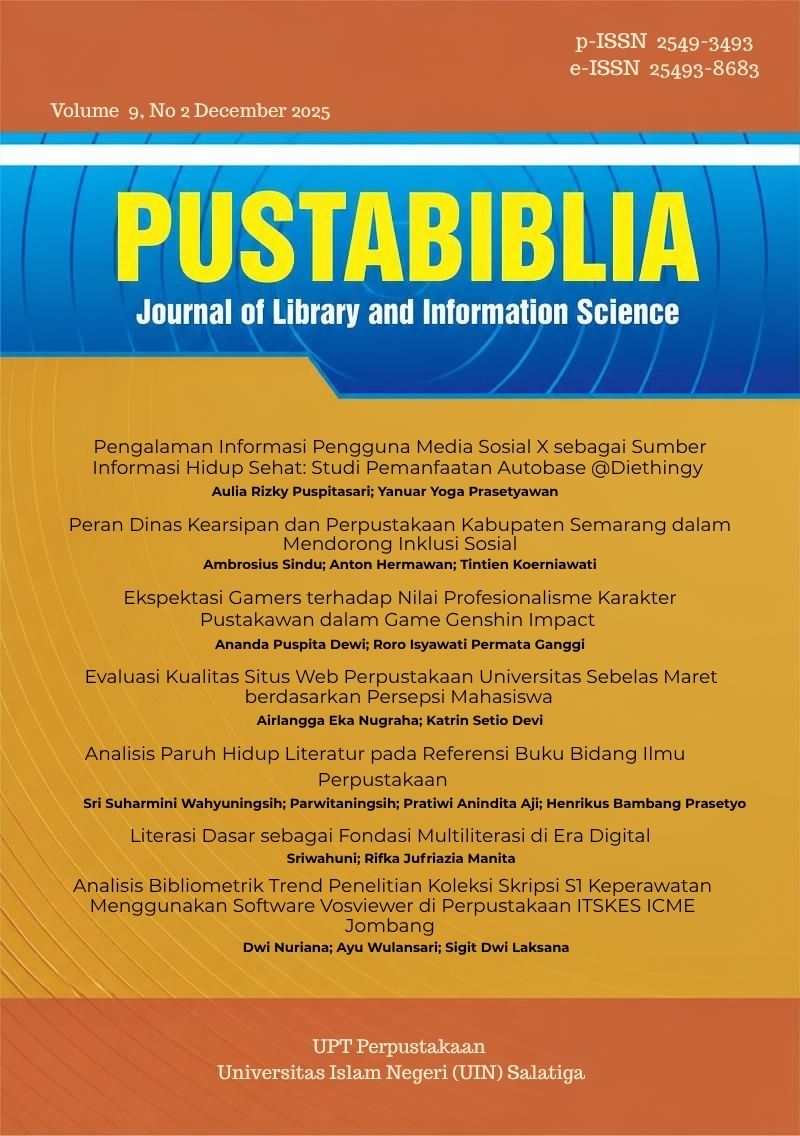
Pengalaman Informasi Pengguna Media Sosial X sebagai Sumber Informasi Hidup Sehat: Studi Pemanfaatan Autobase @Diethingy
DOI:
https://doi.org/10.18326/pustabiblia.v9i2.4880Keywords:
Information Experience, Social Media, healthy livingAbstract
Human interaction with information is no longer limited to physical space, but has also penetrated into cyberspace. Along with the development of digital technology, cyberspace has become the main space for individuals to find, share and interpret information quickly and participatively, especially through social media. This study aims to understand the information experience of autobase X @diethingy users as a source of healthy living information. This research uses a qualitative method with a phenomenological approach. The data collection method was carried out by interviewing twelve active users of autobase @diethingy. The results showed that users utilize @diethingy autobase to share information, discuss, and also share support. This encourages active participation of users in accessing, understanding, and internalizing healthy living information in their daily lives. There are two sides of the experience experienced by informants when interacting with information in assessing the quality of information, namely the positive side and the negative side. The positive side shows that the available information is easy to obtain and apply in daily life. Meanwhile, the negative side felt by informants is that many new users spread misinformation, disinformation and hoaxes about healthy living, which is exacerbated by the silence and absence of health experts who usually share more valid and reliable information.
References
Afandi, A., Nur, K. R. M., Kurniawan, D. E., & Kurniyawan, E. H. (2023). Clean and Healthy Living Behavior (Washing Hands with Soap) with a Peer Group Support Approach to the Community. International Journal of Community Services, 1(1), 22–27. https://doi.org/10.61777/injcs.v1i1.7
Alika, F. (2022). Kualitas informasi pada media sosial instagram sebagai sumber. Jurnal Ilmiah Multidisiplin, 1(4), 223–226.
Armstrong, M., Halim, N. K., Raeside, R., Jia, S. S., Hyun, K., Boroumand, F., Mandoh, M., Singleton, A. C., Phongsavan, P., Redfern, J., & Partridge, S. R. (2021). How helpful and what is the quality of digital sources of healthy lifestyle information used by australian adolescents? A mixed methods study. International Journal of Environmental Research and Public Health, 18(23), 1–14. https://doi.org/10.3390/ijerph182312844
Azzahra, S. R., & Dewi, A. O. P. (2023). Pengalaman Informasi Pengguna Akun Autobase Twitter @sbmptnfess sebagai Sumber Informasi bagi Calon Mahasiswa. Jurnal Ilmu Perpustakaan, 12(2), 109–124. https://ejournal3.undip.ac.id/index.php/jip/article/view/39361
Bruce, C., Davis, K., Partridge, H., & Stoodley, I. (2014). Information experience: Approaches to theory and practice. In Information Experience: Approaches to Theory and Practice. Emerald Group Publishing Limited. https://doi.org/10.1108/S1876-056220140000010031
Clarke, V., & Braun, V. (2016). Thematic analysis. The Journal of Positive Psychology, 9760(December), 1–2. https://doi.org/10.1080/17439760.2016.1262613
Creswell, J. W., & Creswell, J. D. (2018). Research Design Qualitative, Quantitative, and Mixed Methods Approaches Fifth Edition. (5th ed.). SAGE Publications, Inc. https://books.google.co.id/books?id=Pr2VEAAAQBAJ
Davis, K. (2015). The information experience of new mothers in social media: a grounded theory study (Doctoral dissertation, Queensland University of Technology). August. https://eprints.qut.edu.au/86784/12/n4352556 Kate Davis Thesis with redactions_Redacted.pdf
Dutton, W. H. (2013). 1Internet Studies: The Foundations of a Transformative Field. In W. H. Dutton (Ed.), The Oxford Handbook of Internet Studies (p. 0). Oxford University Press. https://doi.org/10.1093/oxfordhb/9780199589074.013.0001
Faturtama, D. L., & Abidin, S. (2023). Jurnal Indonesia : Manajemen Informatika dan Komunikasi PEMANFAATAN MEDIA SOSIAL SEBAGAI SUMBER Abstrak Jurnal Indonesia : Manajemen Informatika dan Komunikasi. 4(3), 1123–1130.
Hoyte, P. (2019). Implications of the embodied, enactive mind on theorizing about information experience. Proceedings of the Association for Information Science and Technology, 56(1), 413–416. https://doi.org/10.1002/pra2.40
Hughes, H. (2014). Researching Information Experience: Methodological Snapshots. In Information Experience: Approaches to Theory and Practice (Vol. 9, pp. 33–50). Emerald Group Publishing Limited. https://doi.org/10.1108/S1876-056220140000010004
Hunsinger, J., & Senft, T. (2013). The Social Media Handbook. (1st Editio). Routledge.
J.R. Raco. (2010). Metode Penelitian Kualitatif: Jenis, Karateristik dan keunggulannya. Jakarta: PT Grasindo.
Jason, L. A., & Glenwick, D. S. (Eds.). (2015). Handbook of Methodological Approaches to Community-Based Research: Qualitative, Quantitative, and Mixed Methods. Oxford University Press. https://doi.org/10.1093/med:psych/9780190243654.001.0001
Miller, F., Davis, K., & Partridge, H. (2019). Everyday life information experiences in twitter: A grounded theory. Information Research, 24(2).
Pálsdóttir, Á. (2018). "Analysing Digital Information Seeking and Quality Evaluation of Sources about Healthy Lifestyle among Senior Citizens in Iceland ". Revista Română de Biblioteconomie Și Știința Informării = Romanian Journal of Library and Information Science, 14(2), 35–45. https://doi.org/10.26660/rrbsi.2018.14.2.35
Pattath, P. (2021). A qualitative study of health information-seeking behavior on the Internet among information technology professionals. Journal of Education and Health Promotion, 10, 274. https://doi.org/10.4103/jehp.jehp_19_21
Prasetyawan, Y. Y. (2019). Pengalaman Informasi (Information Experience) Sebuah Alternatif Perspektif Komprehensif dalam Kajian Ilmu Informasi dan Perpustakaan. Anuva: Jurnal Kajian Budaya, Perpustakaan, Dan Informasi, 3(2), 101–108. https://doi.org/10.14710/anuva.3.2.101-108
Rahmadillah, A. (2022). Pengaruh Penggunaan Media Sosial Twitter Terhadap Keterampilan Komunikasi Interpersonal di Kalangan Remaja Kecamatan Tambun Utara Bekasi Jawa Barat. Journal, 1, 1–20.
Rony, Z. (2017). SIAP FOKUS, SIAP MENULIS Skripsi, Tesis, Disertasi (Jurus Mudah Gunakan Metode Kualitatif Tipe Studi Kasus). In Jakarta, PSSDM.
Shwartz-Asher, D., Chun, S., Adam, N. R., & Snider, K. L. G. (2020). Knowledge sharing behaviors in social media. Technology in Society, 63, 101426. https://doi.org/https://doi.org/10.1016/j.techsoc.2020.101426
Söderlund, C., & Lundin, J. (2017). What is an information source?: information design based on information source selection behavior. Communication Design Quarterly Review, 4, 12–19.
Sugiyono. (2020). Metode Penelitian Kuantitatif Kualitatif dan R&D. Penerbit Alfabeta.
Syafitri, N. K., Rullyana, G., & Ardiansah, A. (2020). autobase@collegemenfess, A Twitter Account Used as Information Retrieval Tool. Khizanah Al-Hikmah: Jurnal Ilmu Perpustakaan, Informasi Dan Kearsipan, 8(2), 161–172. https://doi.org/10.24252/kah.v8i2a6
Talip, B. A., Narayan, B., Watson, J., & Edwards, S. (2020). The Role of Information Experience on IT Professionals’ Twitter Use. Libri, 70(1), 1–15. https://doi.org/10.1515/libri-2018-0096
Tambuscio, M., Oliveira, D. F. M., Ciampaglia, G. L., & Ruffo, G. (2018). Network segregation in a model of misinformation and fact-checking. Journal of Computational Social Science, 1(2), 261–275. https://doi.org/10.1007/s42001-018-0018-9
Wertgen, A. G., & Richter, T. (2023). Source credibility and plausibility are considered in the validation of textual information: evidence from a social media context. Journal of Cognitive Psychology, 35(2), 183–204. https://doi.org/10.1080/20445911.2022.2149757
Xiao, X., & Su, Y. (2023). Stumble on information or misinformation? Examining the interplay of incidental news exposure, narcissism, and new media literacy in misinformation engagement. Internet Research, 33(3), 1228–1248. https://doi.org/10.1108/INTR-10-2021-0791
Yates, C., & Partridge, H. (2015). Citizens and social media in times of natural disaster: Exploring information experience. Information Research, 20(1), 1–24.
Downloads
Published
Issue
Section
License
Copyright (c) 2026 Aulia Rizky Puspitasari -, Yanuar Yoga Prasetyawan

This work is licensed under a Creative Commons Attribution-ShareAlike 4.0 International License.
Copyright
Authors retain copyright and grant the journal right of first publication with the work simultaneously licensed under a Creative Commons Attribution-ShareAlike 4.0 International License. In line with the license, authors are allowed to share and adapt the material. In addition, the material must be given appropriate credit, provided with a link to the license, and indicated if changes were made. If authors remix, transform or build upon the material, authors must distribute their contributions under the same license as the original.
Licensing

This work is licensed under a Creative Commons Attribution-ShareAlike 4.0 International License.