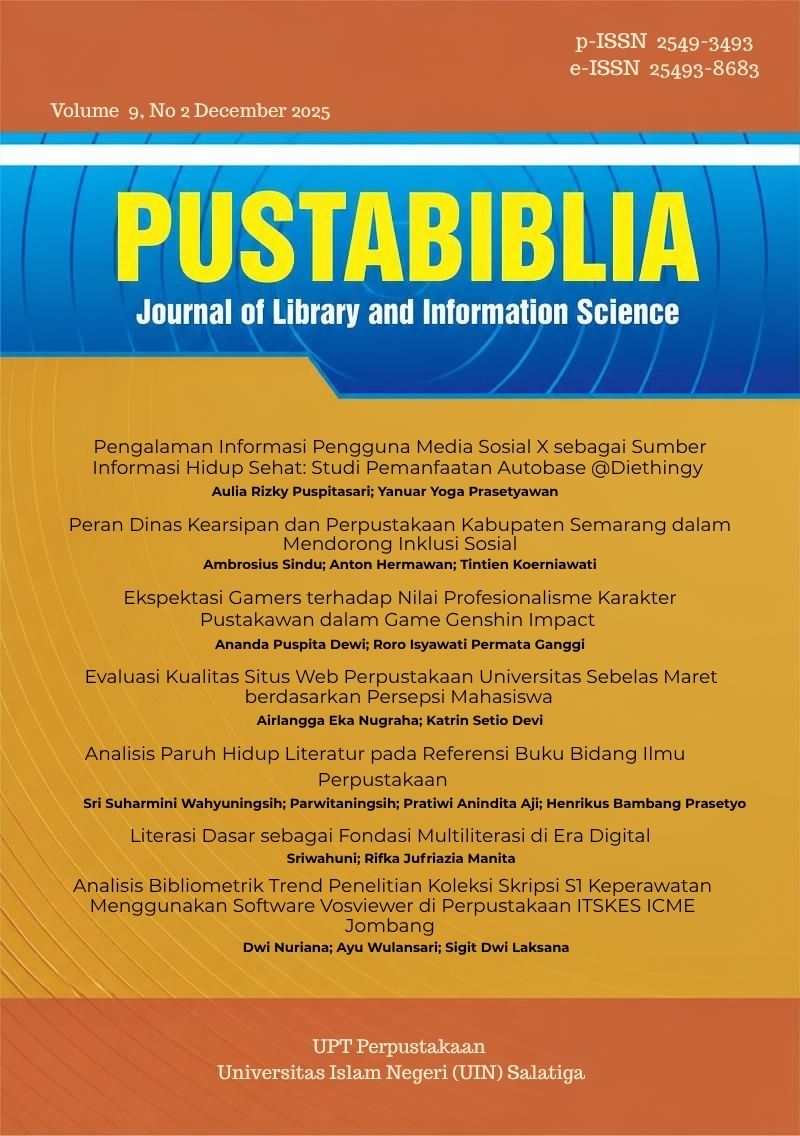
Analisis Bibliometrik Trend Penelitian Koleksi Skripsi S1 Keperawatan Menggunakan Software Vosviewer di Perpustakaan ITSKES ICME Jombang
DOI:
https://doi.org/10.18326/pustabiblia.v9i2.4216Keywords:
bibliometrics, VOSviewer, nursing, emergency, research visualizationAbstract
In the era of digital transformation and scientific advancement, the thesis is one of the academic requirements that must be completed by students of the Bachelor (S1) program, a scientific product that is in accordance with the peculiarities of the S1 Nursing study program with the characteristics of an emergency. This study aims to analyze the thesis titles of S1 Nursing students at ITSKes Insan Cendekia Medika Jombang in 2023– 2025 with a bibliometric approach using VOSviewer software. The background of this research is based on the gap between the topic of the student's thesis and the peculiarities of the study program that emphasizes the field of emergency nursing. The research method used is quantitative descriptive with co-word, co-occurrence, and citation analysis techniques. The data used came from 177 titles of student final projects obtained from institutional repositories, data was analyzed through three types of visualizations in VOSviewer, network, density, and overlay visualization.The results of the study show that the dominant topics in students' theses revolve around community nursing and general issues such as stress, sleep quality, nutritional status, hypertension, and adolescent and elderly behavior. Emergency topics such as trauma, triage, resuscitation, and disaster management appear only very limited, both in keywords and abstract content. The VOSviewer visualization shows an imbalance in the distribution of themes, suggesting that the main focus has not yet reflected the peculiarities of the study program. The conclusion of this study is that student research trends are not fully in line with the vision, mission, and scientific characteristics of the S1 Nursing study program that is oriented towards emergency nursing. Therefore, academic strategies are needed such as topic briefings by supervisors and library officers who can provide recommendations for research topics in accordance with the characteristics of the study program, as well as the preparation of superior topic policies based on bibliometric analysis.
References
Ampese, L.C., W.G. Sganzerla, ..., and T. Forster-Carneiro. 2022. “Research Progress, Trends, and Updates on Anaerobic Digestion Technology: A Bibliometric Analysis.” Journal of Cleaner Production. https://doi.org/10.1016/j.jclepro.2021.130004.
Anuar, A., N.F. Marwan, ..., and A. Sharif. 2022. “Bibliometric Analysis of Immigration and Environmental Degradation: Evidence from Past Decades.” Environmental Science and Pollution Research 29: 13729–41. https://doi.org/10.1007/s11356-021-16470-1.
Aria, M., and C. Cuccurullo. 2017. “bibliometrix: An R-tool for Comprehensive Science Mapping Analysis.” Journal of Informetrics 11 (4): 959–75. https://doi.org/10.1016/j.joi.2017.08.007.
Baminiwatta, A., and I. Solangaarachchi. 2021. “Trends and Developments in Mindfulness Research over 55 Years: A Bibliometric Analysis of Publications Indexed in Web of Science.” Mindfulness. https://doi.org/10.1007/s12671-021-01681-x.
Biggs, J. 1996. “Enhancing Teaching through Constructive Alignment.” Higher Education 32 (3): 347–64. https://doi.org/10.1007/BF00138871.
Biggs, J., and C. Tang. 2011. Teaching for Quality Learning at University. 4th ed. McGraw-Hill Education.
Bloom, B.S. 1956. Taxonomy of Educational Objectives: The Classification of Educational Goals. Handbook I: Cognitive Domain. Longman.
De Looze, M., and J. Lemarie. 1997. “Corpus Relevance Through CoWord Analysis: An Application to Plant Proteins.” Scientometrics 39 (3): 267–80.
De Bellis, Nicola. 2009. Bibliometrics and Citation Analysis. United States: Scarecrow Press, Inc.
DeBoer, George E. 2000. “Scientific Literacy: Another Look at Its Historical and Contemporary Meanings and Its Relationship to Science Education Reform.” Journal of Research in Science Teaching 37 (6): 582–601. https://doi.org/10.1002/1098-2736(200008)37:63.0.CO;2-L.
Donthu, N., S. Kumar, D. Mukherjee, N. Pandey, and W. M. Lim. 2021. “Bibliometric Analysis as a Research Method in Business and Management: A Bibliometric and Systematic Review.” Journal of Business Research 133: 285–96. https://doi.org/10.1016/j.jbusres.2021.04.070.
Glenisson, P., W. Glänzel, F. Janssens, and B. De Moor. 2005. “Combining Full Text and Bibliometric Information in Mapping Scientific Disciplines.” Information Processing & Management. https://doi.org/10.1016/j.ipm.2005.03.021.
Harden, R. M. 2001. “AMEE Guide No. 21: Curriculum Mapping: A Tool for Transparent and Authentic Teaching and Learning.” Medical Teacher 23 (2): 123–37.
Heryana, A. 2020. Buku Ajar Metodologi Penelitian pada Kesehatan Masyarakat. https://doi.org/10.13140/RG.2.2.13880.16649.
Khaeroningtyas, N., A. Permanasari, and I. Hamidah. 2016. “STEM Learning in Material of Temperature and Its Change to Improve Scientific Literacy of Junior High School Students.” Jurnal Pendidikan IPA Indonesia 5 (1): 94–100. https://doi.org/10.15294/jpii.v5i1.5797.
Kharis, Faisol Abdul, and Amin Taufiq Kurniawan. 2016. “Pemetaan Ilmu Perpustakaan Berdasarkan Kata Kunci Pada Majalah Visi Pustaka Tahun 2000-2014.” Jurnal Ilmu Perpustakaan 1 (1): 13–39.
Murray, N., and M. Christison. 2017. What English Language Teachers Need to Know Volume III: Designing Curriculum. Routledge.
Nawawi, H. Hadari, and H.M. Martini Hadari. 1995. Instrumen Bidang Sosial. Yogyakarta: Gadjah Mada University Press.
Sidiq, Muhaemin. 2019. “Panduan Analisis Bibliometrik Sederhana.” Universitas Negeri Jakarta. https://doi.org/10.13140/RG.2.2.15688.37125.
Sugiyono. 2014. Metode Penelitian Manajemen: Pendekatan Kualitatif, Kuantitatif, Kombinasi (Mix Methods), Penelitian Tindakan (Action Research), Penelitian Evaluasi. Bandung: Alfabeta.
Sulistyo-Basuki. 2002. Kumpulan Makalah Kursus Bibliometrika. Depok: FIB UI Press.
Trigwell, K., and M. Prosser. 1991. “Improving the Quality of Student Learning: The Influence of Learning Context and Student Approaches to Learning on Learning Outcomes.” Higher Education 22 (3): 251–66.
Tupan, and Nashihuddin Wahid. 2016. “Analisis Publikasi Ilmiah Peneliti LIPI yang Terindeks di Scopus: Studi Bibliometrik dengan VOSviewer.” Jurnal Lentera Pustaka 2 (2): 95–107.
Tupan. 2016. “Peta Perkembangan Penelitian Pemanfaatan Repositori Institusi Menuju Open Access: Studi Bibliometrik dengan VOSviewer.” Khizanah Al-Hikmah 4 (2): 104–17.
Valérie, D., and A.G. Pierre. 2010. “Bibliometric Indicators: Quality Measurements of Scientific Publication.” Radiology. https://doi.org/10.1148/radiol.09090626.
Van Eck, N. J., and L. Waltman. 2010. “Software Survey: VOSviewer, a Computer Program for Bibliometric Mapping.” Scientometrics 84 (2): 523–38. https://doi.org/10.1007/s11192-009-0146-3.
Van Eck, N. J., and L. Waltman. 2014. “Visualizing Bibliometric Networks.” In Measuring Scholarly Impact.
Van Eck, N. J., and L. Waltman. 2021. “Visualizing Bibliometric Networks with VOSviewer.” International Journal of Bibliometrics in Scholarly Communication.
Vita, Amelia. 2012. Pemanfaatan Koleksi Perpustakaan Dalam Penulisan Disertasi Di UIN Sunan Kalijaga Yogyakarta (Studi Tentang Pola Sitasi dan Plagiatisme). Tesis. Yogyakarta: UIN Sunan Kalijaga.
Downloads
Published
Issue
Section
License
Copyright (c) 2026 Dwi Nuriana, Ayu Wulansari, Sigit Dwi Laksana

This work is licensed under a Creative Commons Attribution-ShareAlike 4.0 International License.
Copyright
Authors retain copyright and grant the journal right of first publication with the work simultaneously licensed under a Creative Commons Attribution-ShareAlike 4.0 International License. In line with the license, authors are allowed to share and adapt the material. In addition, the material must be given appropriate credit, provided with a link to the license, and indicated if changes were made. If authors remix, transform or build upon the material, authors must distribute their contributions under the same license as the original.
Licensing

This work is licensed under a Creative Commons Attribution-ShareAlike 4.0 International License.